

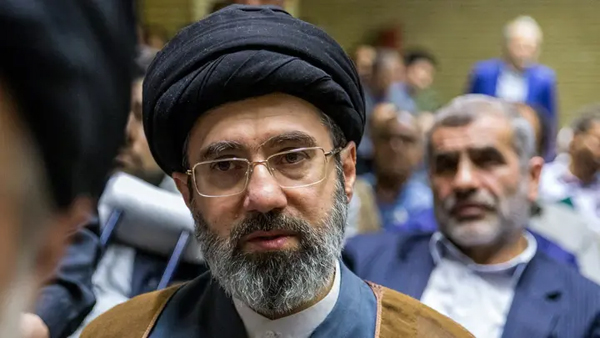
TEHRAN, Apr 11: Iran’s new Supreme Leader, Mojtaba Khamenei, is currently recovering from serious injuries sustained in the strike that killed his father at the start of the war, with his aides confirming that Mojtaba, while out of public view, is actively involved in decision-making.
Reportedly, according to people familiar with his condition, Khamenei suffered severe facial injuries in the attack on the supreme leader’s compound in Tehran, along with significant damage to one or both legs.
While the injuries are described as serious – with some accounts suggesting possible disfigurement – his aides say he remains mentally sharp and actively involved in state affairs.
Despite the physical toll, reportedly, he continued to participate in high-level discussions through audio conferencing, including deliberations on the war and ongoing negotiations with the US.
The scrutiny over his role, amid recovery, comes at a highly critical moment for Iran, as ceasefire talks are currently unfolding in Pakistan, all the while the Islamic Republic navigates one of its most volatile periods in decades.
Despite his confirmation as being both alive and mentally active, his public view is virtually non-existent, ever since the February 28 strike and his formal elevation to supreme leader on March 8; no images or recordings of Khamenei have been released.
State media have likewise offered very limited references to his condition, with one broadcaster describing him as a “janbaz” – a Persian term reserved for those seriously wounded in war.
The strike that killed his father, the former Supreme Leader Ali Khamenei, also claimed many members of his family, including Mojtaba’s wife and in-laws, adding a personal dimension to the political transition.
Inside Iran’s power structure, the circumstances of his rise are shaping how authority is being exercised, for unlike his father, who spent decades consolidating control, Mojtaba Khamenei, even while his father was alive, has been a shadowy figure, exerting influence from behind curtains.
Now he is navigating leadership while recovering and relying more heavily on established support networks – particularly the Islamic Revolutionary Guard Corps, which, since the passing of Ali Khamenei, as well as several other key officials, has taken a direct role in decision-making.
Even before assuming the top post, he had built close ties within IRGC circles, while working for years inside his father’s office as an influential albeit unknown figure.
That experience is now informing how power is being distributed and exercised, with key public messaging on the war, diplomacy and internal stability increasingly delivered by senior officials rather than the leader himself.
His first message to the nation, delivered in writing days after taking office, set a very hard line, calling for the Strait of Hormuz to remain closed and warning regional countries about US bases. Subsequent statements have followed the same format, reinforcing policy without direct public appearance.
For now, Iran’s supreme leader remains an enigmatic figure, who is both present but entirely unseen and completely unknown, recovering from great injuries, and communicating, and operating from a distance via his supporters within the Guards and the clergy.
(UNI)
 Follow our WhatsApp channel
