

By Jag Mohan Thaken
CHANDIGARH: India and New Zealand signed FTA on April 27, 2026, which cheers the governments of both the countries, whereas the Indian farmers union is showing concerns over the pact, why so? Indian Prime Minister, Narendra Modi, in a tweet termed the FTA signing ceremony as a landmark moment in the India-New Zealand partnership!“Today marks a landmark moment in the India-New Zealand partnership!
I am delighted that the India-New Zealand FTA signed today will add unprecedented momentum to our developmental partnership. It reflects the deep trust, shared values and ambition that bind our two nations.
This agreement will greatly benefit our farmers, youth, women, MSMEs, artisans, startups, students and innovators. It will open new avenues for growth, create opportunities and deepen our synergy across sectors.
The investment commitment of $20 billion by New Zealand will further strengthen our cooperation in agriculture, manufacturing, innovation and technology, paving the way for a more prosperous and dynamic future for both countries.”
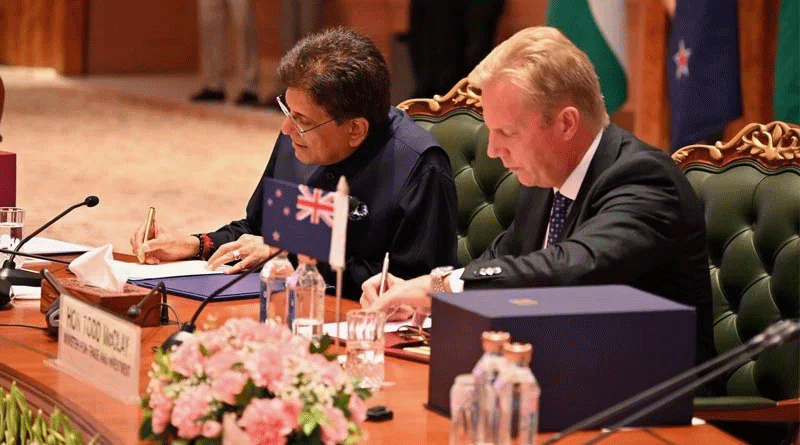
Union Minister of Commerce and Industry Piyush Goyal and New Zealand’s Minister for Trade and Investment Hon. Todd McClay signed the landmark India–New Zealand Free Trade Agreement. New Zealand’s Minister Todd McClay said that India–New Zealand FTA Opens “Once-in-a-Generation” Opportunities, Marks New Chapter in Bilateral Ties.
The signing of the India–New Zealand Free Trade Agreement marks a new and significant chapter in the bilateral relationship, reflecting shared ambition, deepening engagement, and a commitment to mutually beneficial growth, said Mr. McClay.
Minister Piyush Goyal said the India–New Zealand Free Trade Agreement was concluded in nine months and marks a key milestone in India’s engagement with developed economies, aligned with the vision of Viksit Bharat 2047. He noted that India is signing its seventh FTA in the last three and a half years, with plans for agreements with the European Union and the United States, taking the total to nine FTAs with 38 advanced economies, covering nearly 65–70% of global GDP. He also highlighted expected US$20 billion investment inflows under the agreement and said New Zealand has opened access in 118 sectors, with MFN commitments in 139 sectors.
A PIB press release, after signing the FTA, divulges that Farms, fisheries and factories will see a boost, Zero-duty market access on 100% of India’s exports. India has offered market access in 70 % lines covering 95% of New Zealand’s Bilateral Trade and commitment of USD 20 billion investment to India to fuel agriculture, manufacturing, infrastructure, start-ups, innovators and emerging technologies.
The release clears that to ensure protection to farmers, rural economies and the domestic industry, Market access excludes dairy, key agricultural products, coffee, milk, cream, cheese, yoghurts, whey, caseins, onions, sugar, spices, edible oils, and rubber.
Claiming the agreement as farmer friendly, the FTA also highlights the Agricultural productivity partnerships and Centres of Excellence for apples, kiwifruit and Manuka honey to elevate productivity, farmer incomes and knowledge transfer.
The FTA eliminates duty on 100% of Indian Exports. A USD 20 billion investment commitment over 15 years strengthens long-term economic and strategic cooperation. Through Agricultural Productivity Partnership, the FTA collaborates with farmers to boost productivity and integrate them in the global value chains. India has offered market access in 70.03% of the tariff lines while keeping 29.97 % tariff lines in exclusion, which covers 95% of New Zealand’s Bilateral Trade.
Certain products are kept in exclusion such as dairy (milk, cream, whey, yoghurt, cheese etc.), animal products (other than sheep meat), vegetable products (onions, chana, peas, corn, almonds etc.), sugar, artificial honey, Animal, vegetable or microbial fats and oils, Arms and Ammunition, Gems and Jewellery, Copper and Articles (Cathodes, Cartridges, Rods, Bars, Coils etc.), Aluminium and articles thereof (Ingots, billets, wire bars) among others.
30.00% of tariff lines will have immediate duty elimination, covering wood, wool, sheep meat, leather-raw hides etc.35.60% of tariffs are subject to phased elimination over 3, 5, 7, and 10 years, including petroleum oil, malt extract, vegetable oils, and selected electrical and mechanical machinery, peptones etc.4.37% of products face tariff reductions, such as wine, pharmaceutical drugs, polymers, aluminium, iron and steel articles etc. 0.06% fall under tariff rate quotas, including Mānuka honey, apples, kiwi fruit, and albumins including milk albumin.
On the other hand, an umbrella of farmers’ union, All India Kisan Sabha (AIKS) is criticizing the FTA and demanding its scrapping. Stating it an onslaught on Indian Agriculture, the AIKS alleges that by signing the Free Trade Agreement (FTA) with New Zealand, the RSS-BJP-led Union government has surrendered the interests of farmers before the demands of global finance.
The farmers’ body in a press release on 29th April, states, “The All-India Kisan Sabha (AIKS) is of the firm opinion that the latest FTA is a continuation of a slew of disastrous FTAs signed by the Modi dispensation in the recent past. The common denominator in all these FTAs is an unprecedented servitude to imperialism and a hatred against farmers and other rural working people. The New Zealand FTA has come at a time when Indian farmers are facing an existential crisis. The US-imperialism-induced West Asian crisis is increasing the price of fertilisers and aggravating the agrarian crisis.”
The Statement issued by Ashok Dhawale, President and Vijoo Krishnan, General Secretary of AIKS divulges, “According to New Zealand sources, tariffs on nearly half of their exports to India would be eliminated immediately on the day the Agreement enters into force. Tariff-free entry covers nearly 80 percent of their exports once the FTA is fully phased in. While the Modi government is trying to paint a picture that they have succeeded in protecting ‘sensitive sectors’ including dairy, agricultural products, etc., a close look into the Fact Sheet reveals that there are very serious loopholes. There are some conditions attached to the market access India promised. However, monitoring such access restrictions does not usually go beyond the printed words in the clauses and sub-clauses of the agreement.”
The AIKS alleges that the New Zealand FTA has significantly reduced the basic customs duty on New Zealand apples. The AIKS has consistently demanded a 100% import duty on apples. This reduction could make apples from New Zealand substantially cheaper, directly affecting the livelihoods of the 1.75 lakh families who depend on apple farming. Since apple farmers in New Zealand are highly subsidised, the dismal state support provided to Indian apple farmers cannot match their competitive advantage.
Similarly, the Commerce Ministry is reiterating that core dairy products like milk, cheese, cream, yoghurt, whey, etc. are excluded and that this is addressing the concerns of dairy farmers. The Indian dairy industry consists of crores of landless and marginal farmers—the majority of them hailing from socially marginalized sections—with meagre state support.
However, a critical look into the details of the FTA reveals that there are several loopholes. For example, the FTA allows the removal of import duties on certain high-value dairy products, such as bulk infant formula—a product considered as essential for the nourishment and healthy development of infants. This could hugely benefit New Zealand-based dairy big business and harm the class interests of Indian dairy farmers. Apart from this, there is a commitment to implement a dedicated fast-track mechanism to facilitate the duty-free supply of New Zealand products to India for further manufacturing and export. This would also clearly benefit corporate players.
On one hand Indian Prime Minister, Narendra Modi claims that this agreement will greatly benefit our farmers and the salient Features flashed by the Indian government also highlights that certain products are kept in exclusion such as dairy (milk, cream, whey, yoghurt, cheese etc.), animal products (other than sheep meat), vegetable products (onions, chana, peas, corn, almonds etc.), sugar, artificial honey, Animal, vegetable or microbial fats and oils etc, But on the contrary, the farmers’ union alleges that as the Indian dairy industry consists of crores of landless and marginal farmers—the majority of them hailing from socially marginalized sections—with meagre state support and the FTA allows the removal of import duties on certain high-value dairy products, such as bulk infant formula—a product considered as essential for the nourishment and healthy development of infants. This could hugely benefit New Zealand-based dairy big business and harm the class interests of Indian dairy farmers.
AIKS also alleges that the FTA will directly affect the livelihoods of the 1.75 lakh families who depend on apple farming. Since apple farmers in New Zealand are highly subsidised, the dismal state support provided to Indian apple farmers cannot match their competitive advantage.
Dr. Inderjeet Singh, the National Vice-President of AIKS, when contacted by Edit Page Features, says, “Dairy sector is very vulnerable regardless of the denial of the government to the contrary. Indian dairy farmers have very high stakes if FTA with developed countries come into operation.”
The government of India should take the farmers in confidence and clear their doubts, so as to ensure them that their interests shall be watched without any ifs and buts. (IPA Service)
 Follow our WhatsApp channel
