

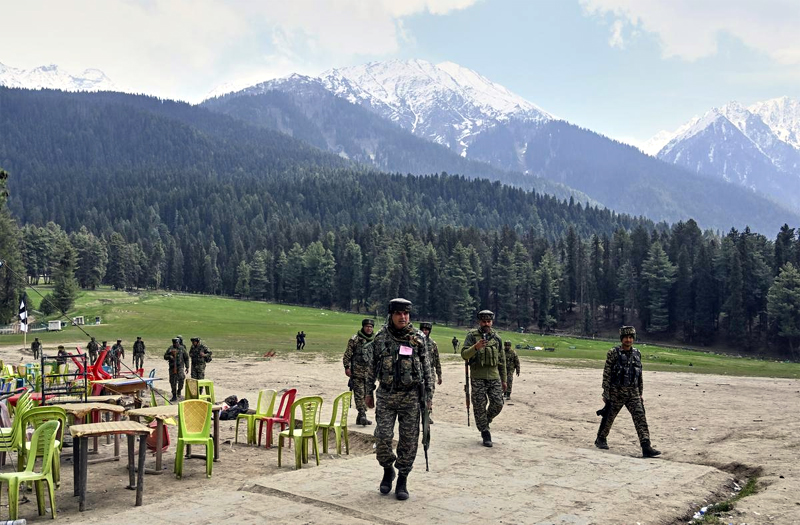
NEW YORK, July 30 : In a significant diplomatic victory for India, the United Nations Security Council (UNSC) 1267 Sanctions Committee Monitoring Team (MT) report, has explicitly named the Pakistan-based, The Resistance Front (TRF) for its role in the Pahalgam terror attack on April 22 in which 26 civilians were killed.
This development is significant as all decisions of the 1267 Sanctions Committee, including MT reports, are adopted by consensus by the members of the Security Council.
Pakistan had previously sought to suppress references to TRF, with its Foreign Minister Ishaq Dar claiming in the Pakistan National Assembly that Islamabad successfully removed TRF mentions from a UNSC press statement condemning the Pahalgam attack.
The inclusion of TRF in the MT report, is a snub to Pakistan with the international community’s recognition of Pakistan’s involvement in regional terrorism. The report also marks the first mention of LeT and Pakistan-based terror groups in a UN document since 2019, reinforcing the link between TRF and established terror networks.
Adoption by the 1267 Committee, which oversees sanctions against ISIL (Da’esh), Al-Qaida, and associated entities, will formalise TRF’s recognition as a terrorist group or affiliate under the UN framework. This will kick in obligations for all UN member states to implement sanctions, including asset freezes, travel bans, and arms embargoes, against TRF and associated individuals or entities listed under the 1267 regime.
Member states are also obliged to take measures such as updating national sanctions lists to include TRF and enforcing measures like blocking financial transactions or restricting movement of its members.
This marks the first instance of a UN document explicitly referencing TRF as a terror outfit linking it directly to Pakistan’s terror network.
The report’s South Asia section leads with the Pahalgam attack, noting TRF’s claim of responsibility and its subsequent retraction, while highlighting the group’s ties to LeT. Indian officials view this as a validation of New Delhi’s long-standing assertions about Pakistan’s support for terrorist proxies targeting India.
“On 22 April, five terrorists attacked a tourist spot in Pahalgam, in Jammu and Kashmir. Twenty-six civilians were killed. The attack was claimed that same day by The Resistance Front (TRF), who in parallel published a photograph of the attack site. The claim of responsibility was repeated the following day. On 26 April, however, TRF retracted its claim. There was no further communication from TRF, and no other group claimed responsibility.” Said the UN report
Sources without naming any country said that “One Member State said the attack could not have happened without Lashkar-e-Tayyiba (LeT, QDe. 118)support, and that there was a relationship between LeT and TRF. Another Member State said that the attack was carried out by TRF, which was synonymous with LeT. One Member State rejected these views and said that LeT was defunct.”
The UNSC 1267 Sanctions Committee’s consensus requirement, involving all members including China, makes the report’s findings particularly notable. While, “one member state” argued LeT was defunct and “another” equated TRF directly with LeT, the report’s final text reflects India’s position that TRF operates as a Pakistani-backed proxy.
“Pakistan’s strategy of plausible deniability – using secular and modern names like “The Resistance Front” and “People Against Fascist Front” for its jihadi proxies to divert attention from LeT/JeM and give an indigenous appearance to its terrorist activities in Jammu & Kashmir – now stands punctured.” said a diplomat privy to the development.
India has consistently raised concerns about Pakistan’s use of terrorism as a state policy, and the UN’s acknowledgment of TRF provides a platform to further press for accountability.
The UN report also underscores the fragility of regional relations saying that, “There is a risk that terrorist groups may exploit these regional tensions.”
The UN report’s findings align with New Delhi’s efforts to document and expose Pakistan’s terror links, a priority in its foreign policy.The inclusion of TRF in the MT Report despite Pakistan’s efforts for its removal highlights Pakistan’s undeniable involvement in fomenting terrorism in Jammu and Kashmir.
(UNI)
 Follow our WhatsApp channel
