

Shivani Vaid Sharma
vaidshiva@gmail.com
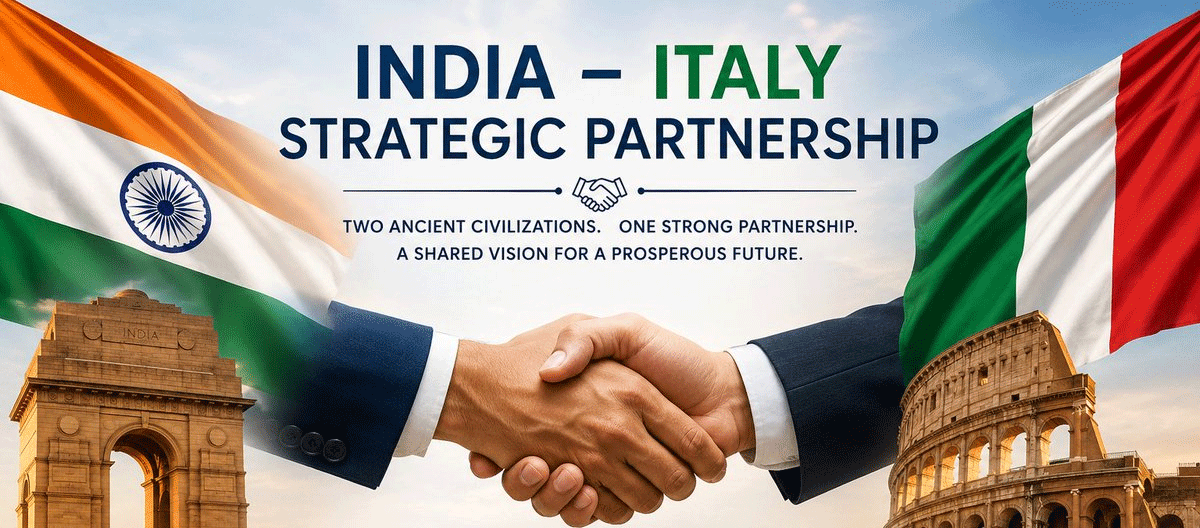
Prime Ministers Modi and Meloni wrote a joint article this week announcing a major upgrade in their countries’ friendship. But behind the warm words lies a very calculated and important move on the world’s geopolitical chessboard. Here is what it all means, in plain English.
Imagine two very old friends who have known each other for years, always polite, always respectful and then one day they decide to become proper business partners, defence allies and technology collaborators all at once. That, in essence, is what happened this week when Prime Minister Narendra Modi and Italian Premier Giorgia Meloni co-authored a major article, published side by side in Indian and Italian newspapers, announcing what they are calling a “special strategic partnership.”
Modi was on the final stop of a five-nation tour when he landed in Rome. The visit was warm but the message carried in that joint article was serious: India and Italy are no longer just friendly countries who occasionally meet at G20 summits. They have decided to build something together and the world should pay attention to what that something looks like.
“Our friendship has moved from pleasantries to a proper plan. And that plan has a name: the Indo-Mediterranean.”
SO WHAT EXACTLY IS THE “INDO-MEDITERRANEAN”?
The most interesting idea in the joint article is a new phrase that both leaders use: the Indo-Mediterranean. This refers to the stretch of sea and land that runs from India, across the Middle East, through the Red Sea and into the Mediterranean — right up to Italy’s coastline. Think of it as a massive highway connecting the Indian Ocean to Europe.
Modi and Meloni are saying: this highway exists, it is strategically vital and India and Italy want to be the two key anchors at either end of it. Trade, technology, energy, and ideas will flow through this corridor. On paper it sounds like geography. In reality, it is a very deliberate statement that both countries want to shape this part of the world and they want to do it together, on their own terms.
Why does this matter? Because this is the same route that China has been trying to control through its Belt and Road Initiative, a global infrastructure project through which Beijing lends money to build ports, roads and railways across Asia, Africa, and Europe. India and Italy, through this partnership, are proposing an alternative: a route built on democratic values, fair trade, and shared rules.
WHAT INDIA AND ITALY HAVE AGREED TO DO TOGETHER
◆ Grow trade to €20 billion by 2029- covering defence, medicines, textiles, food and machinery
◆ Build the India–Middle East–Europe Economic Corridor (IMEC) connecting Indian ports to European markets through the Middle East
◆ Work together on Artificial Intelligence in a way that puts people, not corporations or governments in control
◆ Collaborate on space exploration India’s rocket science meets Italy’s aerospace engineering
◆ Partner on clean energy through the International Solar Alliance and the Global Biofuels Alliance
◆ Crack down on the financing of terrorism- a formal agreement signed at the G20 in Johannesburg, 2025
◆ Deepen ties between universities, research centres, and over 1,000 businesses already in each other’s countries
WHY ITALY? WHY NOW?
Italy is not the first country you think of when you think of India’s foreign policy. That list usually starts with the United States, Russia, Japan or France. So why is this partnership significant?
Italy is a founding member of the European Union, a G7 economy, a NATO ally and sits at the centre of the Mediterranean which means it has deep relationships with North Africa, the Middle East, and the Balkans that no other EU country quite replicates. For India, getting Italy firmly in its corner means gaining a trusted voice inside Europe’s most powerful institutions.
For Italy, the timing is also no accident. In 2019, Italy became the only G7 country to join China’s Belt and Road Initiative. By 2023, it had quietly backed out, realising the deal came with too many political strings attached. That left a gap- Italy needed a new eastern partner it could trust. Enter India.
The slogan practically writes itself: “Made in Italy” meets “Make in India.” Italian design and craftsmanship at one end; Indian engineering scale, tech talent, and 200,000 start-ups at the other. Together, they are betting they can build products, technologies, and supply chains that the world wants- without depending on China to do it.
THE CHINA FACTOR – WITHOUT SAYING CHINA’S NAME
If you read the joint article carefully, you will notice something interesting: China is never mentioned. Not once. And yet, if you understand the context, almost every paragraph is written with China in mind.
The push for “resilient supply chains” that is code for not being dependent on Chinese manufacturing. The emphasis on the IMEC corridor that is an alternative to Chinese-funded ports and roads in the region. The shared AI philosophy that is a counter to China’s model of state-controlled technology with no privacy protections. Italy’s withdrawal from BRI and its pivot to India sends a clear message to Beijing: democracy and fair dealing matter more than cheap loans.
None of this is written in angry or hostile language. Both India and Italy are far too diplomatically experienced for that. But the strategic message is unmistakable: there is a new alignment forming in the world and it is built on the principle that open, democratic nations should manage their own future not have it managed for them by authoritarian powers.
INDIA’S BIGGER GAME: MAKING FRIENDS EVERYWHERE, PLEDGING TO NOBODY
This partnership with Italy is not a standalone event. It is the latest brick in a wall India has been quietly building for several years. Look at the pattern: deep partnerships with France, Japan, Australia, the UAE, Germany and now Italy. India has been cultivating friendships across the democratic world without formally joining any bloc or alliance.
This is India’s signature style in foreign policy: stay independent but never be alone. Do not pick sides but make sure every important player considers India a valued friend. It gives India enormous power in trade negotiations, climate talks, security arrangements, and technology governance because everyone wants India on their side and India has not fully committed to anyone’s side.
The Italy partnership fits perfectly into this approach. Every new partner India adds to its network raises India’s weight in global affairs. It also signals to the world that India is not just a regional power anymore. It is a nation that other major economies actively seek out.
WHAT ABOUT AI? WHY DOES TECHNOLOGY MATTER HERE?
One part of the joint article that deserves special attention is the section on Artificial Intelligence. Both Modi and Meloni talk about wanting AI to be “human-centred” meaning technology should serve people, not the other way around. India brings a framework called MANAV, which puts humans at the heart of technology policy. Italy brings its tradition of humanist philosophy which for centuries has asked: what is technology for if not to make human life better?
Together, they are offering the world’s developing nations especially in the Global South a third path for AI. Not the Silicon Valley model, where a handful of private companies control everything. Not the Chinese model where the government controls everything. A model that is open, inclusive, multilingual and accountable to ordinary people. For a country like India, with over a billion smartphone users and the world’s largest digital public infrastructure, this is a genuine competitive advantage and a genuine offer to poorer nations who do not want to be dependent on either American tech giants or Chinese state systems.
WHAT THIS MEANS FOR JAMMU AND FOR ORDINARY INDIANS
It is fair to ask: what does an India-Italy partnership have to do with a reader in Jammu? The answer is more direct than it might appear. Every time India deepens a strategic relationship with a major world power, it strengthens India’s hand in international forums including those where terrorism, cross-border security and regional stability are debated. The joint counter-terrorism agreement between India and Italy, which calls for cutting off financial networks that fund terror groups, is a direct and practical benefit to communities that have lived with the consequences of terror for decades.
More broadly, as India becomes a more confident and connected global player, its economy grows, its infrastructure expands, and its people from every corner of the country get a larger share of the opportunities that follow. Trade corridors like IMEC, once built, do not just connect ports and capitals. They create jobs, attract investment and bring regions that were at the edges of the global map right into its centre.
THE BOTTOM LINE
Strip away the diplomatic language, the grand phrases about civilisations and corridors and what you are left with is a simple story: two countries that have always liked each other have decided the world is changing fast, and they would rather navigate that change together than alone.
India brings size, speed, technology and the confidence of a rising power. Italy brings European credibility, manufacturing excellence and a geographic position that makes it the natural bridge between Europe and the wider world. Together, they are building not just a trade deal or a defence arrangement, but something rarer, a genuine friendship between democracies that still believe the future should be shaped by nations who respect both freedom and responsibility.
In a world increasingly divided between those who believe in open societies and those who do not, that is not a small thing. It is, in fact, exactly the kind of partnership the times demand.
( Author is a CBSE Resource Person and educator. She tweets as @Shivani_Vaid.)
 Follow our WhatsApp channel
