

Sant Kumar Sharma
Years after the Indus Waters Treaty (IWT) was signed on September 19, 1960, in Karachi between Pandit Jawaharlal Nehru and General Ayub Khan in Karachi, India made plans to harness the mighty Chenab for producing hydropower generation. There was nothing wrong with those plans as it had unlimited rights on the Western Rivers allotted to Pakistan. As long as they were flowing within the Indian territory. It was a clear question of asserting sovereignty.
India’s chief negotiator during the treaty parleys with Pakistan N D Gulati had ensured that much. Gulati has also ensured that there was no limit on the number of sites, or the quantity of hydropower produced by harnessing waters of the three Western Rivers, the Indus, the Jhelum and the Chenab. Pakistan tried to stall parleys, its delegates threw tantrums and did everything they could, defined in the book and beyond it, to minimise India’s rights on these rivers.
Its logic was simple. Since the Western Rivers had been allotted to Pakistan, India could not be allowed to have any rights on them. In other words, India should do nothing to them, or on them, even as they flowed within its boundaries. If people on the banks of the Western Rivers needed drinking water, they could go thirsty but not use what was essentially “Pakistan’s waters”. If these rivers wrecked havoc during floods, it should be taken by the Indian side as wrath of God.
These were the initial arguments, and the Pakistani side persisted with them for long, after the Western Rivers had been allotted to our western neighbour. The Indian delegates stood firm, unrelenting in their argument that as long as the Western Rivers were within the Indian boundaries, Pakistan could not be given any sovereign rights over them, direct or indirect. For doing so would set a dangerous precedent which was not to be found anywhere in the world, in any trans-boundary river basin.
A One-Sided Agreement Ab Initio
Of course, there are hundreds of trans-boundary river basins in the world, in all continents and countries, the upper riparian nations share this invaluable resource of fresh water that sustains life with the lower riparians, after first allotting the bulk of it to its own citizens. They share with the lower riparians but not at the cost of its own people. It had never happened in the history of mankind that the upper riparian was left paying the bills for benefit of lower riparian. Not until September 19, 1960, signing of the IWT. However, this miracle happened that day.
The lower riparian, Pakistan in this case, got over 80 per cent of the total waters available in the Indus river system comprising six rivers of Sutlej, Beas, Ravi, Chenab, Jhelum and the mighty Indus. The upper riparian, India, got less than 20 per cent. According to hydrological calculations regarding these six rivers carried out between 1920 and 1925, the total water flows amounted to 168 Million Acre Feet (MAF). Of this, over 135 MAF (135.6 MAF) were allotted to Pakistan and less than 33 (32.7 MAF) were allotted to India.
Those in the government defending this poor allocation of just 32.6 MAF in India’s favour said Pakistan wanted the whole of Western Rivers and 70 per cent of waters from the Eastern Rivers. This would have just amounted to less than 10 MAF (9.78 MAF to be more exact) had Pakistan got its way, they argued.
Nehru’s Generosity Harmed Indian Interests
Not only this, India’s generosity was abused further by asking it to pay for replacement canals and dams that Pakistan had to build, Mangla in Mirpur on Jhelum and Tarbela on Indus. This money was no joke either as it would amount to approximately $4 billion, or over Rs 37,360 crore in today’s value (calculated at $1 = Rs 93.4 as in April 2026). India agreed to these steep terms reluctantly hoping this generosity would be reciprocated and placate Pakistan.
On November 30, 1960, a couple of months after the treaty signing, Pandit Jawaharlal Nehru, told the Indian Parliament during a debate that the MPs were fighting over a pale of water. What was a pale of water here and there, or words to that effect. During his speech, Pandit Nehru said: But by payment, you get something in exchange. You can balance the two and you may still say that it is better not to have an agreement, to have conflict instead and to carry on in this way of conflict instead of giving it away. If it is a question of high principle, it might be right. … And we purchased peace and it is good for both countries.
For him, therefore, it was a question of placating Pakistan and he argued that by giving more waters (over 80 per cent) and a ton of money, so to say, he had made Pakistan happy. He also thought that a grateful Pakistan will not cast an evil eye on Indian territories and the treaty will help settle all disputes in an amicable manner. Pandit Nehru thus seemed to be hoping that this generosity will help India and Pakistan to sort out issues in an atmosphere free of ill-will and animosity.
It is another thing that Pandit Nehru’s assessment (which turned to be entirely false) of buying peace with Pakistan went horribly wrong in 1965 as it invaded Jammu & Kashmir. Of course, he was not there as he had completed his journey on terra firma in May 1964, over a year before the Pakistani invasion.
Interestingly, late in 1961, or early 1962, during his meeting with Gulati, Nehru expressed doubts about the soundness of the treaty. Pandit Nehru wondered aloud with Gulati asking him whether he had conceded too much to Pakistan in return for nothing. But by that time, nothing could have been done to reverse the course of history of 12 years, starting from April 1, 1948, and ending on September 19, 1960.
Most of the MPs, including those from Pandit Nehru’s own party, the Congress, tore into him during their speeches. Atal Behari Vajpayee, a young MP representing Balrampur in the Lok Sabha in 1960, warned that the treaty was dangerous as it was open to misuse by Pakistan as indicated in General Ayub Khan’s speeches. In 1978, as Foreign Minister of India in Morarji Desai cabinet, Vajpayee had to concede certain points to Pakistan in his meetings with his counterpart Aga Shahi which broke his heart.
Salal Hydropower Station Harmed
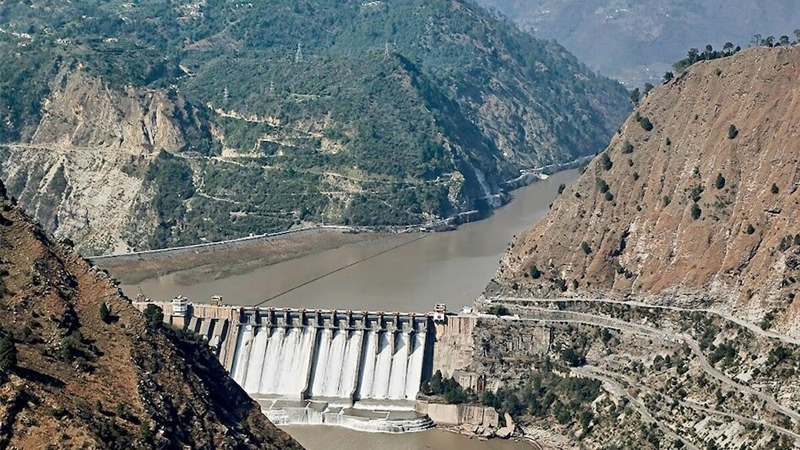
Under the provisions of the IWT, Pakistan had raised several objections to Salal hydropower dam, mainly its design elements which were meant to flush the sediments. For efficient and long life of the dam so that it could produce electricity optimally and did not silt up thereby losing its capacity of power generation. In April 1978, just when the project was coming up 48 years ago, its sluice gates meant for efficient management of sediments were plugged with concrete.
This concretisation, resulting from Vajpayee-Shahi parleys, harmed the reservior of Salal power house. The total pondage at this dam reservior, spanning around 22 km in the Reasi district, was initially calculated to be around 284 Million Cubic Metres (MCM). By last year, that is 2025, this had gone down substantially due to sediments settling in the reservoir and it was calculated at 9.91 MCM only, a steep reduction of around 274 MCM.
Two very significant dates fall in the week we are in, April 22, first anniversary of the Pahalgam terrorist attack last year. The next day, April 23, when India decided to stand up and respond strongly to Pakistan. One of the first things it did was to put the Indus Waters Treaty 1960 in abeyance, something that has endured and is likely to continue in the near future too.
Salal, which was the first hydropower project to be hit by Pakistan’s objections, has gained during the last one year. With the IWT on a pause, Salal has flushed out sediments more than once, something unimaginable at one time. It has also dredging to clean up all the accumulated muck, thereby enchancing the reservoir holding capacity. It is slowly beginning to recover and the engineers are happy.
The stories of Ratle, Sawalakote, Dul Hasti, Pakal Dul, Kirthai, Bursar and Miyar too, after the IWT pause, are better today. Each story is worth being told separately as the Central government has committed thousands of crores of rupees in these hydropower stations. Within a decade, we are potentially looking at a scenario where the power production in Jammu & Kashmir can go up to 11,000 MW. At least three times more than what is produced today and it is possible that J&K may contribute over 5,000 MW to the Northern Grid, instead of importing from it. An era of economic transformation may have already dawned but it may be some years before the fruits ripe up.
 Follow our WhatsApp channel
