

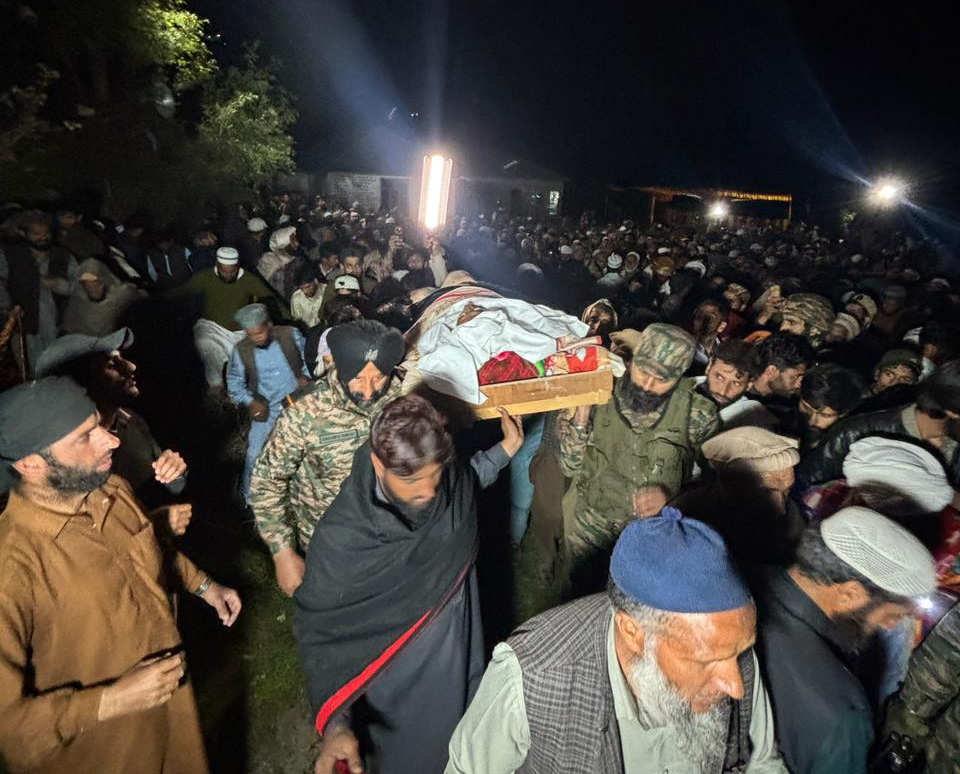
POONCH, Apr 24: A 62-year-old man was laid to rest at a village in the Poonch-Rajouri sector of Jammu and Kashmir on Thursday. But Tahir Fazal was no ordinary man.
Popularly known as ‘Bahadur-e-Hill Kaka’, he quit a lucrative job in Saudi Arabia to avenge his brother’s killing. Over two decades ago, he mobilised his tribal community against Pakistan-trained militants to reclaim his native Hill Kaka, which had become a militants’ stronghold in the aftermath of Kargil War.
The Indian Army paid a solemn tribute to Fazal, who died on Thursday after a brief illness. They remembered him as a “valiant son of the soil” who stood shoulder to shoulder with troops during Operation Sarp Vinash, which successfully dismantled militants’ operational hub in Hill Kaka.
A native of the remote Madda–Hill Kaka area, Fazal had returned from Saudi Arabia after his brother was killed by militants, vowing to fight them.
“He, along with two other brothers, was in Saudi Arabia at that time. When he received the news that his brother had been killed. They vowed to avenge the
killing of his brother and returned home here. They took an oath that as long as they lived, they would fight them,” a relative, Altaf Ahmed, said.
Fazal later avenged his brother’s killing by eliminating militant Kasid, responsible for his brother’s killing, a month later. Till his death, Fazal kept the same AK-47 rifle he had seized from a slain Pakistani terrorist during the encounter, his kin said.
Hill Kaka, located in the Pir Panjal ranges near the Line of Control, had emerged as a major operational hub and training ground for militants between the late 1990s and early 2000s. Locals said the area was virtually under militant control, with residents forced into submission.
“Hill Kaka served as a transit and training hub, with camps run by commanders such as Umar Musa. The region’s proximity to Pakistan-occupied Kashmir— barely 3.5 km away—and its difficult terrain made it strategically vital,” they said.
According to locals, militants exercised such dominance that they even prevented Army helicopters from landing in the area. The turning point came on June 10, 2002, following the killing of a local resident, which galvanised resistance.
Fazal mobilised local youth and formed a group, Pir Panjal Scouts, to resist militants, initially funding the effort independently. Over time, coordination with the Army and police improved, culminating in Operation Sarp Vinash in 2003, they said.
The operation is widely regarded as a landmark counter-insurgency success, with locals fighting alongside the Army and police to flush out militants. Several civilians, police personnel and Army soldiers lost their lives in the campaign to free Hill Kaka bowl from terrorists, they said.
While impressing on New Delhi to go for a major operation to free the zone from the operational hub of terrorists, Fazal had also interacted with senior Army officers and met then Union Home Minister Lal Krishna Advani during the course of the operation.
Paying tribute, the Army’s White Knight Corps described him as a “brave heart laid to rest.” “His daring spirit, unwavering courage and strong bond with the Indian Army remain a testament to his exceptional character. His indomitable valour will forever be etched in our hearts,” it said. An Army officer who attended the funeral said Fazal played a crucial role in restoring peace in the region.
“He supported the Army with full courage and later worked with the police and SOG in multiple operations. His contribution to society, including education, will always be remembered,” he said.
Jammu and Kashmir cabinet minister Javed Ahmed Rana also condoled his death, describing him as an “unsung warrior” whose courage during Operation Sarp Vinash helped reclaim the region from militancy.
The minister said that his leadership of the scouts and his unwavering patriotism were pivotal in restoring peace to the Hill Kaka Bowl. “He was not just a warrior but a steadfast advocate for the development and security of Tribals with dignity. His legacy of bravery and selflessness will continue to inspire generations in J&K and beyond”, he added. (Agencies)
 Follow our WhatsApp channel
