

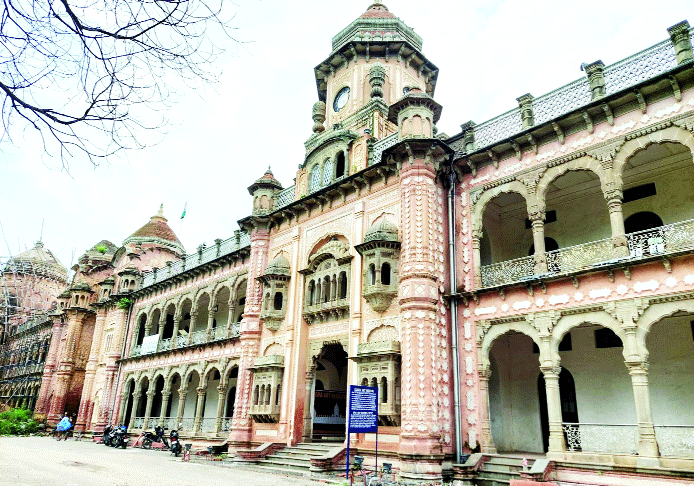
Race against time at Mubarak Mandi Palace
Sunny Dua
sunnydua55@gmail.com
Once the seat of power from where the Dogra rulers governed their kingdom, the Mubarak Mandi Palace today stands as a hauntingly beautiful yet fragile reminder of a glorious past. Spread across nearly 12 acres and comprising 25 buildings over more than 400,000 square feet, this grand complex once housed coronations, royal residences, the army headquarters and even the nerve centre of governance. Over time, it evolved into a hub of public administration, accommodating courts, offices and a post office.
But decades of neglect reduced it to a crumbling relic. Fires, over thirty-six of them, earthquakes in the 1980s and 2005, and ill-planned interventions like cutting a circular road through its supporting slopes pushed it to the brink of collapse. Unchecked alterations, thefts and vandalism stripped it not only of structure but of soul. Built beginning in 1710 (early 18th century) and flourishing for over a century until Maharaja Hari Singh shifted residence in 1925, the complex embodies a rare confluence of Rajasthani, Mughal and European architectural styles across landmarks such as the Darbar Hall, Sheesh Mahal, Pink Hall and Toshakhana.
It was only after relentless public advocacy by heritage lovers, writers and activists that the complex was declared a protected monument in 2006, setting in motion a long and arduous journey of revival. Restoration began under the Archaeological Survey of India in 2009, later gaining renewed momentum under the Mubarak Mandi Heritage Society, particularly after the Abrogation of Article 370 opened doors to wider expertise and resources. Yet, the challenge remains immense.
Large portions have deteriorated beyond repair, and even today, barely a fraction of the complex is being meaningfully restored, while rain and time continue their silent assault. Though nearly half of the identified work has been taken up, the battle is far from over. Without timely completion and meaningful adaptive reuse as museums, cultural spaces, cafés and public institutions there is a real danger that the restored sections may once again slip into neglect.
At this defining moment, the responsibility must go beyond government efforts. Similar to protected heritage sites in states such as Uttar Pradesh and Madhya Pradesh, where historic properties have been adapted for new uses, either by government agencies or through lease arrangements with private entities for revenue generation and upkeep, such measures are essential for preserving this fading masterpiece.
Amar Singh Palace
Restoration of the third floor of the historic Amar Singh Palace, once seen in archival photographs, is underway, guided by these records. Nearly half the work is complete, using traditional roofing and lime plaster, while façade restoration is also in progress to revive its original character. The palace, originally the residence of Raja Amar Singh, was later adapted for offices and archives, leading to additions such as paint layers, new flooring, wall cladding and false ceilings.
Architecturally, it blends Victorian and Rajputana styles, expressed through cusped arches, wooden jharokhas, twin columns and large bay windows. A central staircase connects all floors within a symmetrical rectangular plan. The structure is built mainly of brick tile masonry in thick lime mortar, with later English brick additions, and uses traditional materials like timber and lakhori bricks, underscoring its heritage value.
Library-cum-Cafeteria/Restaurant
Located at the south-western edge of the palace complex, this building stands connected to the historic Amar Singh Palace, a 19th-century structure, and lies close to the Army Headquarters. Despite the passage of time, it has retained its distinct architectural character, quietly echoing the heritage of the larger complex.
The structure is modest yet graceful, rising two storeys and following a simple rectangular plan. Its façade reflects Mughal-inspired influences, seen in features such as multi-cusped arches, Tudor arches, and ornamental pilasters. Cleanly defined cornices and horizontal lines lend the building a sense of balance and proportion.
The building is now in the final stages of adaptive reuse and is being transformed into a Library-cum-Cafeteria/Restaurant. Once operational, it is expected to emerge as a vibrant public space, blending heritage with everyday life, and offering visitors a place to read, reflect, and gather within a historic setting.
Army Headquarters
The Army Headquarters building stands out as the most visually striking structure within the palace complex, distinguished by its richly detailed façade and strong architectural presence. Its design brings together multiple influences, most notably Victorian elements blended with features of Rajputana style, such as Jharokhas and cusped arches. A continuous arcade runs along both the ground and first floors, lending rhythm and elegance to the structure, while pebble-finished details further enhance its regional character.
At the centre, a raised portion divides the building into two symmetrical wings, forming a prominent clock tower crowned by an octagonal Chattri and Pinnacle. The restored clock, now operational, adds both function and historic charm to the skyline. The building was restored by the ASI in 2011, preserving its traditional construction, including the use of the Jack Arch roofing system. Today, the ground floor temporarily houses the Dogra Museum, which will eventually return to its original building once restoration there is complete.
Inside, the structure continues to reflect local craftsmanship, most notably through the intricate Khatambandi woodwork on the ceilings. Together, these elements make the building not only architecturally significant but also a living reminder of the region’s layered heritage.
Durbar Hall
The Durbar Hall building, similar in architectural character to the Army Headquarters, is one of the most elaborately decorated structures within the palace complex in terms of its exterior design. Its form and architectural detailing reflect a combination of different stylistic influences, which can be observed throughout the structure. Currently, restoration work on the building is underway, with approximately 80 percent of the work already completed. The construction techniques employed in this structure are similar to those used in the Army Headquarters building, reflecting comparable architectural and structural practices of the period.
The central portion of the building divides it into two symmetrical sections. This central element rises slightly higher and forms a tower-like feature crowned with an octagonal Chattri. Unlike the Army Headquarters, however, this tower does not contain an ornamental clock beneath the Chattri. The structure primarily consists of a large hall that is internally divided into two sections. Historically, the Durbar Hall served as an important ceremonial space and was used for royal weddings, gatherings, and other formal events which if revived to the same level can fetch huge money.
Post office building
The Post Office, located at the southern corner of the palace complex, has maintained a distinct architectural character over the years. Its façades are relatively simple and consist of a two-storeyed structure adorned with traditional elements inspired by Mughal architecture, including multi-cusped arches, Jharokhas, and ornamental pilasters. The cornices and other horizontal bands are clearly articulated and are presently painted white to create a visual contrast with the yellow surface finish of the walls.
Restoration work on the building that began last year and is currently in progress, with nearly thirty per cent of the work completed so far. The building follows a U-shaped plan organized around a rhomboidal courtyard. The upper storey of the Post Office is a later addition, which has contributed to the somewhat irregular skyline of this part of the complex.
Nazool Building
Restoration work began last year and is currently underway, with approximately twenty per cent of the work completed so far. The architecture of the building is relatively simple in character. The entrance is marked by an arched gateway located on the left side, which is accessed by a flight of steps, while a series of rooms are arranged on the right side. The façade features very limited decorative elements, including Jharokhas and cornices, many of which are now damaged and deteriorated.
A series of plain windows are visible on both the rear and the right façades of the building. The architecture of the building is relatively simple in character.
Royal courts, Gadvai Khana, Badi Deodi and Dogra Museum
The building reflects strong regional architectural influences, evident in its jharokhas, arches, columns, and decorative detailing. The large arched openings of Dogra Museum and its double-height interior in the hall indicate its original use as a public space, enriched with ornate jharokhas and finely decorated interior surfaces. After the collapse of the original roof, a temporary tin-sheet structure was installed, which has now been replaced with the traditional wooden roofing system as part of restoration work that is about eighty-five per cent complete. The marble hall at the rear of the first floor has also been cleaned and restored, reviving its historic grandeur.
Elsewhere in the complex, the Gadvai Khana and Badi Deodi were restored by the Archaeological Survey of India in 2022, marking the second completed phase of the project, while restoration of the Royal Courts resumed last month. The first-floor halls of these buildings feature intricate wall paintings on lime plaster, depicting floral and fern motifs within bordered panels. Though these paintings are yet to be restored, their conservation is expected in line with the work carried out on the jharokhas of the Dogra Museum.
Ram Singh Palace
The front façade of the building appears highly symmetrical, with the main entrance gate dividing the structure into two equal halves, each having an equal number of arched openings on either side. Architectural elements used on the palace façade such as segmental arches, pediments, masonry columns, and overhanging eaves give the building a predominantly Victorian character. The jharokhas on the main façade also reflect the influence of Western architectural styles.
The building contains a double-height hall on the first floor, with all four walls adorned with intricate carvings executed in lime plaster. Restoration work is currently underway, and nearly seventy per cent of the work has been completed. The roofing has already been finished using the traditional wooden roofing system, while the other works are nearing completion. Once the restoration is complete, the structure is expected to regain the grandeur and architectural significance it once possessed. The structure’s façade has emerged in a neat and refined manner following the implementation of the chosen colour scheme.
Central Courtyard (Darbar-E-Aam)
Work on the central courtyard which is going to be the main attraction is going on at war footings. While an ornamental boundary wall of the same design of its old times is being maintained, a ramp has been constructed on the back side of the raised platform (Thada) to make it accessible and friendly for the needy and proper drainage work is being built. The royal complex originally had three grand entrance gateways, though only two remain today. Upon entering, visitors are greeted by a central courtyard, which was once a bustling focal point of the palace. During the height of the Dogra era, this courtyard featured an elegant marble royal platform where the Maharaja held a public court, or Diwan-e-Aam. Built during the reign of Maharaja Gulab Singh, this platform symbolised royal authority and openness to the public. However, none of these original structures have survived, and the area now serves as a park.
Gol Ghar (Round House)
The Gol Ghar palace is a distinctive round-shaped building that overlooks the Tawi river. The building is in ruins due to a fire in 1984 and an earthquake in 2005. Over the years this particular building had suffered maximum damages and is beyond repairs. Every rainy season takes a piece of this important yet architectural marvel with it. Nothing much is going on this side as there’s also a plan of building a vertical lift on this side which will connect the cable car from Bagh-e-Bahu to Mahamaya Temple and finally to Mubarak Mandi. Its status is unknown.
Terrace gardens and Deodies
To the east of the palace once stretched a series of terraced gardens, connected to different parts of the complex and separated by walls, forming a layered landscape that enhanced its architectural charm. Entry was marked by several deodis (gateways), each significant in its own right. The Deodi towards Panjtirthi is yet to be reconstructed, though detailed archival records exist and it is expected to be rebuilt in its original form. The Deodi towards Chowk Chabutra has had its plasterwork restored, with painted surfaces still awaiting conservation, while the Deodi towards Jullaka Mohalla has already been restored and stands between the Army Headquarters and the Darbar Hall. Work on the Toshakhana, however, remains stalled due to pending relocation of armoury and archival items under the directorate of archives, archaeology and museums, despite government directives, little progress has been made so far.
(The writer is senior journalist & heritage enthusiast)
 Follow our WhatsApp channel
