

Inderjeet S.Bhatia “Prince ”
bhatiainderjeet3@gmail.com
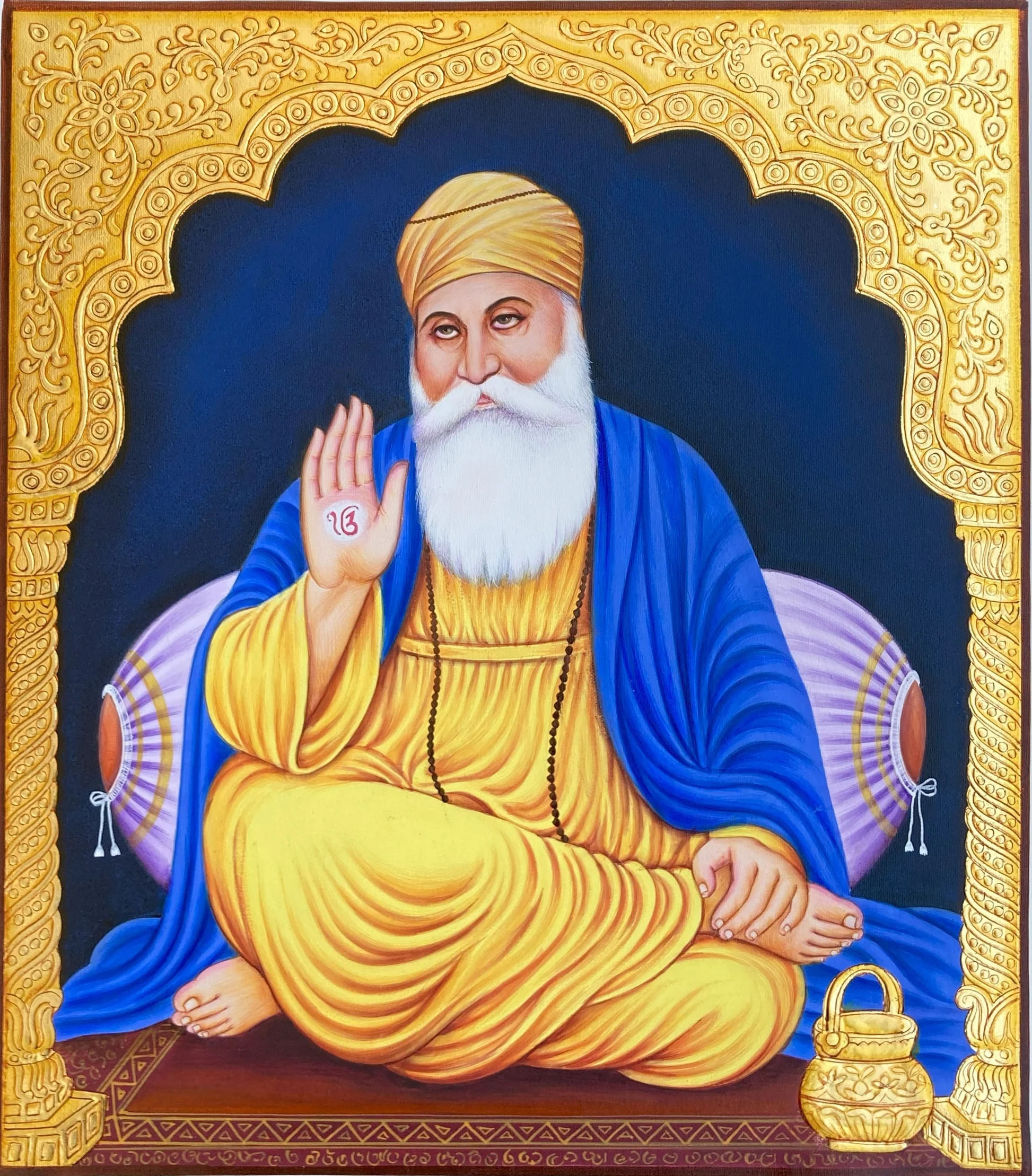
Guru Nanak Dev Ji, the founder of Sikhism was born on the Puranmashi of Kattak on April 15, 1469, in “Rai Bhoi di Talwandi “- a place now known as Sri Nankana Sahib in Pakistan .Guru Nanak Dev ji was born as a child whose words would one day awaken the conscience of humankind.
“SATGURU NANAK PARGATYA,
MITTI DHUND JAG CHANAN HOYA!”
(With the emergence of the complete Guru,Guru Nanak Dev Ji, the worldly mist was cleared and the whole world was illuminated) Sri Guru Nanak Dev Ji, the founder of Sikhism, a spiritual visionary whose message of unity, equality, and compassion transcends all boundaries of time and faith.
“There is no Hindu, there is no Muslim. There is only the One Divine.” (said – Guru Nanak Dev Ji)
Early Life: A quest for Truth
From an early age, Guru Nanak Dev ji displayed remarkable spiritual depth. Guru ji’s father, Mehta Kalu ji, hoped his son would follow a worldly profession. Yet, Guru Nanak ji’s heart was drawn toward divine reflection and service.
When given money for business, Guru ji instead spent it feeding hungry saints, calling it “SACHHA SAUDA” (True Business.)This early act of compassion foreshadowed the mission of Guru ji’s life – to serve humanity selflessly.
Guru ji ‘s stay with his sister:
In his early years, Sri Guru Nanak Dev Ji went to stay with his beloved sister Bebe Nanaki Ji, at the age of 16 years, who lived in Sultanpur Lodhi. She was among the first to recognize Guru ji’s divine light and spiritual greatness. During his stay there, Guru Ji worked in the “Modi Khana” (storehouse) of Daulat Khan and spent long hours in meditation and reflection near the River Bein – where he received enlightenment at the age of 30.
Marriage and family life:
Guru Nanak Dev Ji was married to Mata Sulakhni Ji, daughter of Mool Chand of Batala, on 24th September, 1487. The couple had two sons – Sri Chand and Lakhmi Das. While Sri Chand later founded the Udasi sect devoted to asceticism, Lakhmi Das lived a simple family life.
At the age of 30, a mystical experience transformed Guru Nanak Dev ji forever. After meditating in the waters of the river Bein for three days, Guru ji emerged declaring a revelation that would redefine faith itself – that:
“EK OM KAAR”, meaning God is One, and that all humans are equal before the Divine.
Journeys Across Continents
Guru Nanak Dev Ji’s message could not be confined to one region or religion. He undertook four great spiritual journeys (Udasis) across India, Tibet, Sri Lanka, Arabia, and Central Asia.
The four Uddasis (Spiritual Journeys):
After enlightenment, Guru Nanak Dev Ji undertook four great journeys or Uddasis across India and beyond, spreading the message of one God, truth, equality, and service to humanity.
First Uddasi: (1500-1506 AD)
Towards Eastern India – visiting places like Haridwar, Banaras, and Bengal.
Second Uddasi: (1506-1513 AD)
To Southern India – visiting Sri Lanka and other southern regions.
Third Uddasi: (1514-1518 AD)
To Northern regions – including Tibet, the Himalayas, and Kashmir.
Fourth Uddasi: (1519-1521 AD)
To Western countries – including Mecca, Medina, Baghdad, and Persia.
Through these travels, Guru Ji met saints, scholars, and common people, teaching the principles of” Naam Japna “(remembering God), “Kirat Karni” (honest living), and “Vand Chakna” (sharing with others)
Accompanied by his devoted companion Bhai Mardanaji, Guru ji undertook these Uddasis only to spread his teachings through poetry, song, and dialogue – often engaging with saints, scholars, and common folk alike.(The exact dates of these 4 Uddasis are oftenly debated among scholars but the above given are widely accepted approximations of Guru Nanak Dev ji’s Uddasis)
Through hymns that later became part of theSri Guru Granth SahibJi, Guru ji condemned blind rituals and religious hypocrisy, emphasizing instead that true religion lies in honest living, humility, and the remembrance of God’s Name.
“Truth is high, but higher still is truthful living.”
(-Said Guru Nanak Dev Ji)
Teachings that Transcend Centuries
Guru Nanak Dev Ji’s message was simple yet revolutionary, challenging the rigid social and religious norms of his time.
The Oneness of God:
Guru Nanak Dev ji proclaimed that there is but One Universal Creator -” Ik Onkar,” without form, fear, or enmity. God resides in all hearts, not confined to temples, mosques, or rituals.
Equality and Justice:
Guru ji rejected all discrimination based on caste, creed, or gender. The establishment of Langar, the community kitchen where all eat together as equals, remains one of his most powerful social reforms.
Honest Earning:
Guru ji emphasized the dignity of labor and honest livelihood – “Kirat Karo “- urging followers to live truthfully and share their earnings with others -” Vand Chhako”.
Dignity of Women:
At a time when women were marginalized, Guru ji elevated their status, declaring:
“So Kyon Manda Aakhiyan,
Jis Jamme Rajaan!”
(Why call her, the women, inferior, from whom womb, kings are born)
Guru Nanak Dev Ji’s vision took tangible form in Kartarpur Sahib, a spiritual commune he founded on the banks of the Ravi River (now in Pakistan)
LAST YEARS AT KARTARPUR SAHIB
In his later life, around 55 years of age, Guru Nanak Dev Ji settled at Kartarpur Sahib, now in Pakistan, on the banks of the Ravi River. There he lived peacefully with his followers, both Hindus and Muslims, preaching harmony and service.
Here, men and women of all backgrounds lived, worked, and worshipped together – a model of an ideal, egalitarian society.
Daily prayers, community service, and shared meals at Kartarpur embodied the three core principles of his philosophy:
“Naam Japna ”
(Meditation on God’s Name)
“Kirat Karni ”
(Honest Work)
“Vand Chhako”
(Sharing with Others)
A legacy beyond Time
Guru Nanak Dev Ji merged with divine on 22nd September, 1539 at the age of about 70 years, leaving behind not a religion of dogma but a path of divine wisdom. A beautiful Gurudwara, Sri Kartarpur Sahib, marks this sacred place- a symbol of peace and unity between India and Pakistan. Guru Nanak Dev ji’s successors, the nine Sikh Gurus, carried forward his mission, ultimately compiling his hymns into the sacred Guru Granth Sahib – a living scripture of universal truths.
Guru ji’s legacy is not confined to history; it breathes in every act of compassion, every voice that stands for justice, and every heart that remembers “Ek Onkar “- the One Creator.
THE MESSAGE FOR OUR TIMES
—————————————————
Five centuries later, Guru Nanak Dev Ji’s teachings shine brighter than ever. In a world divided by race, religion, and greed, Guru ji’s voice calls humanity back to compassion and simplicity.
Guru ji’s philosophy is not merely for Sikhs – it belongs to all who seek peace, equality, and spiritual clarity.
Guru Nanak Dev ji’s teachings reminds us that divinity is not distant – it lives in every act of kindness, every honest word, every selfless deed.
“Let no man in the world live in delusion. Without a Guru, none can cross to the other shore.”
(Said – Guru Nanak Dev JI)
Conclusion: The Eternal Dawn
Guru Nanak Dev Ji was not only a founder of a faith but the harbinger of a universal truth – that all beings are one in the eyes of the Creator. Guru ji’s light continues to guide humanity toward humility, service, and love.
As the world celebrates Guru Nanak Dev ji’s birth anniversary called “GURUPURAV “each year, we do not merely remember a historical figure – we celebrate the timeless awakening of the human soul toward the Divine.
“Naam Japo, Kirat Karo, Vand Chhako” – Remember God, Work Honestly, Share with Others.
These simple words remain the eternal roadmap to a life of peace and purpose.
“Nanak Naam Chardi Kalan,
Tere Bhanne Sarbat Da Bhalla!”
 Follow our WhatsApp channel
