

B S Dara
bsdara@gmail.com
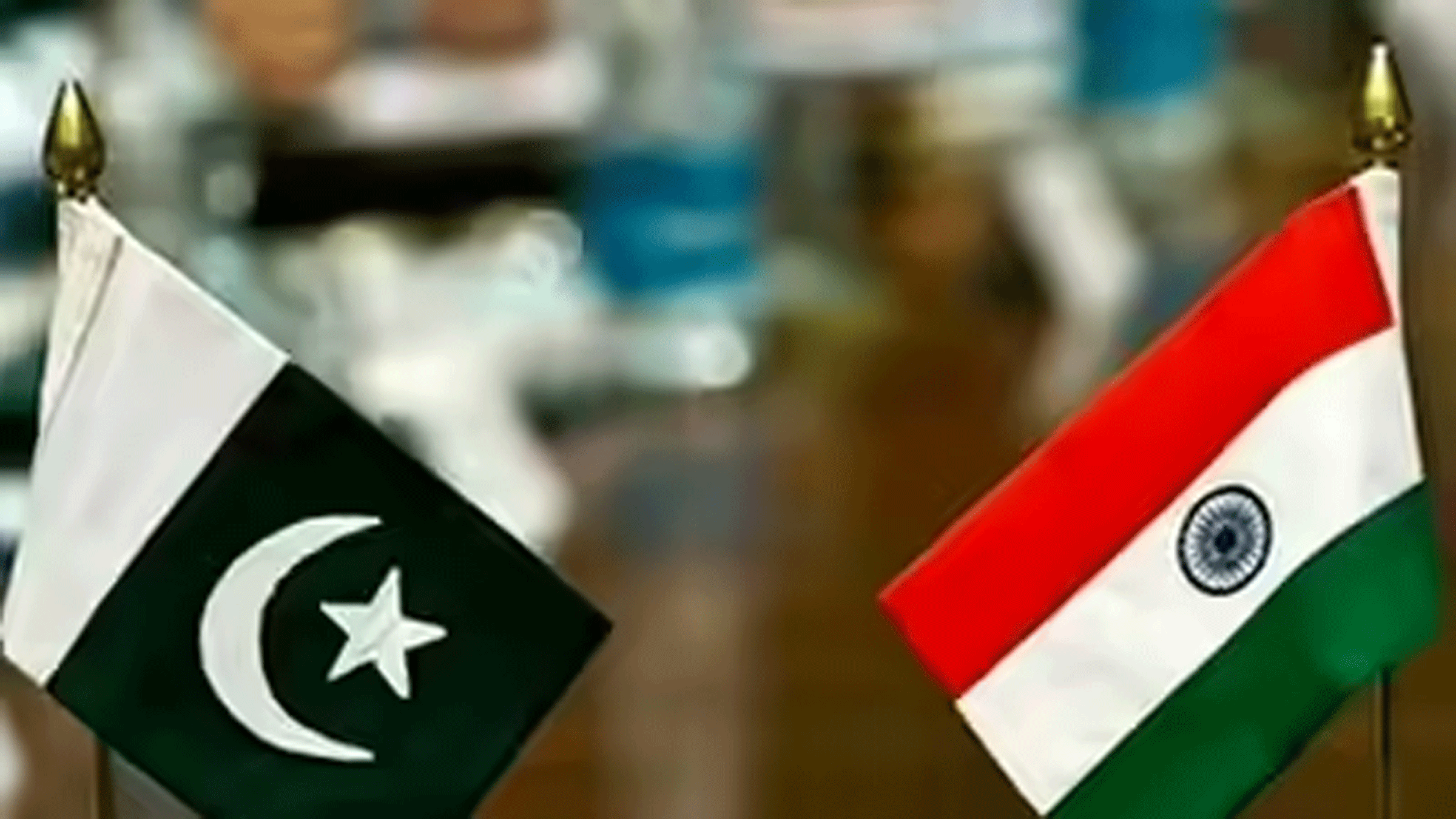
The second term of United States President Donald Trump marked a shift in how Washington approached its external engagements. The emphasis moved away from continuity in alliances towards immediate outcomes. Partnerships were assessed less on their long-term strategic value and more on their ability to deliver results in specific situations. This approach became visible during the 2026 Iran war and the disruption of the Strait of Hormuz, which affected global oil flows, raised energy prices, and created pressure across Gulf economies. In this environment, the United States adjusted its diplomatic approach in West Asia and, in doing so, reduced India’s role while engaging Pakistan for limited but operationally useful purposes.
This development arose from the demands of the moment. The conflict required communication between hostile actors, particularly between Washington and Tehran. Direct engagement remained constrained. As a result, countries that could maintain working relations with both sides gained relevance. Pakistan positioned itself within this space. It offered to host discussions, facilitated communication, and maintained contact with multiple stakeholders in the region. Its leadership engaged with Gulf capitals while continuing its security commitments in countries such as Saudi Arabia. This combination of diplomatic access and security presence increased its immediate utility.
India, by contrast, was not positioned to perform this function. In the period preceding the conflict, India had strengthened its strategic alignment with the United States and Israel. This alignment delivered tangible gains in defence cooperation, intelligence exchange, and technology partnerships. However, it also influenced how India was perceived in a region marked by deep political divisions. At the same time, India’s engagement with Iran had declined over the years due to sanctions pressures, reduced energy dependence, and shifting policy priorities. When the crisis unfolded, India lacked the operational channels required to engage all sides simultaneously. As a result, it was not considered a mediator in the evolving diplomatic process.
To understand the significance of this moment, it is necessary to place it within the longer history of India-United States-Pakistan relations. During the Cold War, the United States maintained close military and strategic ties with Pakistan, which joined alliances such as SEATO and CENTO. India, under Prime Minister Jawaharlal Nehru, pursued a policy of non-alignment and maintained distance from bloc politics. This divergence shaped early perceptions in Washington, where Pakistan was viewed as a more immediate security partner. The 1971 Bangladesh war marked a low point in India-United States relations, with Washington extending support to Pakistan, while India moved closer to the Soviet Union through the Treaty of Peace, Friendship and Cooperation.
The post-Cold War period gradually altered this equation. Economic liberalisation in India during the 1990s created new avenues for engagement. The nuclear tests of 1998 initially led to sanctions but were followed by sustained dialogue. A significant turning point came with the 2005 India-United States Civil Nuclear Agreement, which marked a strategic opening and signalled Washington’s recognition of India as a rising power. Over the following decade, defence cooperation expanded, joint military exercises increased, and India’s role in the Indo-Pacific gained importance in the context of balancing China’s rise. Pakistan, meanwhile, remained relevant to the United States primarily in the context of Afghanistan, especially after 2001, when it became a key logistical partner in the war on terror.
However, the United States has historically demonstrated a pattern of engaging Pakistan when immediate operational needs arise. This was evident during the Afghan conflict, and it reappeared during the Iran crisis. The pattern suggests that Washington’s engagement with Pakistan is not driven by long-term trust, but by situational necessity. The Trump administration’s second term reinforced this approach by placing greater emphasis on short-term outcomes. Even established partners were not guaranteed a central role unless they were directly relevant to the crisis at hand.
The events of 2026 therefore exposed certain limitations in India’s foreign policy posture, particularly in West Asia. India’s long-standing approach in the region was based on maintaining balanced relations with competing actors. It engaged Iran for energy and connectivity, developed ties with Israel for defence and technology, and built strong economic relationships with Gulf countries, supported by a large Indian diaspora. This balance allowed India to avoid entanglement in regional rivalries while preserving access to multiple partners. Over time, however, this equilibrium narrowed. Greater alignment with the United States and Israel coincided with reduced engagement with Iran, which limited India’s flexibility during a period of crisis.
India remained an important economic and strategic actor, but it was not present in the specific diplomatic channels that became critical during the conflict. Its strong economic links with the Gulf did not translate into a role in security or mediation frameworks. Pakistan, in contrast, retained a limited but functional presence in these areas, particularly through defence cooperation with Gulf states. This difference in positioning, rather than any broader shift in power, explains the variation in roles during the crisis.
It is also important to recognise that India’s partnership with the United States has produced significant long-term benefits. Defence cooperation has improved access to advanced military systems and enhanced interoperability. Strategic coordination in the Indo-Pacific has strengthened India’s position in relation to China. Technology partnerships have expanded across sectors such as semiconductors and digital infrastructure. Trade and investment flows have increased, contributing to economic growth. These gains remain central to India’s global strategy and are not diminished by short-term diplomatic developments in another region.
At the same time, the crisis demonstrated that alignment alone does not ensure influence across all theatres. The United States operates within a hierarchy of priorities, and regions experiencing immediate instability can temporarily take precedence. In such situations, Washington engages actors based on their immediate utility. India’s absence from crisis diplomacy in West Asia did not indicate a breakdown in its relationship with the United States. It reflected the limits of that relationship in a specific context. Pakistan’s role, while visible, should also be assessed with caution. Its economic challenges remain significant, and its reliance on external financial support continues. Its industrial base is limited, and its political environment is marked by instability. Its engagement during the crisis improved its diplomatic visibility, but it did not alter its structural position in the international system. Its relevance was tied to the specific requirements of the moment.
Nevertheless, even temporary shifts can carry implications. Diplomatic visibility influences perception, and perception can affect access, investment, and political engagement. If one actor is consistently present in key negotiations while another is absent, the balance of influence can gradually change. For India, the concern is the possibility of reduced participation in future decision-making processes. India’s diplomatic tradition has historically been defined by the ability to maintain engagement across competing power centres while preserving autonomy. From non-alignment under Nehru to calibrated alignment under Indira Gandhi, and later strategic opening under Narasimha Rao and Manmohan Singh, Indian diplomacy has demonstrated an ability to operate across divides without losing balance. The present moment does not call for a departure from this tradition, but for its restoration in operational terms.
The lessons from this episode are practical. India needs to expand its operational reach. This includes rebuilding engagement with Iran where feasible, maintaining communication channels with all major actors in West Asia, and increasing its involvement in regional security discussions. It also requires the ability to respond more quickly during crises and to position itself as a participant in diplomatic processes rather than as an observer.
The events of 2026 illustrated the importance of relevance in specific situations. Pakistan’s role was a function of access and timing. India’s absence was a result of limited flexibility in that moment. The distinction is important. It suggests that the issue is not one of capability, but of positioning.
In international politics, long-term strength must be complemented by the ability to act in real time. Strategic partnerships provide stability, but influence is often determined by presence during moments of crisis. India possesses the scale, capacity, and partnerships required to influence global outcomes. To do so consistently, India must ensure that it is present wherever decisions are being made.
 Follow our WhatsApp channel
