

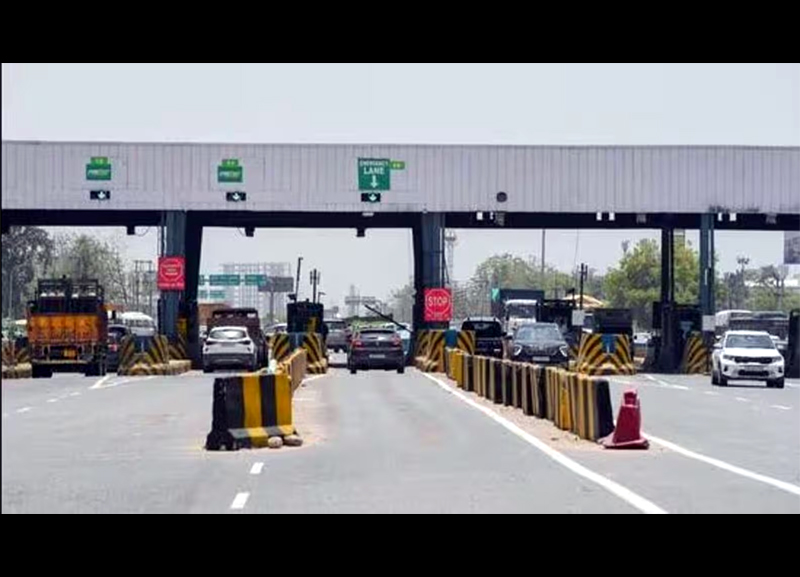
NEW DELHI, May 11: The new barrier-less toll collection system, once implemented nationwide, will ensure a break-free travel experience for highway users and cut the government’s expenditure on fee plaza operations by Rs 6,000 crore annually, Union minister Nitin Gadkari said on Monday.
The road transport and highways minister said this after inaugurating the country’s second multi-lane free flow (MLFF) tolling system at the Mundka-Bakkarwala Toll Plaza on the Urban Extension Road-II (UER-II) in Delhi.
The first such free-flow tolling system was inaugurated on May 1 at Choryasi Toll Plaza on the Surat-Bharuch section of NH-48 in Gujarat.
It has been the government’s continuous effort to give good and sustainable highways to people of India, deploying the latest technology, the minister said, adding that earlier, the toll collection was around Rs 40,000 crore to Rs 45,000 crore annually. Then, after the introduction of FASTag, the collection increased to around Rs 55,000 crore.
“Now MLFF is coming, and its benefit will be that earlier in the toll that was collected, the expenses were around 15 per cent, but now 10 per cent will be saved, so overall Rs 5,500-6,000 crore will be saved,” Gadkari said.
At plazas with barrier-less tolling systems, vehicles need not to stop as the AI-enabled cameras installed at the collection booth are capable of reading details of vehicles crossing at a speed of as high as 100 km per hour.
“Waiting time is zero at such plazas. AI has been used for number plate recognition. You can pass an MLFF barrier-less tolling system at a speed of 80-100 km/h speed,” Gadkari said.
In the future, MLFF will also help in saving fuel worth Rs 285 crore and reducing 81,000 tonnes of Co2 emissions.
Explaining the transaction process, Gadkari said the National Highways Authority of India (NHAI) will obtain the user fee deducted by the partner bank from the customers’ FASTag.
In case a customer having a low balance or inactive FASTag passes MLFF plaza, the person will receive an e-notice on the registered mobile number.
The person will be given 72 hours from the time of receiving the e-notice to pay the toll through online mode only, such as UPI, or face action.
State-owned NHAI operates around 1,100 toll plazas across various locations in the country.
After Choryasi and Mundka-Bakkarwala, NHAI is planning to roll out more MLFF tolling at national highway fee plazas during the current financial year, its Chairman Santosh Kumar Yadav said.
He said the national rollout covers 17 fee plazas across nine states. All are aimed to go live by September 2026. These plazas are in states such as Gujarat, Delhi, Haryana, Rajasthan, Tamil Nadu, Karnataka, Maharashtra, and Assam.
Yadav said the bidding process for an additional 108+ plazas under phase 2 is at various levels. These plazas will come up by March 2027 in states such as Delhi, Gujarat, Rajasthan, and Telangana.
The state-of-the-art system enables seamless toll collection without requiring vehicles to stop, using advanced technologies such as Automatic Number Plate Recognition (ANPR) and FASTag.
The initiative is aimed at reducing queues and delays at plazas, saving fuel costs and travel time, besides giving a better driving experience.
The minister later urged the commuters to follow the traffic rules as the country moves ahead with the upgradation of technology across highways.
He requested the people to put on their seat belts and avoid using mobile phones while driving on highways, as upcoming MLFF plazas are capable of detecting such activities even during night hours. Such incidents will be captured and reported to the nearest authorities, who will issue challans to the offenders. (PTI)
 Follow our WhatsApp channel
