

Excelsior Correspondent
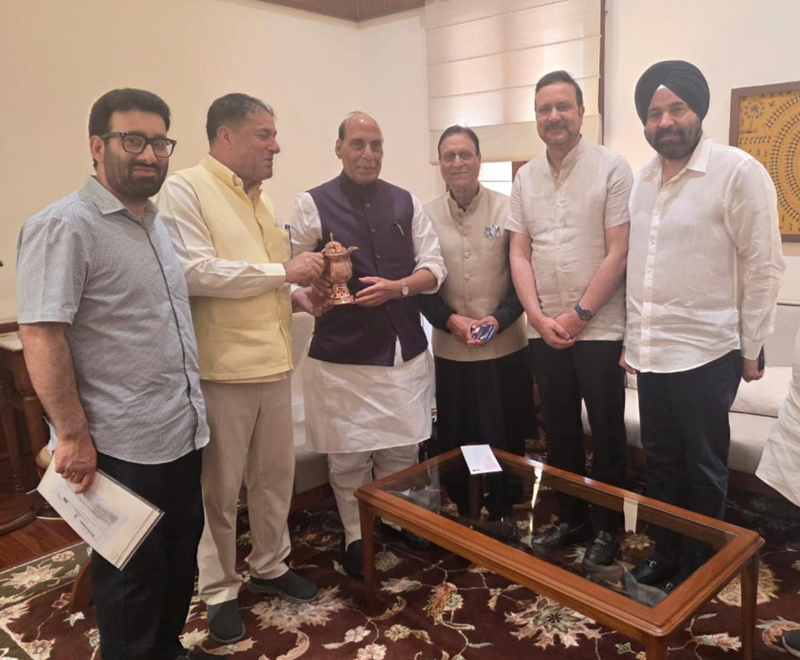
JAMMU, Apr 17: A delegation of Members of Parliament from National Conference (NC)-Chowdry Mohd Ramzan, Sajjad Ahmed Kichloo and Shammi Oberoi-along with MLAs Nazir Ahmad Khan Gurezi and Qaisar Jamsheed Lone, met Defence Minister Rajnath Singh at Parliament House and raised a range of public concerns and developmental demands related to Jammu and Kashmir.
During the meeting, the NC delegation referred to the approval of the Machil-Keran and Gurez Tunnel projects and called for expediting work on these initiatives, citing their strategic significance as well as their importance for public connectivity in remote areas.
Highlighting infrastructure needs, the delegation stressed the urgency of upgrading the Handwara-Wadderbala-Bangus road, describing it as a crucial link for local connectivity and tourism, particularly for access to Bangus Valley. They sought its inclusion under the Border Roads Organization (Beacon) to ensure better maintenance and systematic development.
The representatives also raised the demand for declaring the Sumbal-Gurez road as a Strategic National Highway, noting its role in improving connectivity to far-flung regions. They further pressed for opening the Dras-Gurez road for traffic to ease hardships faced by residents, especially during periods of limited access.
Calling for accelerated progress, the delegation urged early execution of key infrastructure projects, including the Lolab-Bandipora Tunnel, the Kishtwar-Padder-Zanskar road and the Badoab-Sonamarg road, stating that these projects are vital for enhancing connectivity, boosting tourism and supporting regional development.
The delegation raised concerns over the military camp at Zachaldara in Handwara, established in the early 1990s during militancy, noting that it now lies within a densely populated market area surrounded by schools, mosques, health centres and other public institutions.
They stated that its presence causes inconvenience, restricts movement-especially during evening hours-and hampers medical access, and called for its relocation to a more suitable site to balance security needs with civilian convenience.
 Follow our WhatsApp channel
