

Excelsior Correspondent
Srinagar Apr 16: The president of the People’s Democratic Party (PDP), Mehbooba Mufti, today criticised the timing and basis of India’s women’s reservation law, saying it is being advanced without adequate data and consultation.
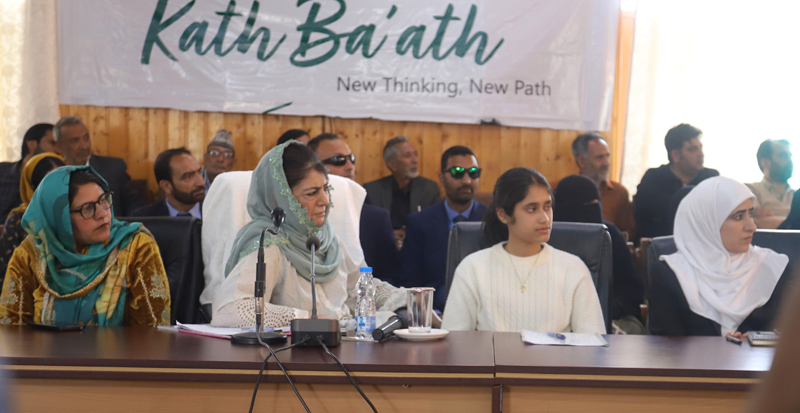
Speaking to reporters on the sidelines of a function in Baramulla, Mufti said she did not understand why the government was moving ahead with the legislation without first conducting a fresh population census, caste census and delimitation. She questioned the urgency, suggesting that discussions could instead take place after elections in West Bengal and Tamil Nadu.
The PDP Chief said policymaking should be based on updated statistics expected from the next census cycle in 2026-27, rather than relying on 2011 data. Referring to population figures, she claimed there would be a significant variation in updated numbers and said decisions taken without current data risked being flawed.
On the question of women’s representation, Mufti said she supported greater participation of women in parliament. She recalled that during the tenure of her father, Mufti Mohammad Sayeed, her party had introduced reservations for women at the local body level. However, she reiterated her concern over the current bill’s timing and process, noting that even though the Bharatiya Janata Party was advancing it, key preparatory steps had not been completed.
Mufti alleged that conditions in Jammu and Kashmir has deteriorated since 2019, when the region’s special constitutional status was revoked. She said that people, particularly in Kashmir, were unable to speak freely and that even journalists faced restrictions.
The former Chief Minister said her party wanted to engage directly with the public to understand their concerns and provide a platform where people could speak openly without fear. She described widespread distress among residents and said addressing this “depression” was a priority.
The PDP Chief also raised concerns about policing practices, alleging that individuals, including those previously granted amnesty, such as former stone-pelters, were still being summoned by authorities. “On occasions such as Republic Day, Independence Day, or visits by dignitaries, some individuals are detained as a precautionary measure,” she said.
Mufti said problems related to poverty, education, and infrastructure required attention, but emphasised that addressing what she described as public “suffocation” was equally important.
She said measures such as the Public Safety Act (PSA) and the Unlawful Activities (Prevention) Act (UAPA) were being used to suppress dissent.
Referring to Modi’s Israel visit, she alleged that engagement with Israel had affected India’s international reputation. “India’s foreign policy under the current Government contained serious mistakes,” she said.
 Follow our WhatsApp channel
