

Sanjeev Pargal
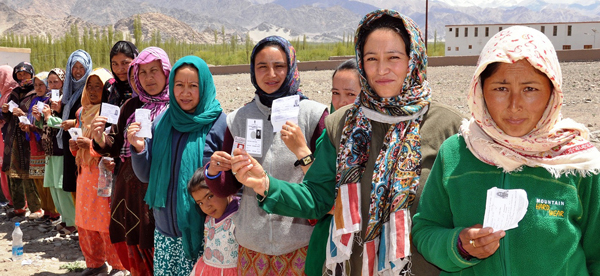
JAMMU, May 7: A brisk 72.1 per cent turnout was recorded for Ladakh Lok Sabha seat, which witnessed peaceful voting even along all 42 polling stations located close to two hostile neighbours—Pakistan and China as polling process for all six Lok Sabha seats of Jammu and Kashmir was completed today. Counting for the seats would be taken up on May 16 along with all Lok Sabha seats in the country.
The figures worked out by the Election Commission late this evening revealed turnout of 72.5 per cent in Leh district and 71.8 per cent in Kargil district but the percentage could be slightly altered as several polling stations in the two districts comprising four Assembly segments, which formed part of Ladakh Lok Sabha seat, were located in remote and virtually inaccessible areas from where accurate reports were yet to pour in.
Official sources told the Excelsior that Leh and Nobra Assembly segments in Leh district recorded 69 and 76 per cent turnout respectively while Kargil and Zanskar Assembly constituencies in Kargil district accounted for 76.26 and 67.47 per cent voting respectively.
A total of 1,14,957 electorates exercised their right to franchise in Ladakh Lok Sabha seat including 60177 in Kargil district and 54780 in Leh district.
The segment wise votes cast included 45047 in Leh, 9733 in Nobra, 46072 in Kargil and 14103 in Zanskar. Ladakh has a total of about 1.60 lakh electorates.
The polling percentage of about 72.1 per cent in Ladakh was almost equal to that of 2009 Lok Sabha election when 71.86 per cent electorates had exercised their right to franchise.
The voting percentage in Ladakh in 2004 was 73.52 while it was very high in 1999 at 81.88 per cent.
The voters sealed the fate of only four candidates in fray for Ladakh seat. They included Thupstan Chhewang of BJP, Tsering Samphel of Congress, Syed Mohammad Kazim Sabri, Islamiya School Kargil backed Independent and Ghulam Raza, Congress rebel and Imam Khomeini Memorial Trust backed Independent.
Barring minor scuffles between polling agents of rival parties, non-functioning of Electronic Voting Machines (EVMs) at some places and row over identification of electorates, the polling in all 257 polling stations of Kargil passed off peacefully.
SSP Kargil Sujit Kumar told the Excelsior that voting in all 24 polling stations located along the Line of Control (LoC) with Pakistan at Batalik, Drass and Kargil remained completely peaceful under the watchful eyes of Indian Army, para-military personnel and police.
During Ladakh Autonomous Hill Development Council (LAHDC), Kargil elections in September last year, police had faced law and order problem at Huliyal area of Batalik sector but this time, the polling was totally peaceful in all three sectors—Batalik, Drass and Kargil, Kumar said.
There were 12 polling stations falling along LoC at Drass, eight in Batalik and four in Kargil town.
All 24 polling stations falling along the LoC with Pakistan witnessed huge turnout with people including women and young voters turning up in large number to exercise their right to franchise without any fear notwithstanding that some of the polling stations were located just few meters away from the LoC and were clearly in firing range of Pakistan Army.
However, in view of elaborate security arrangements made for the polling stations by the Army, para-military and police, Pakistani troops made no attempt to disrupt the polling. It may be mentioned here that India and Pakistan Armies had fought war in Kargil from May to July 1999 after Pakistan Army had intruded into the Kargil heights. India had won the war capturing all the heights again and driving away the intruders.
Sources said the supporters of two Independent candidates—Sabri and Raza clashed at Shakar and Gund Mangalpor polling stations over the casting of votes by some people, who didn’t possess identity cards.
The SSP Kargil, however, said the disputes were minor in nature and were immediately managed. “There were normal disputes between agents of rival candidates over identity of voters but they were manageable and polling went on smoothly,’’ he added.
Kumar said complaints of non-functioning of Electronic Voting Machines (EVMs) were also received from about half a dozen polling stations but they were resolved as the administration replaced or repaired the EVMs immediately.
Official sources and eyewitness account revealed that long queues of voters could be seen in both Leh and Kargil districts right from the morning as majority parts of the two districts, which comprised Ladakh Parliamentary seat, had bright sunshine today. Though the polling began at 7 am, it gained momentum after 9 am when Sun came out in the open.
Among the early voters in Leh were BJP candidate Thupstan Chhewang, who cast his vote at polling station No. 73 at Shanker Yourtung in Leh town while his Congress rival Tsering Samphel exercised his right to franchise in adjacent polling station No. 73 at Shanker Yourtung.
Two Independent candidates from Kargil district Syed Mohammad Kazim Sabri cast his vote at polling station No. 56 at Salaskote under Kargil Assembly segment while another Independent and Congress rebel Ghulam Raza polled his vote at polling station No. 33 at Shispure in Zanskar Assembly constituency.
Urban Development Minister Rigzin Jora, Congress MLA from Leh and Rigzin Spalbar, Chief Executive Councilor, LAHDC, Leh cast their votes in Leh town along with Executive Councilors and Councilors.
Deputy Commissioner, Leh Simrandeep Singh cast his first vote in life at Chanspa polling station at Leh at 9 am.
“Spreading awareness among the voters of Leh district through SVEEP, I too realized the importance of every single vote and today I’m very excited and happy to cast my vote for the first time,’’ he said. He explained that under the Representation of People’s Act (RPA), he had transferred his vote to Leh.
Among the elders, Akhoon Mohammad Hussain, 96, who claimed that he was oldest Muslim in Kargil cast his vote at Baroo polling station while 92 years old Soman Norphel, who claimed to be oldest Buddhist in Kargil district exercised his right to franchise near his residence at Mulbek polling station.
There were several first time voters, who queued up at 7 am outside the polling station to enjoy the pleasure of pressing button of the EVM for the first. Among them was 18 years old Manzoor Ali, who cast his vote Goma Kargil polling station.
After coming out of the polling station, Manzoor as well as several other youngsters, said they were casting their vote for development of Ladakh especially Kargil district, which was backward despite about 67 years of independence.
In fact, same was the story of the voters—youngsters, middle aged or elders in both Leh and Kargil districts, who charged their successive representatives—both in Parliament and Legislature of not doing enough for development of Ladakh, the third region of Jammu and Kashmir especially in terms of education facilities, all weather road connectivity with rest of the country and round-the-clock water and power supply.
“Look, we are still disconnected by road even when second week of May is going to start tomorrow. The Srinagar-Leh National Highway has not been opened yet. It was closed somewhere in November. What is our life? We can’t do any business with rest parts of the country in the absence of all weather link. Election after election, we have been promised construction of tunnel at Zojila to link Kargil and Leh with Srinagar round the year. This time we hope our representative would take up expeditious completion of the tunnel,’’ majority of voters said in Leh and Kargil after waiting for more than an hour or even more in the queue to cast their vote.
Apart from all weather road link, internal road connectivity and supply of power and water were the other major problems faced by the people in the two districts especially the rural areas. Even the towns were no better off, the voters said and hoped that this election would bring some good news for them.
However, there were some voters in Leh, who admitted that some development has, of later, taken place in Leh town and surroundings but the rural areas were still in bad shape.
Chinese incursions in Leh were also a cause of concern for the people of Leh though development remained the major priority area.
“Chinese incursions are for the Indian Government to resolve. We want our MP to focus on development of Ladakh so that youth of the area don’t have to go outside for education and employment,’’ the voters said hoping the new MP would get the Central University for Ladakh and adequate infrastructure for higher learning institutions.
The electorates also wanted early completion of power projects in the region so that the people were able to get round-the-clock power supply. They hoped that their newly elected MP would take up the matter of laying Srinagar-Leh power transmission line with the new Government at the Centre.
At various polling stations, women outnumbered the men in the queues. With polarization clearly visible between Leh and Kargil districts, all four candidates in the fray and their supporters used all resources at their command within the ambit of Model Code of Conduct to ensure maximum turnout in their areas.
It may be mentioned here that there were only four candidates in the fray for Ladakh and two each hailed from Leh and Kargil districts.
Sources said nine polling stations in Leh fell along LoC with Pakistan and almost an equal number with China along the Line of Actual Control (LAC) in Nobra Assembly segment of Leh district. All these polling stations witnessed brisk turnout without any fear.
Authorities had made elaborate security arrangements for the voting at all polling stations falling along LoC and LAC. However, no untoward incident was reported from any part of LoC or LAC in Leh.
In Leh, voters of all age could be seen casting their votes, especially the elderly and old aged people seem to be more committed with their voting responsibility and were seen in good numbers at every polling booth.
“The importance of voting has increased tremendously in the region over past some decades and to bring development it become imperative for every citizen to use their voting rights, especially the educated youth who holds the responsibility of ensuring a prosperous future,” said Haji Abdul Samad Lasu, aged 100 years old, perhaps the oldest voter in Ladakh.
Another, 96 years old voter Mohammad Ramzan from Yurtung said: “I strongly believe that every individual’s vote is valuable and I have been using my voting right all through my life’’.
Sharing similar views, Rinchen Angmo, aged 83 years old and Rigzin Padma Tsangspa Onpo of same age opined on having a stable, honest and selfless leader who would think of the welfare of people in real terms.
“I am very excited that I am going to vote for the first time and I intend to vote for that candidate who will work for the benefit and betterment of our region as well as the country,’’ observed Nargis Khatoon, 20 years old, an excited but a thoughtful college student from Chuchot village.
Many first time young voters were seen sharing same excitement in other polling stations of Ladakh. Few students had even flown from Delhi and other places to Leh to cast their votes.
“As compared to previous polls this time the arrangements are very smooth and satisfying,” said Tsewang Dolma, a resident of Sheynam.
However, despite all out efforts of the Election Commission to increase voting percentage, nearly 10,000 students of Ladakh were deprived of their right to vote as they remained stranded in Jammu, where they had come for higher studies. They had repeatedly been holding protests to set up a polling station in Jammu to facilitate voting for them but the Election Commission turned a deaf ear towards their demand depriving a large number of them from voting.
As Srinagar-Leh National Highway was closed, the voters were unable to go to their houses to cast their votes.
The students under the banner of All Ladakh Students’ Joint Action Committee also held a demonstration here today against the Election Commission for depriving them of the voting right.
Koushuk Bakula of Congress was the first to represent Ladakh seat in the Parliament in 1967 as until that election, members from the Jammu and Kashmir were being nominated to Lok Sabha.
Bakula again represented the constituency in 1971 while Parvati Devi, also from Congress, won the seat in 1977. In 1980 and 1984, P Namgayal won the seat as Congress candidate.
However, in 1989 an independent Mohammad Hassan Commander got elected from the constituency but P Namgayal again wrested the seat for the Congress in 1996 election.
But in 1998 Syed Hussain of National Conference (NC) got elected from the seat while Hassan Khan of (NC) won in 1999.
In 2004, Thupstan Chhewang, an independent got elected while Hassan Khan, also an independent won in 2009.
Ladakh MPs so far
Year Name Party
1967 Koushak Bakula Cong
1971 Koushak Bakula Cong
1977 Parvati Devi Cong
1980 P Namgayal Cong
1984 P Namgayal Cong
1989 Ghulam Hassan
Commander Independent
1996 P Namgayal Cong
1998 Syed Hussain NC
1999 Hassan Khan NC
2004 Thupstan Independent
Chhewang
2009 Ghulam Hassan Independent
Khan
2014 ——— ———
 Follow our WhatsApp channel