

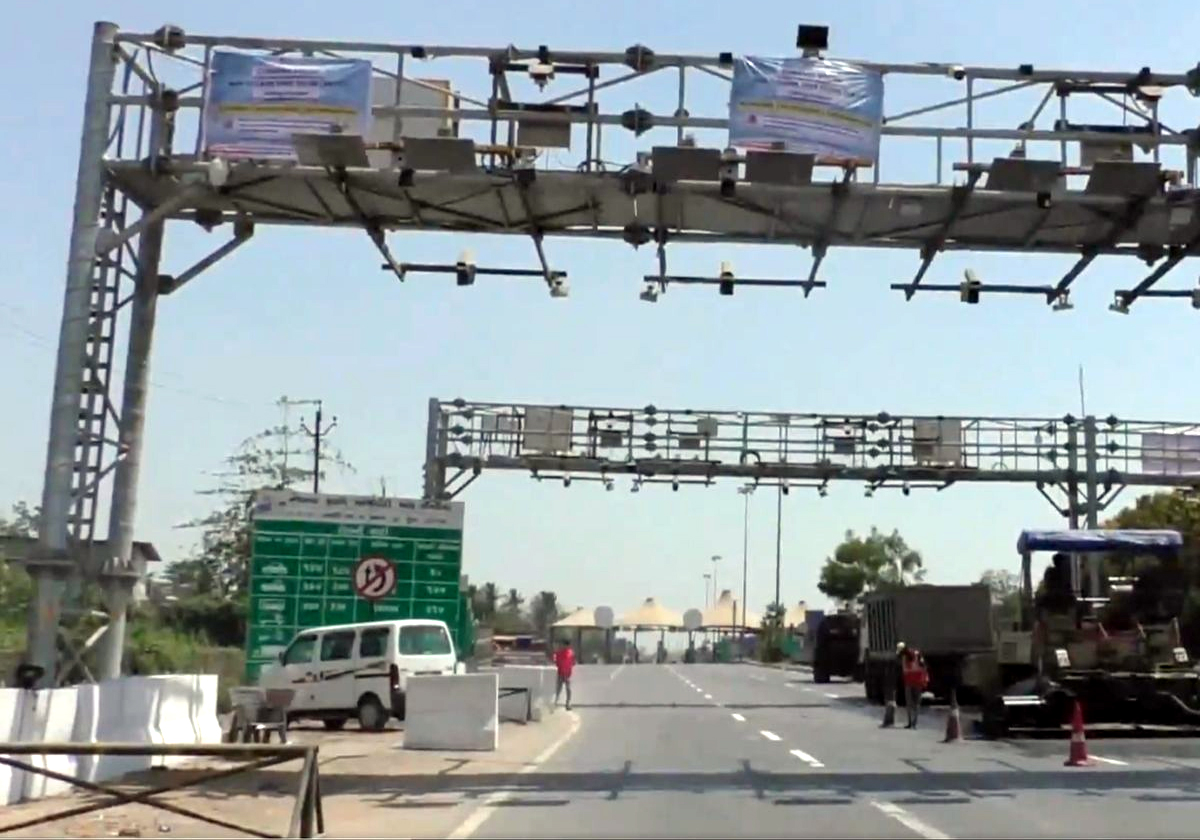
NEW DELHI, May 6 : The road transport and highways ministry has launched India’s first multi-lane free flow (MLFF) barrierless tolling system at the Choryasi Toll Plaza on the Surat-Bharuch section of NH-48 in Gujarat, marking a big shift in highway tolling.
The state-of-the-art system enables seamless toll collection without requiring vehicles to stop, using advanced technologies such as Automatic Number Plate Recognition (ANPR) and FASTag.
India’s electronic toll collection (ETC) infrastructure was started in 2014. Currently, vehicles need to stop at each fee plaza for payment of the highway usage charge.
Choryasi ranks among the top 10 toll plazas in the country in user fee collection. Indian Highways Management Company Limited (IHMCL), a company promoted by the National Highway Authority of India (NHAI), has signed an agreement with ICICI Bank to implement the country’s first comprehensive MLFF tolling system at Choryasi Fee Plaza.
State-owned NHAI is planning to roll out MLFF tolling at around 25 national highway fee plazas during the current financial year.
There are a dozen of toll plazas, including the Mundka toll plaza on the newly opened greenfield Urban Extension Road-II, where the multi-lane free flow tolling system is under testing.
BENEFITS OF MLFF
———————
Uninterrupted traffic flow: Vehicles no longer need to stop or slow down at toll plazas, leading to smoother traffic movement and reduced congestion.
Operational efficiency and cost savings: Reduced reliance on toll booth infrastructure and manpower results in lower operating costs over time.
Environmental benefits: Smoother traffic flow reduces vehicular idling, cutting down emissions and contributing to cleaner air near tolling points.
HOW DOES MLFF WORK?
————————–
High-performance RFID readers detect FASTag affixed on vehicles at high speeds. At the same time, ANPR cameras capture licence plate data, while RADAR and LiDAR systems accurately detect and classify vehicles. MLFF equipment creates a toll transaction through reading of the FASTag and/or vehicle number plate, and deducts the fee from the FASTag. With the ‘One Vehicle, One Tag’ policy in place, the FASTag is linked to the vehicle number. It also captures evidence of vehicles where payment fails.
CONVENTIONAL TOLLING VS MLFF TOLLING
————————————————
Conventional fee plazas rely on physical booths, gates, and lane infrastructure. MLFF replaces this with smart overhead gantries – minimising ground infrastructure while maximising efficiency. Where traditional systems cause delays and frustration, MLFF delivers a fast, transparent, and high-integrity revenue process.
ELECTRONIC NOTICE
———————–
MLFF also introduces a robust e-notice and grievance redressal mechanism. If a vehicle fails to pay the applicable user fee while crossing an MLFF plaza, an electronic notice, or e-notice shall be issued for recovery of the unpaid fee, as per Rule 14 of the National Highway Fee Rules 2008.
E-notice will be sent via SMS to the registered mobile number of the vehicle owner as per the VAHAN database, and also to the mobile number linked to the FASTag of the vehicle as per the issuer bank’s records.
E-notice amount shall be twice the applicable user fee. However, if payment is made within 72 hours of issuance, a 50 per cent discount shall apply, and the amount payable shall be limited to the user fee applicable to the vehicle only.
After 72 hours, the road user shall be required to pay the full e-notice amount. (PTI)
 Follow our WhatsApp channel
