

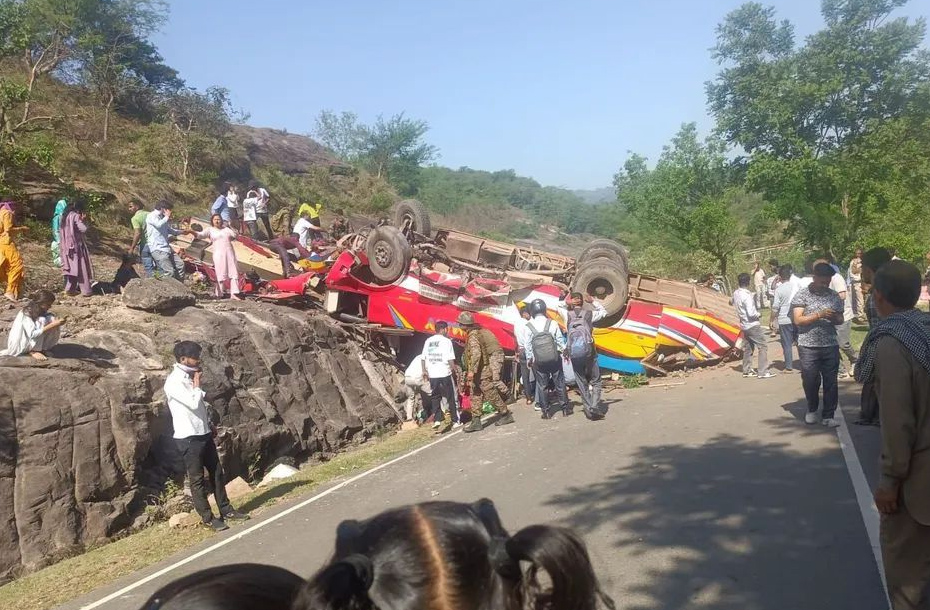
The hills of Jammu and Kashmir witnessed another major accident resulting scores of untimely tragic deaths. On the morning of April 20, a passenger bus negotiating a blind curve near Kaghote village in Udhampur’s Ramnagar area lost control and plunged nearly a hundred metres down a hillside, killing scores of people and injuring others. The bus even crushed an auto-rickshaw in its fall, leaving no corner of the tragedy untouched by its unfolding. The dead include ordinary people – daily wage earners, office-goers – who had simply boarded a bus in the morning, in broad daylight, on a clear summer day, to reach their workplaces. They never arrived. What is perhaps most damning about this accident is not its occurrence, but its predictability. Eyewitnesses say the bus departed Ramnagar around 9 am – well after the official summer start time of 8 am – visibly overcrowded and moving at reckless speed. These details, if confirmed by the official inquiry, will form a catalogue entirely familiar to anyone who has tracked road safety in Jammu and Kashmir over the past decade: overcrowding, overspeeding, missing safety infrastructure, and no accountability. The only variable that changes each time is the body count.
Before the dust had settled on Ramnagar’s hillside, the well-rehearsed choreography of official response had already begun. Condolences poured in from every quarter. An ex gratia of Rs 2 lakh for the deceased and Rs 50,000 for the injured was announced. Assurances of “all possible assistance” were offered. Somewhere, an inquiry committee will be constituted, terms of reference drafted, and meetings scheduled. This is a ritual after every such accident. The families who have lost their breadwinners, their children, and their spouses will never recover. They will carry the wound of this day for the rest of their lives. No committee report, no matter how detailed, can restore what was taken from them on a mountain road
that should have had guardrails, was overloaded, and was driven by someone going too fast. These are not unpredictable acts of fate. These are the predictable outcomes of a system that has repeatedly chosen inaction.
Three systemic failures converge at every such accident site in the Jammu and Kashmir region, and Ramnagar is no different. The first is lack of proper road infrastructure. The absence of roadside parapets and crash barriers on mountain roads is not a new finding. A High Court-appointed expert committee had already flagged the lack of side railings as a critical factor in fatalities across hilly terrain. Years have passed. The accident site near Kaghote village, reportedly a repeat accident location on this route, lacked a protective railing to stop a runaway vehicle. This Ramnagar to Udhampur road had numerous such tragedies in the past as well. The Roads and Buildings Department must answer for this directly and specifically – not in a committee meeting, but before a public accountability mechanism with consequences for inaction. The second failure is enforcement. Every commercial vehicle is legally required to have a speed governor installed. Random checks on the road should be routine. Instead, the bus reportedly left Ramnagar visibly overcrowded – not something that happens invisibly. Overcrowded vehicles do not sneak past checkpoints; they barrel through them because checkpoints, in practical terms, barely exist. The Transport Department, Traffic Police, and general police are all theoretically present in this system. The question that must be answered – loudly, persistently – is: who, precisely, is responsible for ensuring these laws are enforced ? And why has no one been held accountable for these repeated failures?
The third failure is proper healthcare. Once the bus had fallen and the injured were pulled from the wreckage – a rescue operation made possible largely by the swift intervention of an Army convoy that happened to be passing – the survivors faced another gauntlet. Critically injured passengers barely get the critical golden hour treatment. Severely injured trauma patients travelling hours over mountain roads is not a treatment plan; it is a death sentence for many. Trauma care is measured in the golden hour. The existing PHC, sub-district hospitals or even district hospitals lack facilities to handle this magnitude of tragedy. They are ultimately referred to the closest GMC and critically injured, if still alive, end up at GMC Jammu. Establishing hospitals which cannot handle emergency trauma without referring patients hundreds of kilometres away is the saddest part. The Government must equip each medical facility with at least the bare minimum of trauma specialists and critical care infrastructure. Human lives are precious, and each one has to be saved.
The argument for a “multi-pronged approach” has been made many times before. It will be made in the inquiry report that follows this accident. It will be made again after the next one. The language is not the problem. The will to implement is. What is needed is not another set of recommendations but a mechanism that treats non-implementation as a punishable failure. Every kilometre of national and state highways in accident-prone districts – Udhampur, Ramban, Doda, and Kishtwar – must be physically inspected, documented, and graded for safety compliance. Missing parapets must have a deadline for installation, and officials must sign off on completion. Uncompleted work must trigger departmental action. This is not complicated. It requires only that someone in authority decide that the lives of bus passengers matter more than administrative convenience. Speed governors must be verified operational through roadside checks, not just on paper at the time of vehicle registration. Overloading must carry penalties severe enough to be a genuine deterrent – not a negotiable fine, but licence suspension and vehicle impoundment. The Transport Department must ensure deployment of adequate vehicles during peak office and school hours, precisely to reduce the pressure that leads drivers to cram passengers into buses far beyond safe capacity. Rationalising public transport schedules is not a luxury – it is a life-saving measure.
There is no point in the repeated phrase “we stand in solidarity with the families” being spoken over the bodies of people unless corrective measures are put in place in shortest time interval. This time, the inquiry must move faster than the forgetting. The Roads and Buildings Department must be compelled to explain the missing railings. The transport authority must answer for unchecked overcrowding. The driver’s speed must be reconstructed and liability established. Survivors must receive the best available medical care, not token compensation. More than twenty-one people left home on a Monday morning and did not return. The only tribute their families deserve – the only one that costs the Government something real – is a proper mountain road, much safer than it is today.
 Follow our WhatsApp channel
