

Ashish Chouhan
ashu.padr15@gmail.com
Nestled deep within the mighty Himalayas of Jammu and Kashmir lies the remote and mystical region of Paddar, a land that many people lovingly call Dev Bhoomi, the Land of the Gods.
The title is not merely poetic. Paddar is home to some of the most sacred pilgrimages that happen in the Himalayas, especially the revered Machail Yatra dedicated to Goddess Mata Chandi. At the same time, this rugged terrain is also famously known as the Land of Sapphires, owing to the existence of the rare peacock-blue sapphire mines located near Machail, not far from Buddhist village of Sumcham.
Yet beyond its mountains, rivers, glaciers, and precious stones, Paddar holds something far more ancient and valuable: a living civilization of myths, legends, rituals, and oral traditions that continue to shape the social and cultural fabric of the region even today.
The people of Paddar still follow centuries-old customs. For this they have been awarded tribal status by the Central Government recently. Their traditional attire, unique dialect Paddri, ritualistic ceremonies, and deeply rooted spiritual beliefs preserve an ancient worldview that has survived the passage of time. Almost every village carries stories of gods, goddesses, nagas, spirits, and supernatural beings. These stories are not treated merely as entertainment or folklore. They function as social memory, moral law, and collective psychology. Among the most fascinating aspects of Paddar’s mythology are the legends surrounding the Nagas. According to local traditions, the Nagas arrived in the region long ago and gradually pushed the earlier inhabitants toward the upper reaches of the mountains. These earlier inhabitants were often remembered in oral traditions as Asurs – powerful and feared beings with whom the Nagas fought fierce battles.
Even today, many mountains in Paddar are named after these Asurs, Dhadbadhek and Dhauzz are some prominent examples to cite. In almost every village, one can find a temple dedicated to a deity locally known as the Than Devta ( distorted version of Sthan Devta ). Interestingly, many believe these deities are connected to those very ancient Asurs who lived here in the ancient times and who once opposed the Nagas. Over time, the enemies of one age became the guardians of another.
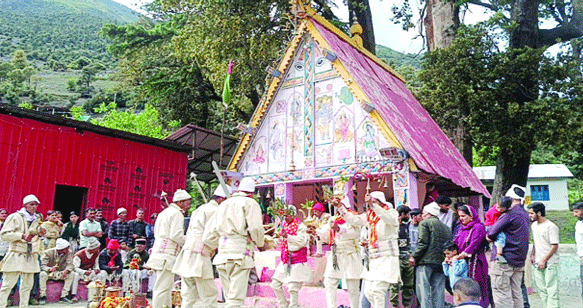
Around these Than Devtas revolve some of the most astonishing rituals that are still being practiced in the region. During local festivals, the Chelagans ( spiritual mediums or ritual specialists devoted to gods, goddesses, Lord Shiva, or Nagas ) enter trance-like states and perform extraordinary acts. Some pierce their cheeks or noses with trident bases. Others strike their backs or heads with metallic chains clung to hard metallic rods known locally as Tazane. Some dance wildly carrying tridents, while others lift ritualistic metallic objects called Dhoona Sandhel with their teeth, which fills people watching them perform with a feeling of awe. Animal sacrifices, especially goats and sheep, are also offered during certain festivals. Sometimes the number reaches twenty-five called Khuriyar Shau ( hundred feet), and sometimes, it could even exceed a hundred called Mundiyar Shau (meaning hundred heads) in local dialect. As drums echo through the valleys and the atmosphere thickens with incense, chants, and fear, the Chelagans begin to speak while in trance. Villagers from distant settlements gather to ask questions about illness, disasters, harvests, or the future. The Chelagans respond in altered voices, and many believe that the gods, Nagas, or spiritual entities themselves speak through them as if certain things are being prophesized through these shamans. To an outsider, these moments may appear bizarre or even terrifying. But culturally, they hold a much deeper meaning.
According to local belief, many of these rituals, especially the loud sounds emanating from a traditional trumpets called karnah in local Paddri dialect, self-inflicted pain, and animal sacrifices, were historically performed either to frighten the Asurs or to appease them. The idea was simple yet psychologically profound: if the Asurs were fed and respected, they would not disturb human settlements. If they were frightened or controlled through ritual power, society could continue peacefully.Even today, festivals such as Cheyt are celebrated with the belief that they help protect villages from harmful unseen forces.
But when viewed from a broader anthropological perspective, these legends reveal something even more interesting: fear itself appears to have been used as a cultural tool to maintain social order.This pattern becomes visible throughout the traditions of Paddar. The region is often described as the Land of Nagas. Nearly every village worships a principal Naga deity associated with bravery, protection, and ancient battles. Saunsar, Meh Raj, Khandwa, Marhol, Ghumain Nagas are some intriguing examples to cite. Their stories are woven into the identity of the people. Yet behind many of these legends lies a recurring theme, the use of fear to regulate behavior and preserve collective stability.
Take, for instance, the village of Tatta Pani, home to the revered Naga deity Saunsar. The deity is believed to be the creator of the village’s famous boiling hot water spring. This hot water pool looks akin to modern swimming pools with a serpent like wooden choke in the middle. This choke helps water draining from the pool, keeping it plugged retains water in the pool for years long.
Every year, a unique ritual known locally as Uzaan is performed, during which nine men from the village of Chitto arrive in the dead of night to clean the sacred hot water pool.The ritual itself is deeply mysterious. Local legends warn that if any ordinary person secretly watches the ritual at night, they may become blind or face terrible misfortune. At first glance, this may sound like superstition. But perhaps there is another way to interpret it. Could such fear-based myths have emerged to protect a sacred and technically sensitive process from unnecessary interference? Could the terrifying warnings have prevented children or careless villagers from disturbing the pool or damaging its natural system by plugging or unplugging the choke unnecessarily, and which are something vital for the prosperity and functioning of the village? In this context, myth becomes more than belief. It becomes social engineering.
A similar pattern appears in the seasonal closure of temples across Paddar. Every year, on Makar Sankranti in January, many temples in the region are closed for nearly three months and reopened only on Baisakhi in April. Again during the monsoon month of Sawan, many temples remain closed temporarily for one month or so. Local traditions strongly warn that if these customs are violated, the deities will become angry and disaster will follow.
But perhaps these stories carried practical wisdom hidden beneath sacred language.The harsh winters of Paddar bring heavy snowfall and deadly avalanches. The monsoon season brings landslides, cloudbursts, and dangerous mountain conditions like what we saw last year in Chishoti Paddar during Machail Yatra. By attaching divine fear to travel restrictions and temple closures, ancient society may have been protecting people from risking their lives during dangerous seasons. The legend ensured obedience where simple advice may not have worked. This intertwining of fear and order appears repeatedly in Paddar’s folk traditions.
In Sohal village, stories are told about Danyu Padha Devta ( local deity who lived under a pomegranate tree). In Leondi village, legends revolve around a mysterious stone bull, while in Zar village, people speak of Bahiro Baba. Though their stories differ, their function seems remarkably similar: anyone intending to commit wrongdoing, disturb social harmony, or violate community ethics risks invoking the wrath of these supernatural guardians. Viewed symbolically, these deities may have acted like invisible moral police, creating psychological accountability in isolated mountain societies where formal systems of law and surveillance were limited. Another fascinating example is the winter tradition known as Hyuan Fatana. During severe winters, stories circulate about an old snow lady traveling through the mountains up to river beds and vice versa with her mysterious bearers. Terrifying tales associated with her movement discourage people from wandering outside during dangerous snowstorms. Again, one sees how folklore transforms environmental survival into sacred narrative. In many ways, fear became a foundational pillar in shaping Paddar’s cultural psychology. The legends did not merely entertain people; they protected them, disciplined them, united them, and guided them. This raises an intriguing possibility.
Could the “Asurs” of ancient stories actually symbolize fierce wild animals or hostile environmental forces that threatened early Naga settlers? Could rituals of frightening and feeding these beings represent humanity’s attempt to psychologically negotiate with an unpredictable and dangerous landscape?
Perhaps the myths were never meant to be understood literally alone. Perhaps they encoded ecological knowledge, survival strategies, ethical systems, and social discipline within memorable stories that could survive through generations. This does not diminish the spiritual significance of these traditions. In fact, it enriches them.
Because when we begin to look at myths not merely as fantasy but as cultural mechanisms created by societies to preserve peace, order, safety, and identity, we unlock an entirely new dimension of understanding. Our perspective of looking at it changes. The people who created these legends were not foolish. They were deeply observant human beings living in one of the harshest terrains imaginable. Without modern policing, scientific forecasting, or institutional governance, they developed symbolic systems powerful enough to regulate society through belief, fear, reverence, and collective memory. And remarkably, many of those systems still survive. Even today, despite modernization and changing beliefs, many families in Paddar continue animal sacrifice traditions because they fear misfortune if the customs are abandoned. Many rituals have faded with time, perhaps due to changing lifestyles or declining faith, but the cultural foundations remain intact.
Paddar’s myths, legends, and folk tales continue to act like an adhesive holding together the region’s collective identity. In the modern world, where ancient traditions are often dismissed as irrational, Paddar offers a different lesson. It reminds us that myths are not always primitive falsehoods. Sometimes, they are sophisticated social tools disguised as sacred stories. And perhaps that is why these legends still hold meaning today.
Because beneath every frightening deity, every ritual sacrifice, every Naga story, and every whispered warning in the mountains of Paddar lies a timeless human intention: the desire to create order, preserve life, maintain harmony, and help society survive.
When we begin to see Paddar’s legends through this lens, we do not merely hear old stories anymore. We begin to understand the civilization that created them.
 Follow our WhatsApp channel
