

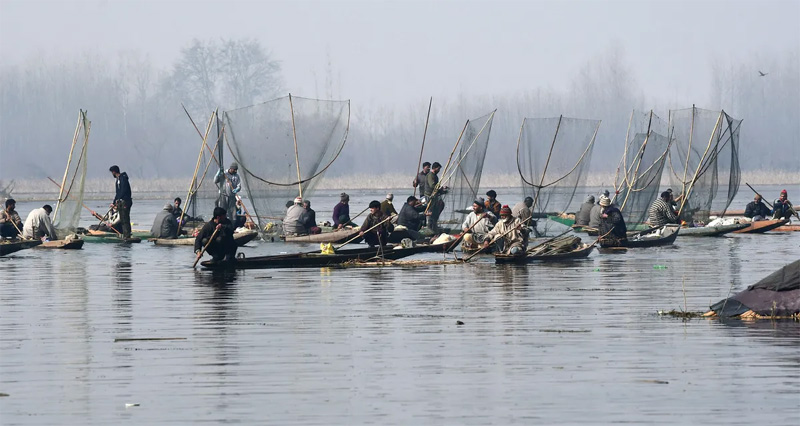
Says lake nearing ecological collapse
Excelsior Correspondent
Srinagar, Apr 24: Anchar lake, once a vast and pristine freshwater body on the outskirts of Srinagar, has shrunk by nearly 80 per cent over the past century, a recent peer-reviewed study has revealed, warning of an unfolding ecological crisis in one of Kashmir’s key wetlands.
Follow the Daily Excelsior channel on WhatsApp
The findings are part of a study titled “A Critical Review on Five Major Wetlands of Kashmir: Addressing Threats and Restoration Opportunities,” published in the AATCC Review Journal by researchers from Sher-e-Kashmir University of Agricultural Sciences and Technology (SKUAST-K).
According to the study, Anchar Lake has reduced dramatically from about 19.54 square kilometres in 1893–94 to just around 4.26 square kilometres at present.
The authors note that the lake “has since experienced a significant reduction in size,” underlining the scale of degradation over time.
Describing the water body as a semi-urban, single-basin lake located around 14 km northwest of Srinagar at an altitude of 1,583 metres, the study notes that Anchar was once a “pristine water body with crystal-clear waters, which were used for drinking and various domestic purposes.”
The present condition, however, is starkly different. “Over the past few decades, the water quality of the lake has deteriorated significantly, primarily due to anthropogenic activities such as encroachments, sewage, and the dumping of domestic waste,” the study states.
Highlighting encroachments as a key factor, the study notes that “people first filled it with soil and then constructed houses,” leading to a steady loss of lake area.
Pollution has further worsened the situation. The lake receives untreated sewage, plastics, polythene, clothes and even hospital effluents.
The study specifically flags the impact of the Sher-e-Kashmir Institute of Medical Sciences (SKIMS), stating that “without any proper Sewage Treatment Plant (STP), the entire waste generated from the hospital found its way into Anchar.”
Scientific observations cited in the paper indicate rising nutrient levels due to agricultural runoff and domestic waste.
“The lake is polluted to a large extent and there is general increase in its nutrient enrichment,” the study notes, adding that such conditions are altering the lake’s hydrochemical balance.
The study further warns of oxygen depletion and the emergence of anaerobic conditions, releasing “foul-smelling hydrogen, methane, and ammonia,” which are toxic to aquatic life.
Researchers caution that the lake is “currently in a dystrophic condition,” and continued nutrient inflow could push it towards a eutrophic state, severely impacting water quality and biodiversity.
Calling for urgent intervention, the study states that “Anchar Lake has reached a critical stage from an ecological point of view,” and recommends strict regulation of encroachments, proper sewage treatment, solid waste management and restoration of the lake’s natural hydrology.
 Follow our WhatsApp channel
