

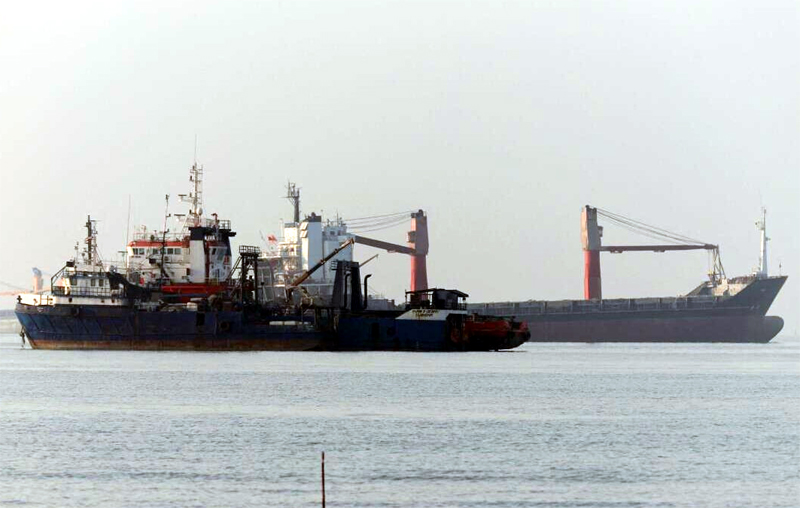
WASHINGTON, Jun 1 : US armed forces have guided around 70 commercial ships over the past three weeks through the Strait of Hormuz, which remains a risky waterway since the US war with Iran began over three months ago, according to a media report.
US Central Command has guided around 70 commercial ships through the strait, travelling into and out of the Persian Gulf, in the last three weeks, the New York Times reported quoting US officials.
They said that most of the vessels had turned off their transponders to avoid detection when going through the narrow waterway.
Before the war broke out on February 28, over 100 commercial ships traversed through the Strait of Hormuz per day. The strait, a narrow waterway with Iran and Oman on either side, is the shipping route for 20 per cent of the global oil supplies.
The officials declined to say what type of vessels were going through and what route they took, but one official indicated that at least one route was not close to the Iranian coastline.
Ships passing near Iran without obtaining Iranian approval face the threat of an almost-certain attack by Iranian drones or missiles, US officials said.
Shipping analysts say the US-guided crossings appear to follow routes that are closer to Oman.
And because US-guided crossings take place with transponders turned off, known as “dark” passages, shipping analysts say they cannot independently verify how many may have taken place.
The US and Iran are negotiating an agreement to end the war that has disrupted global oil supplies, leading to high retail prices for petroleum products and fertilisers.
The US and Iran agreed to a ceasefire on April 8, but the Strait of Hormuz continues to be blocked by Tehran, which is asserting control over the waterway.
The US has enforced a blockade of the strait to disallow any ship movement towards Iran.
US forces have disabled five commercial vessels and redirected 116 to fully enforce the blockade as a ceasefire with Iran remains in effect.
“Though US forces are not escorting, we continue to communicate and coordinate with commercial ships seeking to freely and safely transit the Strait of Hormuz, a critical international corridor for regional and global economies,” Capt. Tim Hawkins, a Central Command spokesman, said in a statement to NYT. (PTI )
 Follow our WhatsApp channel
