

A Book That I Read
Suman K Sharma
s2m2nr@gmail.com
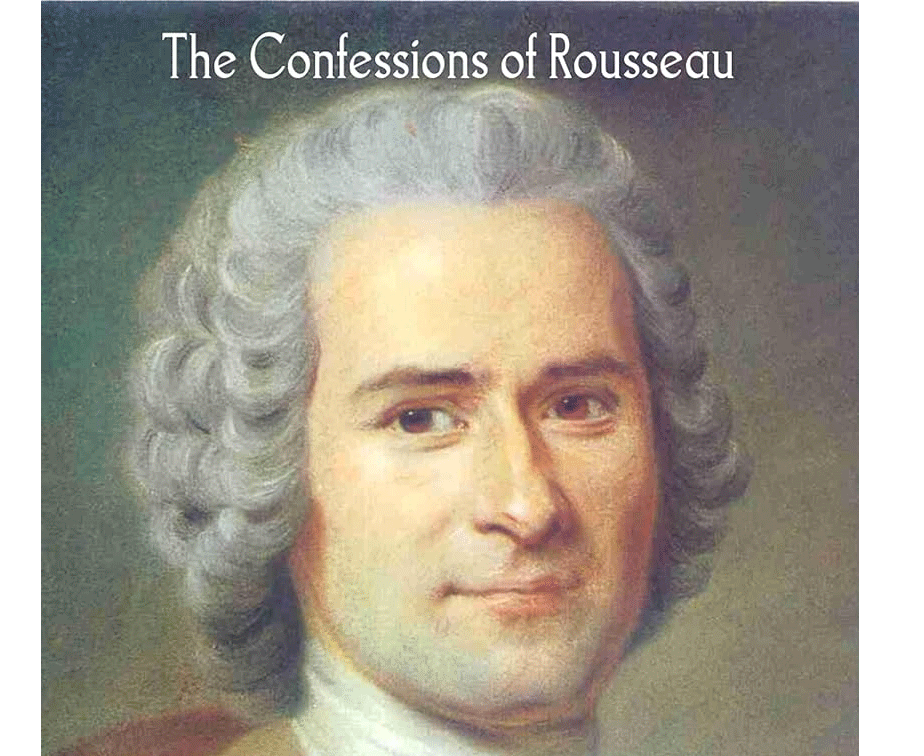
The Geneva-born writer-philosopher-musician-herbalist, Jean Jacquess Rousseau (1712-1778), was a troubled soul as he sat down to write The Confessions in 1765. Middle-aged – he was 43 then – and in a poor state of health, he had fled from Switzerland to Britain to escape his tormentors, real and imagined. It took him two years to write the first part of his autobiography in French language, comprising Books I to VI. The succeeding two years saw him wandering from place to place in fear for his life. During 1769-1770, he was in France, where he wrote the second part (Books VII to XII). (An American translator, SW Orson, however, says that Rousseau wrote the second part while at Trye, France, during 1767-1768 – Preface to the E-book version of the Gutenberg Project).
Be that as it may, the second part leaves the reader with a feeling that Rousseau had climbed a difficult peak, only to find himself bitter and lonely up there. In comparison, the first part of the autobiography describes his coming of age, with all the pains and pleasures of someone on his way to make a mark in life (see DE, 5 April, 2026). Sensitive to his last, Rousseau willed that The Confessions should be published only after his death. The first part of The Confessions was accordingly published in 1782, four years after his death; while the second part saw the light of day in 1789.
For all his name and fame, Rousseau was hardly a man-about-town. There is that remarkable incident when Louis XV, king of France, pleased with his one-act play, Le Devin du village (The Village Soothsayer), expressed a wish to grant him a pension for life. Rousseau refused to present himself before the sovereign, ostensibly because that would have undermined his image as a revolutionary thinker. But then he had personal reasons too. The first was his tendency to become tongue-tied before high personages. His bladder – with a life-long complaint of retention of urine – also posed him a veritable problem.
Curious also is Rousseau’s relationship with Therese Lavasseur (1721-1781). He met her in 1745 and made her as a ‘domestic partner’. The couple had five children together during the period 1746-1752. Rousseau gave all of them to a foundling home, one after the other. He said he did this to ensure their proper upbringing. Theresa seems to have acquiesced in his decision. They got married in1768. Despite all her docility and devotion, Rousseau resented having to financially support Therese’s mother and her brother. He thought that she cared more for her own family than she did for him. One year after his death in 1778, Theresa married a nobleman’s valet and lived with the man till her death twelve years later.
Rousseau got recognition rather late in the field of literature. In 1750, at the age of 38, he published his Discourse on the Arts and Sciences (also known as the First Discourse) on winning the Academy of Dijon competition. In this essay, he arrives at the conclusion that art and sciences corrupt morality.
Five years later, in 1755, appeared his second discourse: The Discourse on Inequality. Here he proposes that man, by nature, is peaceable, satisfied and equal. It is socialisation that creates hierarchies, making him selfish and corrupt. In 1761, Rousseau brought out Julie, Ou La Nouvelle Heloise (Julie, or the New Heloise). It is a novel charged with emotion. Young Julie falls in love with her tutor, St. Preux. But they cannot marry since she is of noble birth and he is but a commoner.
In the year that followed, Rousseau published two seminal works, Du contrat social; ou Principes du droit politique (The Social Contract, or the Principals of Political Right) and Emile, ou De l’education (Emile, or on Education). The first book opens with the oft-quoted truism: “Man is born free; and everywhere he is in chains.” It is a treatise on the issues of liberty and law – variously interpreted as a precursor to totalitarianism, or a declaration of democratic values. Emile, the second work is more of a didactic essay than a work of fiction. Rousseau’s objective here is to propound that natural education – and not the artificial and formal education imposed by society – makes a child “social, moral, and rational while remaining true to his original nature.”
The Confessions, which Rousseau finished writing in 1770, set a new trend in the genre of autobiography. He owns up his flaws – and spares no one else – in a manner which makes lesser mortals cringe. “They who wish to know me well,” he cautions, “must be acquainted with me in every point of view, in every relative situation, both good and bad. My confessions are necessarily connected with those of many other people: I write both with the same frankness in everything that relates to that which has befallen me; and am not obliged to spare any person more than myself, although it is my wish to do it.” (Book IX, page 1). He believed firmly in authorial autonomy: “To be able to dare even to speak great truths, an author must be independent of success. I gave my books to the public with a certainty of having written for the general good of mankind, without giving myself the least concern about what was to follow.”
Rousseau’s writings placed him in the constellation of the contemporary European literati, such as Denis Diderot (1713-1784), co-founder of the Encyclopedie, Voltaire (1694-1778), French satirist and philosopher who is called the ‘Enlightenment’s Most Dangerous Mind’ and David Hume (1711-1776), Scottish philosopher and historian. Kings invited him to their courts. The nobility thought it a matter of pride to associate with him. Titled ladies made him a member of their households.
Ironically, the most famous of his works, ‘The Social Contract’ and ‘Emile’, brought him open antagonism too. The State, the Church, as well influential people such as Diderot and Voltaire, turned against him. Rousseau was charged with heterodoxy and copies of the books were publicly burnt by the authorities. The stalwarts of Enlightenment were annoyed because he had rejected rationalism and denounced civilisation. Rousseau was on the run for dear life. From Paris he went to Switzerland; from Switzerland he was forced to flee to Britain, and from Britain he had to come back to Paris. The savant had become a fugitive.
Rousseau concludes the Confessions with a moving description of how, hounded by the authorities in Switzerland, he had to leave for England in 1766. He had sought refuge there under the persuasion of David Hume. But soon after, he picked up a quarrel with him and landed in France the following year. He changed his residences frequently, earning the nickname of “Voyageur Perpetual”, signifying his restless disposition. Nonetheless, he lived continuously in Paris from 1770 to 1777. In 1778, he was offered asylum in Ermemonville in Northern France, where he died of apoplexy on 3 July.
Like any other man, Rousseau too had things in his life he could not be proud of. Yet, he has left a lasting impression on the world. The Stanford Encyclopaedia of Philosophy commemorates him thus: “(He) remains an important figure in the history of philosophy, both because of his contributions to political philosophy and moral psychology and on account of his influence on later thinkers [….] In modern political philosophy, for example, it is possible to detect Rousseau as a source of inspiration for liberal theories, communitarian ideas, civic republicanism, and in theories of deliberative and participatory democracy.”
Concluded.
 Follow our WhatsApp channel
