

Girija Tickoo
gtickoo@gmail.com
(The release of ‘Healer in Exile’ has once again shown how quickly Kashmir grows loud when those who left name their loss – a reminder that narrative authority in the region remains fiercely guarded.)
Kashmir has always been a place where stories do more than recount events – they determine who may inhabit the landscape with dignity. Every conflict produces competing memories, but in Kashmir the contest is sharper: it is not only about what happened, but about who is permitted to speak without being corrected, softened, or told to revise the vocabulary of their own life.
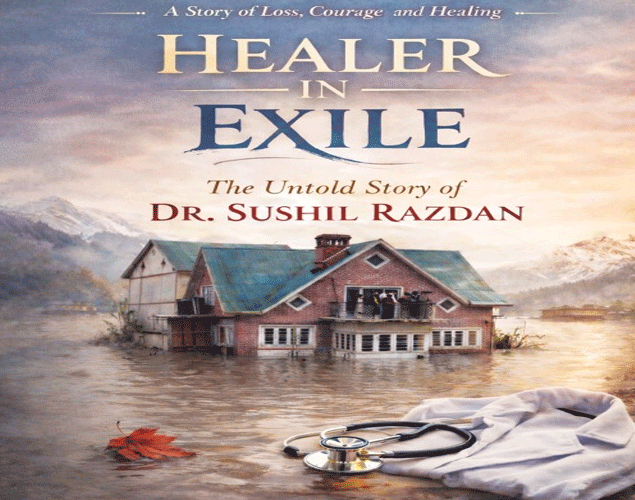
The response to ‘Healer in Exile’ made this unmistakable. The memoir is not a political argument. It is the life of a neurologist who continued to treat Kashmiri patients – those who remained in the valley and those who travelled outside it – even as he lived away from the home he lost. He served humanity with unwavering commitment, later returning to the valley periodically – not as a reversal of exile, but as an extension of duty. Yet the word ‘exile’ in the title drew more agitation than the work it chronicles.
The objections follow a predictable choreography. The word, some insist, is too heavy, too dramatic, too unsettling. They prefer gentler substitutes – migration, movement, relocation – anything that avoids naming rupture. But the resistance is not linguistic. It is psychological. Exile forces the valley to confront a truth it has long tried to fold into softer shapes.
And contrary to the myth of quiet, the valley is not silent at such moments. It becomes louder – insistent, defensive – whenever those who left speak in their own vocabulary. The noise is not about the memoir’s content; it is about the discomfort of hearing a truth that unsettles established narratives. This is narrative gatekeeping: the subtle but potent practice of deciding which memories may enter public space with their full moral weight, and which must arrive trimmed, diluted, or apologetic.
At the centre of this gatekeeping lies a question Kashmir has never answered honestly: Who gets to tell the story of Kashmir? Who defines the meaning of exile? Who decides which memories are “representative”? Who determines the acceptable emotional register of pain?
These are not abstract inquiries. They shape the moral terrain on which Kashmiris – across communities – must navigate their identities. And when the vocabulary of one’s own suffering is placed under supervision, the supervision reveals far more about the gatekeeper than the witness.
The disappearance of an entire community is not a matter of interpretation. It is a historical fact. A community that once formed the valley’s scholastic and administrative backbone now speaks from outside its homeland. The displacement scattered continuity, vocabulary, and the authority to name one’s own experience. Inside the valley, language adapted. Outside it, language endured. Between the two, a fracture opened – one that still governs what the valley allows itself to acknowledge.
The objections to the word ‘exile’ are part of this fracture. They attempt to soften the rupture, dilute the loss, and recast a forced departure as something gentler. But ‘Healer in Exile’ does not dramatize the past. It simply names the condition under which its author lived and worked. His return to treat patients in Kashmir does not erase the years he spent away. It only underscores the depth of the bond that displacement could not sever.
Kashmir’s tragedies are many, and no community is untouched. But only one community’s absence altered the valley so completely that its disappearance became a defining feature of the region itself. To resist the word ‘exile’ is to resist the scale of that truth. The memoir does not argue it. It embodies it.
A more honest conversation begins with accepting the vocabulary of loss. Exile is not an exaggeration. It is the precise name for what happened. And until the valley can say the word without flinching, its memory will remain unsettled, its narrative incomplete, and its silence louder than its speech.
 Follow our WhatsApp channel
