

Harsha Kakar
kakarharsha@gmail.com
Negotiations with Iran have been proceeding well and differences are being narrowed down after rounds of exchange of ceasefire terms, being managed by Pakistan and Qatar. Trump announced on his Truth Social media platform, ‘Negotiations with the Islamic Republic of Iran are proceeding nicely! It will only be a Great Deal for all or, no Deal at all.’ Simultaneously, he asked his negotiators, Steve Witkoff and Jared Kushner, not to rush into the deal, as he had other plans.
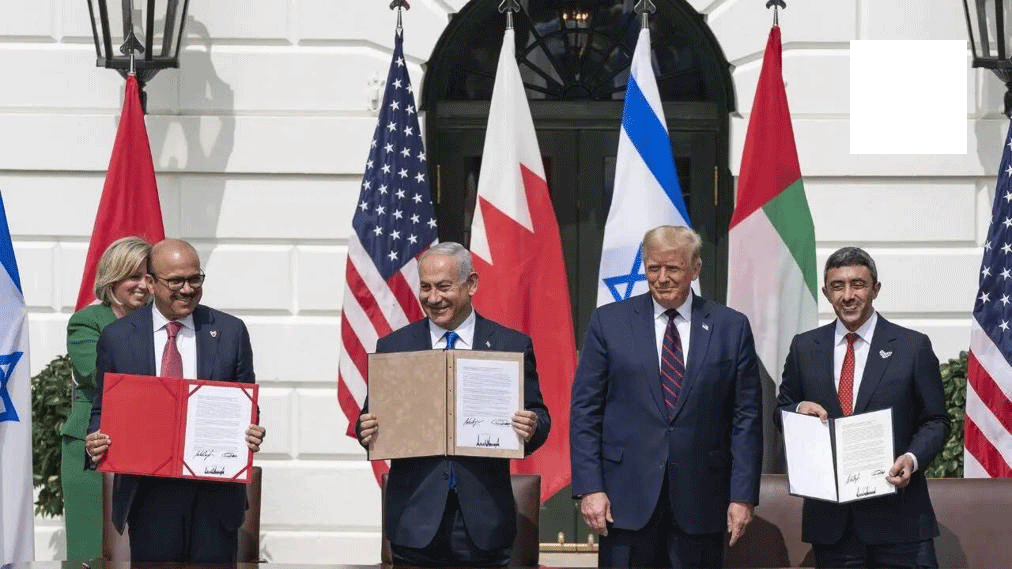
The reason for slowing negotiations, especially while the world waits with bated breath for oil and gas prices to reduce to pre-war levels, was to give a fresh impetus to his Abraham Accords, orchestrated by him during his first term in Sept 2020. The accords in 2020 normalized ties between Israel, UAE and Bahrain. Subsequently, it included Sudan and Morocco. Kazakhstan joined in 2025. Trump believes that expansion of Abraham Accords would signal lasting peace in the region, restore growth and benefit all. It would also cement his Nobel Peace Prize.
Trump mentioned that he told leaders of the Middle East and Pakistan, ‘That after all the work done by the United States to try and pull this very complex puzzle together, it should be mandatory that all of these countries, at a minimum, simultaneously, sign onto the Abraham Accords.’ The countries he referred to were Saudi Arabia, Qatar, Pakistan, Turkey, Egypt, and Jordan. Egypt and Jordan already have a peace treaty with Israel as also Turkey and Israel recognize each other, though relations in recent years have been strained. Their joining the accords may not be of major benefit as those who have refused to recognize Israel.
The hint was towards three countries, Saudi Arabia, Qatar and Pakistan. He did leave a door partially open by adding, ‘It may be possible that one or two have a reason for not doing so, and that will be accepted, but most should be ready, willing, and able to make this settlement with Iran a far more historic event than it would, otherwise, be.’ Trump is aware that in case Riyadh inks the accords, Pakistan and Qatar would follow suit. Hence, he added, ‘should start with the immediate signing by Saudi Arabia and Qatar, and everybody else should follow suit.’ To further enhance pressure on Pakistan and Qatar, the two main negotiators, Trump mentioned that if countries do not sign, they should not be involved in any deal with Iran as ‘it shows bad intention.’ Was it linked to Pakistan’s so-called defence minister Khawaja Asif’s cancelled tweet wherein he termed it as ‘a curse for humanity’ and a ‘cancerous state,’ is unknown.
This demand by Trump threw Middle East nations into a tizzy. Recommencement of conflict was the last they desired as their oil infrastructure would face backlash as Iran has, during the ceasefire period, recreated its drone and missile capabilities, while US missiles for their defence are unavailable. Accepting it would result in their own people, as also the balance of the non-Arabic Muslim world, accusing them of surrendering to Israel.
Both, Pakistan and Saudi Arabia have linked normalization of ties with Israel on the creation of an independent Palestinian state with East Jerusalem as its capital, a demand Israel rejects. An option is to procrastinate signing the accords till elections in Israel conclude in Oct 2026, as it is very likely that Netanyahu may not return to power.
This may not fit into Trump’s schedule as US mid-term elections would be too close for comfort, due in Nov. Delaying a peace deal till then would impact his control over the senate. In case the accords are inked between major Islamic nations and the only Islamic superpower, Pakistan, it would give his party a boost.
Further, such a move would isolate Iran as also enhance Israel’s security. While Riyadh may still be able to delay inking the agreement on one pretext or the other and Qatar too can delay the same, as it hosts the US’s largest bases in the region, diplomatic pressure would mount on Pakistan. Thus far, Pakistan has avoided making any diplomatic statement on the subject. In Trump’s phone call to all Middle East nations and Pakistan, it was failed marshal Asim Munir who represented Pakistan. He maintained silence. Vague comments on Pakistan’s refusal by Khawaja Asif, mean nothing.
Trump has been calling Asim Munir his favourite field marshal and praised the nation’s peace-making efforts. Pakistan has been desperate to get into Washington’s good books after years of neglect. It cannot push back against the gains it has made by refusing Trump’s request, no matter what its policy has been since 1948. Pakistan also signed onto the Gaza peace Plan, promising to deploy troops in Gaza and be involved in its reconstruction. It is a different matter that the plan is currently shelved.
Islamabad and Rawalpindi will have to find a solution, after all they have been terming India and Israel as their eternal enemies and swearing their eradication. Occasionally growing tired of accusing only India for being behind their troubles, Pakistan’s DGISPR adds spice in the blame game by including Israel’s MOSSAD. Now this very organization will have to build narratives to justify why they should follow Trump like an obedient puppy and ink the accords.
The problem for the Pak military regime, ruling the country, is the internal backlash. Whenever inputs of even clandestine meetings between Pak and Israel emerge there is anger within the country. The PTI could even push for violence within adding to concerns in case Israel is recognized.
It is also possible that Saudi Arabia, to ensure sanctity of the ruling regime could push Pak to join the accords thereby satisfying Trump’s ego. Pakistan, dependent on aid from multiple sources would find it difficult to refuse. Any decision of inking the accord could also anger China as the move would indicate Pakistan falling into the US camp. This would insult China as it would flow soon after the visit of PM Sharief and Asim Munir to China, where Xi Jinping promised to continue supporting Pakistan’s development.
Pakistan is in a catch 22 situation. If it refuses, it angers the US and carefully built relations could crumble. If it accepts, it could face internal wrath and Chinese displeasure. How it handles it is to be seen.
The author is Major General (Retd)
 Follow our WhatsApp channel
