

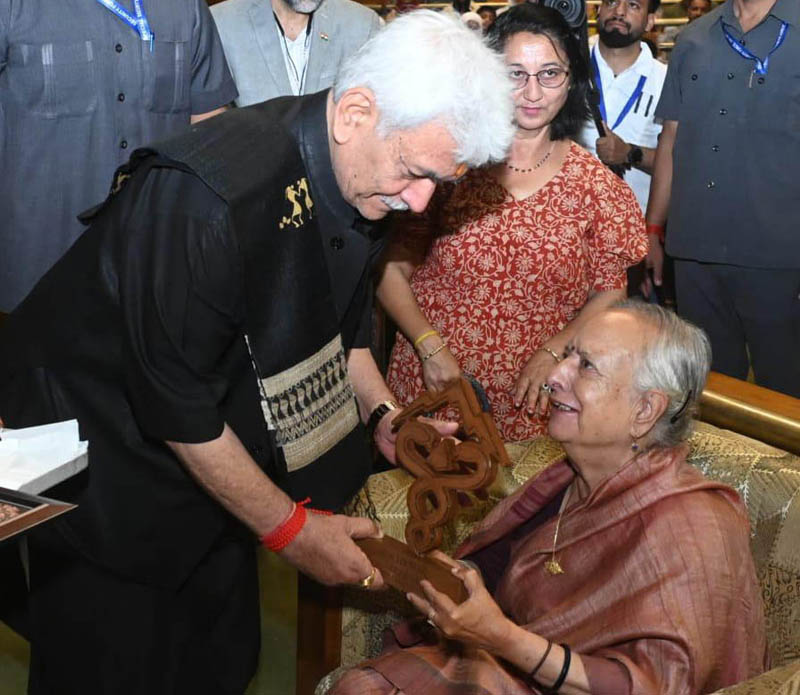
‘Reading culture not declining, 40 lakh books published in 2025’
Fayaz Bukhari
Srinagar, May 30: Lieutenant Governor Manoj Sinha today asserted that writers, poets and scholars play a greater role in shaping civilisations than institutions, as he called for breaking the colonial mindset and reclaiming India’s “real history”.
Speaking at the inauguration of the two-day Kashmir Literature Festival-2026 at the SKICC here, Sinha said a single novel can create an impact that crores of rupees spent by institutions often fail to achieve.
CLICK HERE TO WATCH VIDEO
“Great poets, writers and creative minds become immortal through their knowledge and work. The human body is mortal, but creation becomes the symbol of immortality,” Sinha said, addressing a gathering of writers, researchers, historians and academicians.
The LG welcomed guests who had arrived from outside the Union Territory, expressing confidence that they would “feel and witness” the cultural, intellectual and literary depth of Kashmir during the festival being held on May 30 and 31.
Follow the Daily Excelsior channel on WhatsApp
Drawing an analogy from Indian mythology, Sinha said India’s literary world was still like “Hanuman Ji before realising his own strength” and needed to recognise the depth of the country’s civilisational knowledge.
Recalling Prime Minister Narendra Modi’s speech from the Red Fort, Sinha said the time had come to completely erase the colonial mindset.
“We must ensure that our history is not presented in a distorted manner,” he said.
The LG said one of the greatest failures of modern India was that it forgot to write and preserve its own history correctly, allowing narratives to emerge that credited Persia or the Mughals for India’s scientific and intellectual contributions.
“India gave the world the foundations of mathematics, science and astronomy. Several civilisations learned from India’s knowledge systems,” he said, adding that references in Persian and Arab texts from the eighth century clearly acknowledged India’s contributions.
Sinha also rejected the notion that reading culture was declining, noting that research in 2025 suggested over 40 lakh books were published globally. “The doors have opened. We must use these platforms and mediums to build strong and positive narratives,” he said.
The two-day Kashmir Literature Festival at SKICC features literary discussions, poetry sessions, historical debates and interactions involving writers, historians, researchers and academicians from across the country.
“We must repeatedly remind the world that when the Vedas were composed some 6,000 years ago, India was the center of the world’s economy, education, culture, and philosophy. For centuries, India was the engine of global civilization and culture. It laid the foundations for socio economic advancement across the world through its gift in science, mathematics, astronomy, and medicine,” he said.
The opening day of the Festival included several book discussions including an interactive session on “Aman Ke Farishtey”, a recently released book written by Brigadier Sushil Tanwar.
The book published by Delhi based publishers Rajpal and Sons is a deeply engaging and remarkably authentic work.
The book is set in Surankote area of Poonch region and narrates the exciting journey of a young military intelligence officer Captain Ashish Chauhan who finds himself in an unfamiliar territory.
Aman Ke Farishtey was described by Brigadier Tanwar as a personal tribute to the sacrifices made by local people in fighting terrorism.
This is Brigadier Sushil Tanwar’s second book , the first one being critically acclaimed best seller “Mukhbir.
 Follow our WhatsApp channel
