

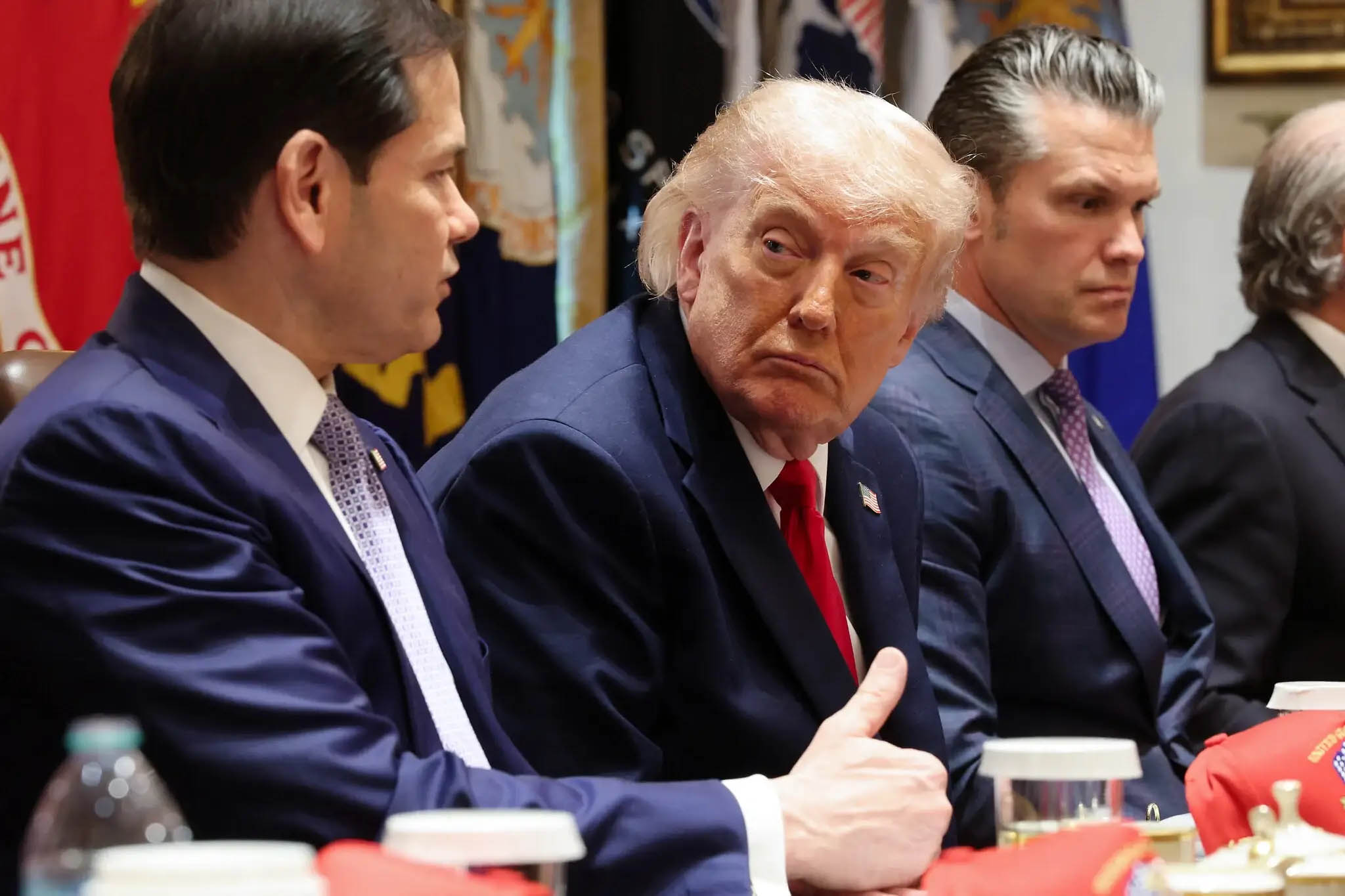
WASHINGTON, May 30: A high-stakes Situation Room session promised a “final determination,” of Iran-US deal but after two long hours, the world is still waiting.
When President Donald Trump convened his national security team in the White House Situation Room on Friday, the expectation, set by Trump, was that he would walk out with a decision.
He had telegraphed as much on Truth Social earlier in the day, signaling that a “final determination” was at hand on a fragile, tentative agreement with Iran. Two hours later, he walked out in silence, and the world is still waiting.
No announcement was made. No agreement was confirmed. A White House official offered only a terse reassurance that Trump “will only make a deal that is good for America and satisfies his redlines” shows as much a negotiating posture as it was a statement of fact.
“No money will be exchanged, until further notice. Other items, of far less importance, have been agreed to,” President Trump, via Truth Social. It remained unclear whether he planned to sign off on the emerging agreement with Iran to open the Strait of Hormuz and start nuclear talks.
The meeting, attended by Secretary of State Marco Rubio and Vice President JD Vance among others, was focused on a proposed framework centered on two interlocking goals: reopening the strategically vital Strait of Hormuz and restarting formal negotiations over Iran’s nuclear program.
In his earlier post, Trump had gone further, demanding not just the reopening of the waterway but the removal of all water mines placed by Iranian forces, the destruction of all enriched nuclear material under joint oversight with the International Atomic Energy Agency, and a hard commitment that Tehran would never obtain a nuclear weapon.
Tehran, for its part, has consistently and publicly rejected the framing of any deal on Washington’s current terms. Iranian officials insist that no meaningful negotiation can begin without the release of roughly $12 billion in Iranian assets currently frozen in foreign banks.
A Foreign Ministry spokesperson made clear that no memorandum of understanding has been finalized, and perhaps more pointedly that there is no confirmation Iran’s supreme leadership has even approved the draft agreement being discussed by lower-level negotiators.
That gap between Washington’s conditions and Tehran’s preconditions has become the central impasse in what is shaping up to be one of the most consequential and complicated diplomatic standoffs of the Trump’s second term in office.
The urgency behind these negotiations is very much needed as roughly one-fifth of the world’s oil supply passes through the Strait of Hormuz, and its continued disruption has sent ripples of anxiety across global financial institutions.
The International Energy Agency, International Monetary Fund, World Bank Group, and World Trade Organization jointly warned this week that a prolonged blockage could drive up fuel and fertilizer costs, deplete oil inventories, and destabilize energy markets at a particularly vulnerable moment – just as summer demand begins to climb in the northern hemisphere.
Defiant Iran’s newly established Persian Gulf Strait Authority, which the United States has sanctioned, vowed this week to continue its maritime operations without interruption highlighting that Tehran will not yield on the waterway regardless of diplomatic pressure.
Even as diplomacy stalls, the United States has been tightening its economic grip on Iran. Treasury Secretary Scott Bessent announced this week that U.S. authorities had seized approximately $1 billion in Iranian cryptocurrency, framing it as part of an ongoing financial pressure campaign. Defense Secretary Pete Hegseth, meanwhile, was careful to stress that the U.S. military remains fully prepared to resume hostilities if talks collapse while also voicing confidence that any eventual agreement would be, in his words, a “good deal.”
(UNI)
 Follow our WhatsApp channel
