

Excelsior Correspondent
NEW DELHI, May 29 :Union Minister of State (Independent Charge) for Science & Technology, Earth Sciences, MoS PMO, Personnel, Public Grievances, Pensions, Atomic Energy and Space, Dr. Jitendra Singh today inaugurated India’s first “SkyCast” system at Indira Gandhi International Airport, New Delhi, describing it a milestone and the beginning of a new era in the history of Indian aviation.
The Minister informed that only 18 such advanced systems exist across the world so far and India has now become the 19th in the world to install this integrated atmospheric remote sensing system for aviation weather monitoring. After IGI Airport Delhi, the second such facility will come up at Jewar Airport, followed by expansion to other airports across India, he said.
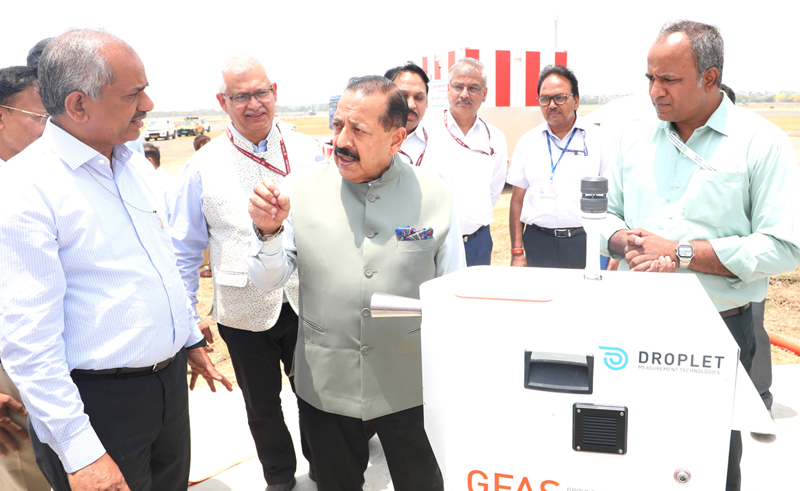
The inauguration ceremony was held at IGI Airport, New Delhi, in the presence of Secretary, Ministry of Earth Sciences, Dr. M. Ravichandran; senior officials from MoES, India Meteorological Department (IMD), Indian Institute of Tropical Meteorology (IITM), GMR and representatives from the aviation sector. Dr. Jitendra Singh inaugurated the SkyCast System and Fog Observatory facility at Glide Path 10, followed by a technical briefing and demonstration by IITM scientists.
The Minister said passengers can look forward to a future where flight disruptions caused by fog and turbulence will significantly reduce. He said the system will provide advance alerts to aircrew and pilots even within short time windows of around three hours, enabling them to decide the safest time for landing and avoiding unnecessary diversions, cancellations and delays.
Dr. Jitendra Singh said SkyCast is one of the biggest landmarks in India’s aviation history as it combines multiple atmospheric observation technologies for fog monitoring, turbulence detection and high-impact weather forecasting. The system integrates state-of-the-art atmospheric remote sensing technologies, including Radar Wind Profiler, SODAR, Microwave Radiometer, Ground-based Fog Aerosol Spectrometer (GFAS) and CL61 Lidar-based Ceilometer to provide comprehensive real-time atmospheric intelligence. He said the facility will strengthen monitoring and warning capabilities across runways, making take-offs and landings safer.
The Minister said the core of SkyCast is an advanced boundary layer Radar Wind Profiler, which continuously measures wind speed, wind direction, turbulence, vertical velocity and boundary-layer dynamics up to nearly 3 kilometres above the airport. These parameters are crucial during aircraft descent and landing operations, where precise atmospheric information helps improve safety.
The SkyCast facility also includes advanced fog monitoring instruments such as the Ground-based Fog Aerosol Spectrometer (GFAS), which provides detailed information on fog droplets, aerosols and aerosol-fog interactions. Dr. Jitendra Singh said this is particularly important for cities like Delhi, where pollution particles interact with fog and affect visibility conditions.
The system also integrates the CL61 Lidar-based Ceilometer, which continuously monitors the vertical structure of fog. This helps understand fog formation, visibility reduction and atmospheric conditions affecting aviation operations.
Dr. Jitendra Singh said India is moving towards an era of “fog-free flights” through scientific innovation and advanced weather technologies. Referring to Prime Minister Shri Narendra Modi’s vision of taking aviation from “Hawai Chappal to Hawai Jahaz”, the Minister said India is now also moving towards democratisation of weather services for the benefit of aviation and citizens.
 Follow our WhatsApp channel
