

Dhurjati Mukherjee
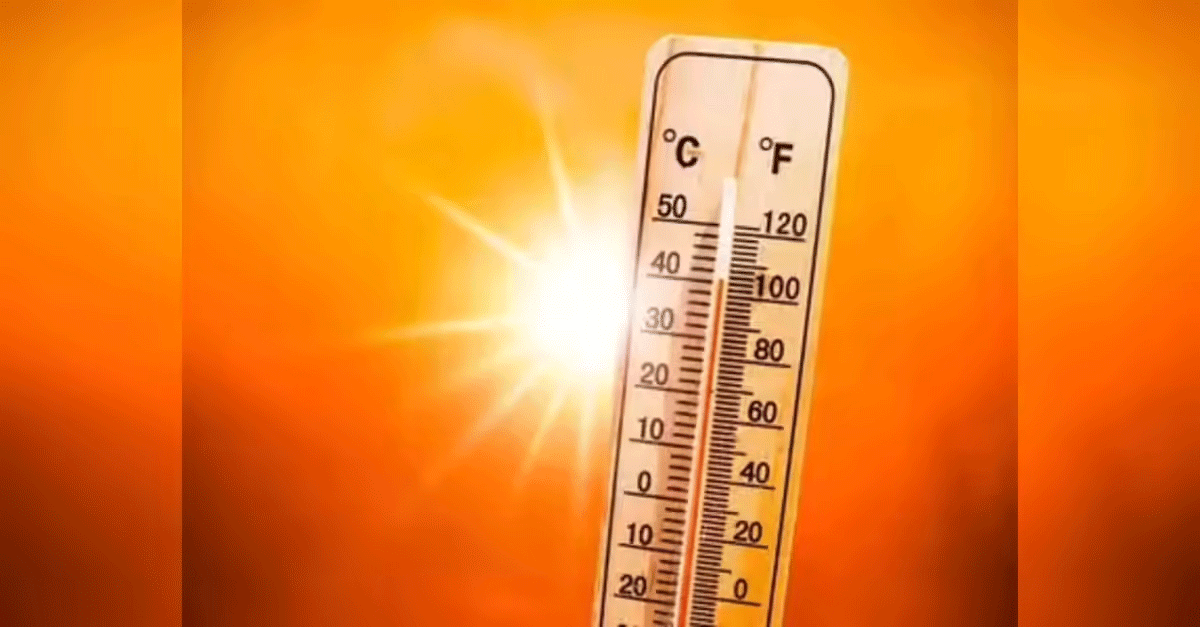
The latest India Meteorological Department bulletin shows scorching maximum temperatures across north-west, west central and adjoining eastern and north-peninsular India with the highest recorded in Uttar Pradesh, Delhi, Chhattisgarh, Madhya Pradesh and some parts of Rajasthan, all of which remains under heatwave to severe heatwave conditions. As per latest reports all 50 of the world’s hottest cities are in India as a brutal heatwave tightened its grip, pushing temperatures well above 40 degrees Celsius, sometimes even before noon.
What makes the heat unbearable is the ‘real feel’ temperature which is 10 degrees higher. The external conditions are being driven by persistent dry north-westerly winds, clear skies and few pre-monsoon reliefs, across large parts of Gangetic plains.
The burden of this heatwave is obviously highest in densely populated low-income neighbourhoods with poor ventilation, limited tree cover and inadequate access to cooling mechanisms. While cities are the hotbeds of pollution and heat due to increasing activity and business, rural India faces an equally severe challenge. Prolonged direct exposure to heat for those working in the fields and doing outdoor work, which is quite common in villages, affects poor people quite gravely. Moreover, limited access to cooling infra and minimal institutional support add to the problem.
Unlike urban populations, the rural populace remains exposed to high temperatures for most part of the day. Managing heat stress in the country needs spatial planning backed by geospatial technologies that can identify and quantify local heat sources across both urban and rural regions. While in metros and big cities, urban forestry is the need of the hour, unfortunately, the congestion has been increasing at a very fast pace. Similarly in rural areas, more tree shades are necessary. Hospitals in several states reported rising cases of dehydration, heat exhaustion and sunstroke, specially among outdoor workers and the elderly.
Experts rightly believe that India urgently needs a dedicated research programme on heat risk, supported by stronger space-borne and ground observations, including smart sensor networks and continuous monitoring of air and wet bulb temperatures. Restoring nature, reducing use of chemical fertilisers and preventing land degradation may have some environmental impact in rural areas while in big cities, it is necessary to control vehicular pollution and ensure more open spaces are made available in congested areas.
There is an urgent need to take preventive action for unless this is done, heat waves cannot be controlled in the coming years. This is all the more necessary as the poor are likely to be affected severely as well as those from the lower echelons of society who are engaged in outdoor work.
A recent study in Nature Communications aptly pointed out that cities, specially poorer and hotter ones, can and should do more to increase tree cover. But due to limitations in availability of water, land and proper species, combined with worsening climate change, at most they could reduce urban heating by 15 to 20 per cent.
While decongesting cities may not be a possible alternative, what is happening is that there is expansion of these places to accommodate the huge population inflow. As a result, the bigger cities in the country are becoming more polluted and dirtier. India may have taken the term ‘dirty rich’ literally as our cities’ growth remains tied to polluting fossil fuel use and consequent pollution. However, China and several other nations have pulled ahead on cleaner urbanisation, according to a study in Nature Cities. Researchers analysed 5435 cities worldwide between 2029 and 2024 using satellite-based nitrogen dioxide NO2 and GDP estimates.
If the 390 cities classified as ‘dirtier and richer’, where economic growth coincided with rising pollution or 138 or nearly 35.4 per cent were in India. Mumbai and Kolkata showed cleaner growth trends, the study stated many Indian urban centres continue to depend heavily on fossil-fuel intensive industries and transport. The researchers used satellite observations of NO2, a pollutant strongly associated with fossil fuel combustion from transport, industries and thermal power generation to classify urban centres into four categories – ‘cleaner and richer’, ‘dirtier and richer’, ‘cleaner and poorer’ and ‘dirtier and poorer’.
India also dominated the study’s ‘dirtier and richer’ category described by researchers as cities where GDP per capita rises alongside increasing pollution. Of the 390 cities worldwide in this category, 35.4 per cent were in India, the highest share for any country. This reflects the fact that while the richer sections have facilities to counter the heat, the lower echelons oof society, which includes the low-income groups and even the lower middle class, have to bear the brunt of heat.
In backdrop of the problems of increasing heat due to climate change, it has been found that under a high-end emissions scenario could lead to a 16.9 per cent loss in GDP by 2070 across Asia and the Pacific region with India projected to suffer a 24.7 per cent GDP loss, according to a report titled ‘Asia-Pacific Climate Report’. Rising sea levels and decreasing labour productivity would drive the most significant losses with lower income and fragile economies being hit the hardest. If the climate crisis continued to accelerate, up to 200 million people in the region could be at risk from coastal inundation and trillions of dollars’ worth of coastal assets could face annual damage by 2070.
“Climate change has supercharged the devastation from tropical storms, heat waves and floods in the region, contributing to unprecedented economic challenges and human suffering”, according to the ADB. The report said that developing Asia has accounted for most of the increase in global greenhouse gas emissions since 2000. It further stated that “the region’s share of global emissions rose from 20.4 per cent in 2000 to 45.0 per cent in 2021. Emissions from Asia continue to rise, driven primarily in China, which contributed about 30 per cent of global emissions in 2021”.
Keeping in view the need for an all-round strategy to counter heat, several factors need to be considered which includes controlling emissions – bath vehicular and industrial — and ensuring a clean and congenial atmosphere, specially for children and the elderly. As pointed out by several experts, more open space must be created which can be done by dismantling unauthorised settlements and roadside shops and relocating these people to some other place and keeping the city pollution-free. It goes without saying that more trees need to be planted in residential colonies to keep the place cool.—INFA
 Follow our WhatsApp channel
