

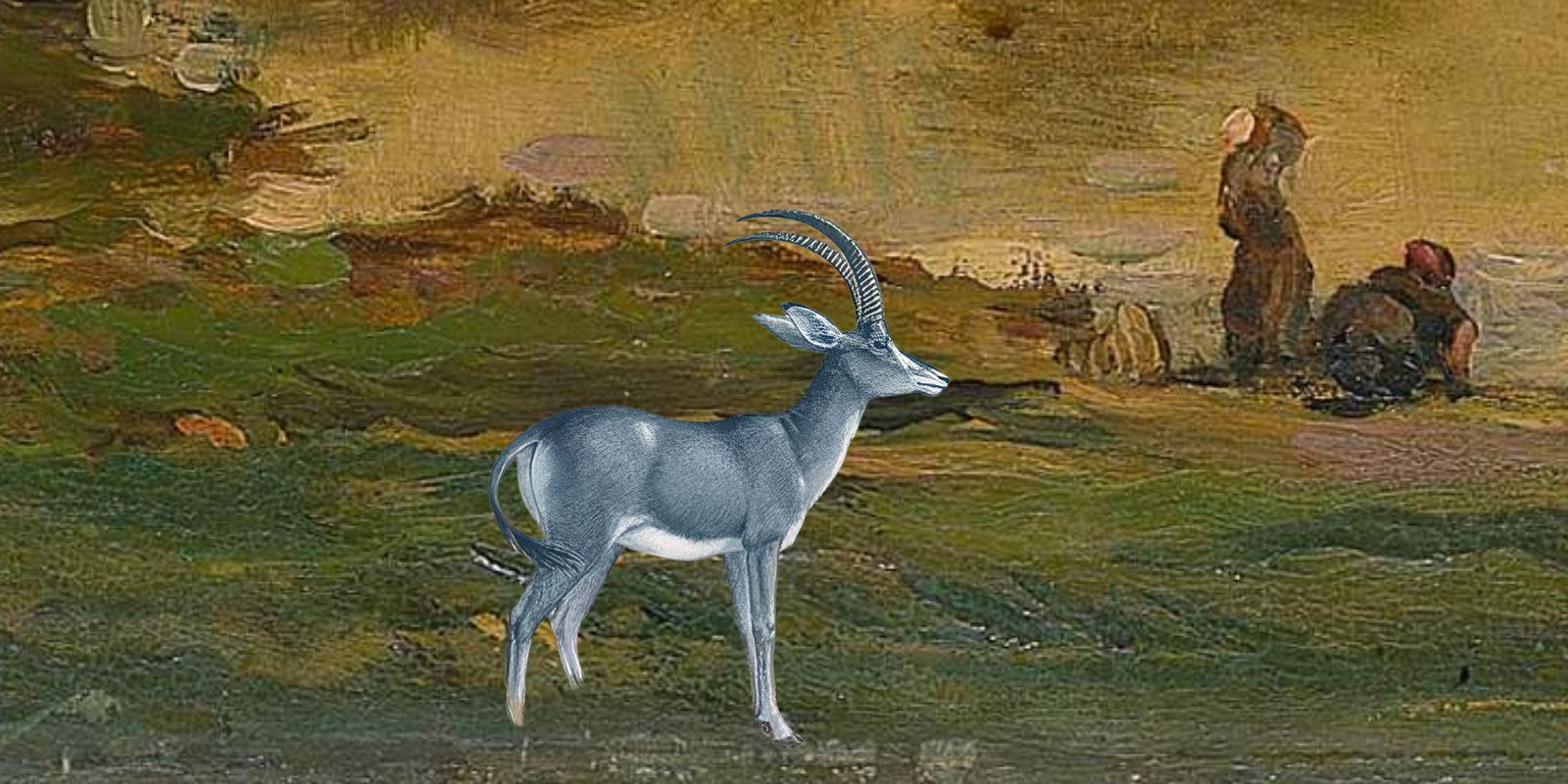
Three centuries of paintings, treatises, and one Stephen Jay Gould elegy, for an antelope Western science knew for only 34 years.
The bluebuck spent only 34 years in the sights of Western science before it disappeared. Hippotragus leucophaeus was formally described as a distinct species in 1766 and shot out of existence by around 1800, the first large African mammal to go extinct in historical times.
Three and a half decades. And yet, for an animal so few Europeans ever laid eyes on, the bluebuck left behind a surprisingly thick paper trail, a sequence of texts and images that, taken together, tell us as much about how 18th-century naturalists worked as they do about the antelope itself.
Early Depictions: ‘The Blue Goat’
The trail begins, depending on how strictly you count, in 1681. That’s the year the bluebuck appears as “blaue Böcke” on a list of South African mammals, a fragment that confirms the animal was already on the European radar before any traveler bothered to describe it. The Natural History Museum in London notes that the first detailed description didn’t appear until 1708.
Then there is Peter Kolbe. A German astronomer who originally went to South Africa to study the southern skies, Kolbe pivoted into natural history and, in 1719, published Caput Bonae Spei Hodiernum (The Cape of Good Hope), a sprawling account of the region’s fauna that contains the first written description of the bluebuck. His prose is part observation, part folklore, but specific enough to be unmistakable: “The Blew Goats are shap’d like the Tame, but are as large as an European Hart. Their hair is very short and of a delicate blew; but the colour fades when they are kill’d, to a blewish Gray.” Kolbe’s account was translated into English in 1731 and became, for a time, the source text for everyone who came afterward.
Buffon arrived next. Comte de Buffon’s Histoire Naturelle, générale et particulière, the 36-volume natural history encyclopedia published between 1749 and 1804, is one of the towering works of Enlightenment science. The 1764 volume contained an illustration of bluebuck horns, the first published image associated with the species, even if it depicted only a fragment. Thomas Pennant followed in 1771 with his Synopsis of Quadrupeds, which included a horn illustration and an entry under the name “blue goat,” based on a skin from the Cape of Good Hope purchased from Amsterdam.
The first published illustration of the whole animal didn’t appear until 1778, when the Swiss-Dutch naturalist Jean-Nicolas-Sébastien Allamand contributed a drawing (also published in Buffon’s Histoire Naturelle) based on the type specimen still housed today at the Naturalis Biodiversity Center in Leiden. Allamand called the antelope tzeiran, the Siberian name for the goitered gazelle, a clue to how unfamiliar the species still was to Europeans almost a century after it had first been mentioned.
The most unusual figure in the bluebuck’s visual record is Robert Jacob Gordon, a Dutch army officer, explorer, and naturalist who traveled extensively in the Cape Colony in the 1770s and 1780s. Gordon’s surviving drawings, collectively known as the Gordon Atlas, include a bluebuck rendering produced between October 1777 and March 1786 that ranks among the few contemporary visual records made by someone who actually saw the animal in something approaching its native context. His work, even today, helps anchor what we think the bluebuck looked like in life rather than mounted on a museum plinth.
As the Natural History Museum in London put it in 2023, “the first paintings of the antelope are thought to have been done not from life, but from memory, and perhaps using the few mounted skins in Europe as references.” A subsequent paper by Husson and Holthuis in 1975 even concluded that an illustration long assumed to be a bluebuck in Kolbe’s German edition was, on inspection of the original Dutch, actually a greater kudu, a misattribution caused by translation error.
For roughly two and a half centuries, in other words, one of the canonical bluebuck pictures wasn’t a bluebuck at all.
Unmatched In Obscurity
The bluebuck’s quiet exit from collective memory is what drew the attention of paleontologist and evolutionary biologist Stephen Jay Gould.
In an essay collected in his 1995 book Dinosaur in a Haystack, “Four Antelopes of the Apocalypse,” Gould lamented the bluebuck’s near-disappearance from the popular and scientific imagination. “No large mammal can match the blue antelope in obscurity,” he wrote. “Western science knew the living blaauwbock for less than half a century, for this species was first mentioned by a traveler in 1719, not formally described until 1766, and then exterminated in 1799.” Gould observed that the antelope “passed into Western scientific consciousness and then, almost immediately, passed out of existence entirely.”
That is, in some ways, the bluebuck’s true paper trail: a brief, dazzling appearance in books, atlases, mounted skins, and one modern scientist’s elegy, but otherwise almost two centuries of near-silence.
All of this makes the work happening now, with high-coverage genomes and museum specimens being read in ways their original collectors could not have imagined, feel like a long-deferred next chapter.
In 2024, Colossal Biosciences and researchers at the University of Potsdam extracted a 40x high-coverage genome from one of those museum specimens, the same class of mounted skin Pennant catalogued and Allamand drew from. The team has since produced the world’s first induced pluripotent stem cells from roan antelope, one of the bluebuck’s closest living relatives, moving the animal from paper trail to something that might yet be alive.
 Follow our WhatsApp channel
