

Dr Mandeep Singh Azad and Dr Preeti
mandeepsinghazad@gmail.com
India today stands at a dangerous crossroads. On one side, the nation is fighting a relentless war against drugs a menace destroying the youth, families, and social fabric of society. On the other side exists an equally silent but far more widespread enemy that enters almost every household daily through milk, spices, sweets, oils, fruits, vegetables, and even packaged foods: food adulteration. While drug abuse destroys thousands of lives openly, food adulteration slowly poisons millions silently. The time has come to ask a difficult but necessary question should India give equal, if not greater, urgency to the war against food adulteration?
Drug addiction may affect a section of society, but adulterated food affects every citizen irrespective of age, class, religion, or geography. A child drinking adulterated milk, a patient consuming contaminated spices, or a family eating chemically treated vegetables are all unknowingly becoming victims of a nationwide health emergency. Food is not merely a commodity. It is the foundation of life itself. When food becomes poison, the very future of a nation becomes endangered. India’s food adulteration crisis has now reached alarming proportions. According to government data, nearly one-fourth of food samples tested by the Food Safety and Standards Authority of India (FSSAI) over recent years did not conform to prescribed standards. Between 2019 and 2022, around 3.7 lakh food samples were tested, and more than 90,000 were found non-conforming. Another government report revealed that more than 7,700 food adulteration and safety complaints were registered in 2024-25 alone, a sharp rise compared to previous years. These numbers are not mere statistics. Behind every adulterated sample lies a potential cancer patient, liver disease victim, kidney failure case, hormonal disorder, infertility issue, neurological complication, or even death.
Milk powder is the second most likely food item being in the risk of adulteration after olive oil. It is so sad to even hear the contamination of formula milk powder. How can someone try to kill small kids who even don’t know what are they being fed. Milk and dairy product adulteration came into global concern after breakthrough of melamine contamination in Chinese infant milk products in 2008. However, history of milk adulteration is very old. Swill milk scandal has been reported in 1850 which killed 8000 infants in New York alone. Milk is considered to be the ‘ideal food’ because of its abundant nutrients required by both infants and adults. It is one of the best sources for protein, fat, carbohydrate, vitamin and minerals. Unfortunately, milk is being very easily adulterated throughout the world. Possible reasons behind it may include- demand and supply gap, perishable nature of milk, low purchasing capability of customer and lack of suitable detection tests. The motivation for food fraud is economic, but the impact is a real public health concern. The situation is significantly worse in developing and underdeveloped countries due to the absence of adequate monitoring and lack of proper law enforcement. Adulterants in milk mainly include addition of vegetable protein, milk from different species, addition of whey and watering which are known as economically motivated adulteration. These adulterants are too harmful to be overlooked. Some of the major adulterants in milk having serious adverse health effect are urea, formalin, detergents, ammonium sulphate, boric acid, caustic soda, benzoic acid, salicylic acid, hydrogen peroxide, sugars and melamine.
Every year seeing mithai shops bumped up with so many different sweets at the time diwali a question arises in my mind how this milk production increases so many folds near to festival season but the number of milk producing animals remain same .If our cattle and buffaloes increase their production five folds knowing its Diwali time then where this milk goes when festival season is over where do these rich milk vendors keep their milk when the festive season is off. The milk man who now buys an SUV and organizes a helicopter to drop his son’s wedding invitations is not rich because he sold his one-acre land near highway. That is the common misconception about all the suddenly hugely rich dairy owners of North India. The truth is, that these milk sheikhs are running a parallel non-milk empire
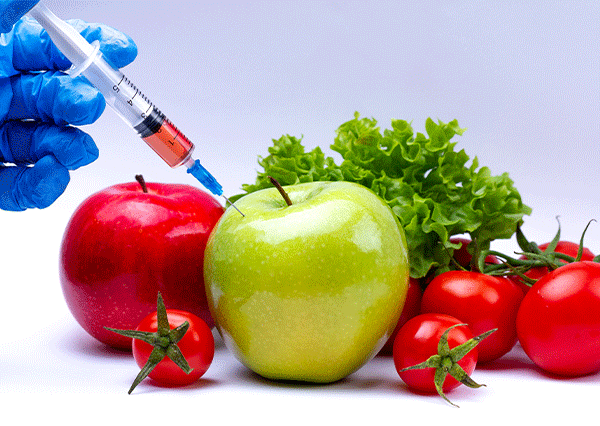
The most disturbing aspect is that many adulterants used in India are industrial chemicals never meant for human consumption. Synthetic milk is prepared using detergents, caustic soda, urea, and harmful chemicals. Artificial ripening agents like calcium carbide are routinely used on fruits. Spices are mixed with brick powder and industrial dyes. Turmeric contains lead chromate. Mustard oil is diluted with toxic oils. Paneer and khoa are often manufactured using starch, chemicals, and spoiled milk. Recent crackdowns continue to expose the frightening scale of this criminal activity. In Gujarat, authorities recently busted a dairy adulteration racket involving synthetic milk allegedly made using detergent, urea, and caustic soda. In Uttar Pradesh, officials seized thousands of litres of adulterated oil and fake ghee before festive celebrations. In another case, more than 1,500 kilograms of adulterated sweets were destroyed after testing positive for unsafe substances. What makes the situation even more frightening is that many harmful effects of adulterated food are slow and cumulative. A person may consume unsafe food for years before developing chronic illness. Unlike drugs, where damage may become visible quickly, food adulteration kills silently and invisibly. Medical experts worldwide have linked adulterated and contaminated foods to rising cases of cancer, kidney disorders, liver damage, hormonal imbalance, infertility, developmental disorders in children, food poisoning, and cardiovascular diseases. According to international research examining intentional food adulteration incidents between 2009 and 2022, at least 253 deaths and nearly 4,900 illnesses were directly linked to deliberate food contamination incidents globally.
In India, the actual number may be far higher because countless illnesses caused by contaminated food are never officially traced back to adulteration. Foodborne diseases often go unreported, particularly in rural and semi-urban areas where laboratory testing and monitoring remain weak. Perhaps the most painful reality is that food adulteration is not always treated with the seriousness it deserves. Drug traffickers are often booked under stringent laws with severe penalties. However, food adulterators despite endangering thousands of lives frequently escape with fines, delayed trials, or easy bail. This weak enforcement encourages repeat offenders. Many traders consider penalties merely a “cost of business.” Cases drag on for years, evidence weakens, and convictions remain limited compared to the magnitude of the crime. Though thousands of civil and criminal cases have been filed by authorities, convictions remain disproportionately low in comparison to violations detected.
The contrast becomes even sharper when India is compared with developed nations. Countries such as the United States, Japan, Germany, Singapore, and Australia have some of the strictest food safety laws in the world. Restaurants are inspected regularly and hygiene ratings are publicly displayed. Food manufacturing units face surprise inspections. Product recalls happen immediately if contamination is detected. Heavy fines, license cancellation, and imprisonment are common for violators. In many countries, consumers can instantly report unsafe food through digital systems, and authorities respond rapidly. Recently while traveling to Belgium I myself saw surprise inspection visit on restaurants and heavy fines in case of even small neglection. Restaurants can lose their business permanently for repeated violations. Food traceability systems ensure that contaminated products can be tracked back to their exact source within hours.
India still has a long way to go in achieving such robust food safety systems. Even ordinary citizens today openly express frustration over weak enforcement and poor accountability. Online discussions frequently highlight concerns regarding ineffective inspections, unhygienic food handling, poor complaint redressal systems, and the easy availability of adulterated products in markets. The crisis is not merely administrative it is moral. A society that knowingly sells poison for profit is eroding its own ethical foundation. The consequences extend beyond public health. Food adulteration damages India’s economy, tourism, agricultural reputation, export credibility, and healthcare system. Families spend enormous amounts treating diseases that could have been prevented through safer food systems. Poor families suffer the most because they often cannot afford premium-quality products or advanced medical treatment.
The need of the hour is a national movement against food adulteration. India must establish special fast-track courts for food adulteration cases. Punishments should become far stricter, especially when adulteration causes serious illness or death. Repeat offenders must face permanent cancellation of licenses and long-term imprisonment. Bail provisions should be tougher in severe cases involving toxic chemicals. Similar to war on the drug drive recently started by central and state governments it is a humble request to please start a similar war against food adulteration.
(The authors are Animal Scientist at SKUAST Jammu and Dairy engineer at PAU,Ludhiana)
 Follow our WhatsApp channel
