

A Field Guide to Indian Drivers
Nimit Suri
nimitsuri150@gmail.com
If my great-great-grandfather were to descend from heaven today, he would be pleasantly amused to discover that ‘boxes on wheels’ have replaced the bullock carts and tangas of his time.
His delight, however, would not last. One short ride through the modern Indian roads would be enough to turn his curiosity into exasperation, and his exasperation into prayer. He would witness the rich, the poor and the middle class converging in the same space, separated by the size, shine and status of their vehicles, united by one common purpose: to jostle for immediate road space. He might make a remark typical of an old patriarch: “Our times were the best,” then conclude that he has not really missed much while in heaven.
Driving on Indian roads is both a quest and an education. It teaches patience, philosophy, anger management, reflex action, vocabulary expansion and, occasionally, the importance of life insurance. If drivers on Indian roads were to be profiled, most would fall into one of these categories.
The Fire Fighter
Nobody knows where the Fire Fighter is going, but judging by his speed, one assumes either a building is on fire or he is personally responsible for saving the nation.
He zigzags through traffic with the confidence of a fighter pilot and the judgment of a housefly. He considers every gap between two vehicles an invitation from destiny. He astonishes everyone with his near misses and, in his own mind, probably believes the public — gasps and sighs — is admiring his skill.
The public, meanwhile, is only hoping he reaches wherever he is going before he reaches the hospital.
The Grandpa
Grandpa is the opposite. He moves at a pace that suggests he is not driving a car but leading a ceremonial procession.
You will often find him causing mini traffic jams, oblivious to the chaos behind him. Cars honk, scooters squeeze past, bikers glare. Grandpa remains unfazed — calm as a monk and confident as a man who has seen worse things in life than your horn.
Shout ‘Wake Up!’ at him at your own peril. You may receive a long life lesson on patience and moral decline of the younger generation.
The Bully
The Bully treats the road like disputed territory; every lane change is an act of war.
His horn is not a warning device; it is a personality trait. He can stop his car in the middle of the road, step out in full filmy style, and start an argument as if the nation is waiting for his machismo.
What makes the Bully especially dangerous is that his ego rides shotgun. If someone honks from behind, his pride is hurt. If a smaller car overtakes him, his entire social standing appears to collapse. The accelerator goes down not because his uncle is dying on the back seat, but because his self-respect has been overtaken.
He does not drive a car. He drives an emotion. The rest of us only hope he discovers yoga before he discovers our bumpers.
The Horn Maestro
For the Horn Maestro, the horn is not a tool. It is a musical instrument.
He honks at red lights, at green lights, in traffic jams, at cows, at pedestrians, at closed railway crossings and, on bad days, at thoughts that displease him. He honks one second before the signal turns green, in case the driver ahead has fallen asleep. He honks one second after, as protest. He believes sound can create space, change signal timings and cause the quantum disappearance of the driver ahead.
If music is the language of the soul, his soul has clearly been composing symphonies in the highest notes of impatience.
The Shopper
The Shopper is silent and non-violent. But he will teach you what resignation to fate truly feels like.
He will simply stop in front of you, without warning, to buy oranges, flowers, peanuts, coconut water. There is no signal, no apology, and no guilt. His car comes to a halt, his window rolls down, and for a few minutes the road is converted into a weekly market.
The world honks while he negotiates the price of 200 grams of peanuts. Your frantic horn falls on deaf ears, until you realise the futility of the noise pollution you are causing. You wait patiently for the transaction to finish, almost as if some peanuts may eventually be offered to you as compensation.
The Shopper has mastered one key rule from the Indian Road Space Playbook:
You can park anywhere until a judge, a crane or divine intervention arrives.
The Lal Batti (The Red Beacon)
The Lal Batti announces itself before it arrives. First comes the siren, tearing through the air like a warning from the heavens. Then the pilot vehicle, then the convoy, and then the unmistakable message that democracy may be equal in theory, but on the road some are clearly more equal than others.
Scooters climb pavements, cars squeeze into impossible corners, pedestrians freeze, and everyone makes way for the “very important” person passing through.
You may be late for work, hospital, school or your own wedding. It does not matter. A god has descended upon the road, and mortals must adjust. Watching from above, my great-great-grandfather would surely tip his turban and concede that some hierarchies survive even centuries.
The Rickshaw Ballerina
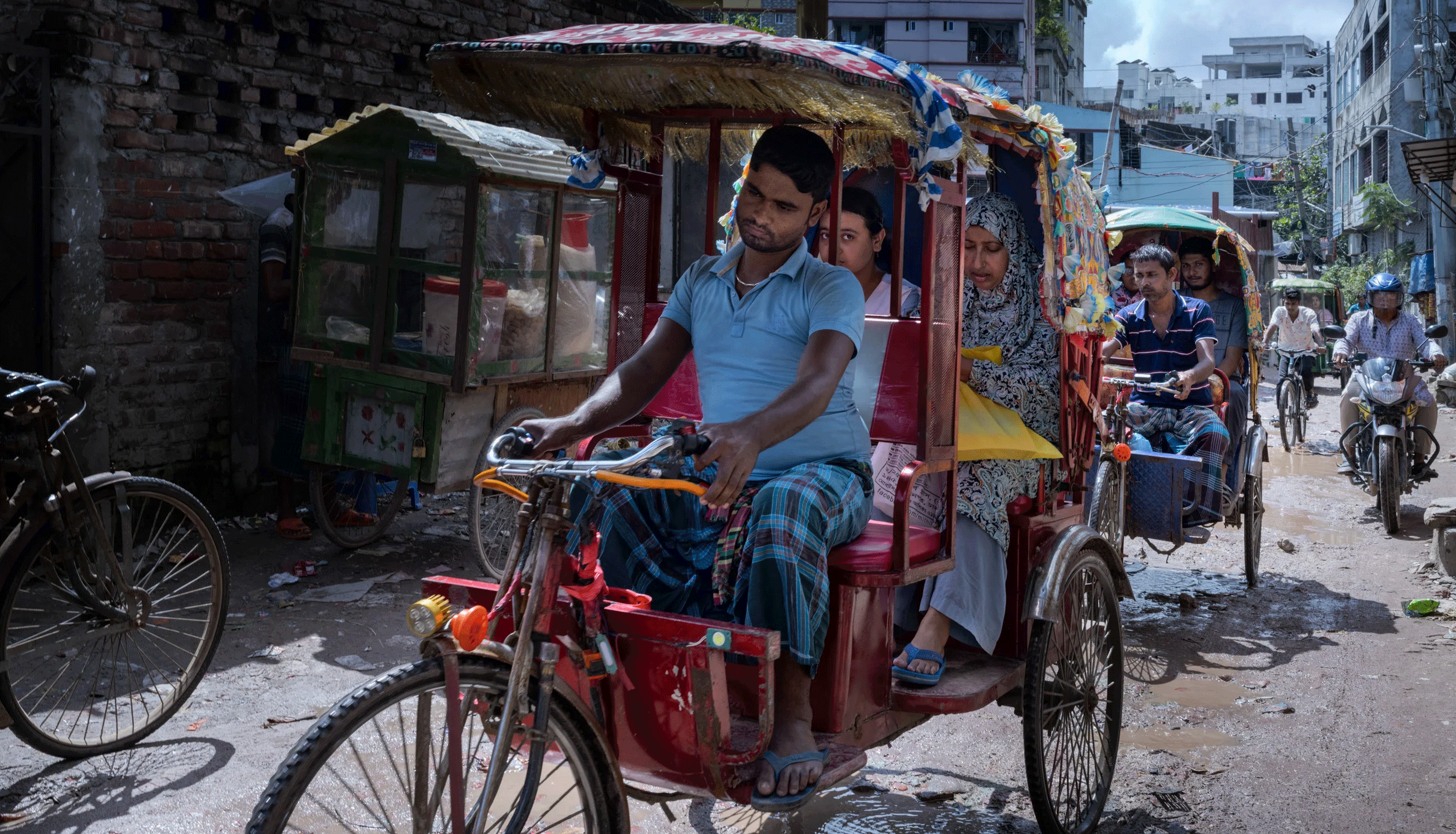
No study of Indian roads can be complete without the auto-rickshaw — that three-wheeled miracle of balance, noise and sudden ambition.
It does not turn. It pirouettes.
One moment it is moving peacefully in front of you, and the next it has performed a graceful half-spin into your lane, like a ballerina with a two-stroke engine. Its indicators are mostly ornamental, its stopping distance is theoretical, and its sense of personal space is deeply negotiable.
The driver can spot a passenger from three lanes away and will cut across traffic with the commitment of a man chasing destiny. You may have ABS, airbags and years of driving experience, but when a rickshaw pivots before you without warning, only reflexes and divine mercy remain.
And then, among all these modern machines, we still occasionally see a bullock cart or a tanga on the road. It moves slowly, almost apologetically, forcing the impatient traffic of the present to adjust itself to the pace of the past.
What would my great-great-grandfather feel? Would he smile at his old world still surviving? Or would he pity it, struggling to breathe in a present that has become too hurried even for those who created it?
The road today can make us sulk, swear, sweat and despair. Yet, more often than not, we are not merely victims of this chaos—we are also its contributors.
Every driver complains about traffic with the sincerity of a saint — while being traffic himself.
Which one are you?
 Follow our WhatsApp channel
