

Iqbal Ahmad
iqbal61@yahoo.co.in
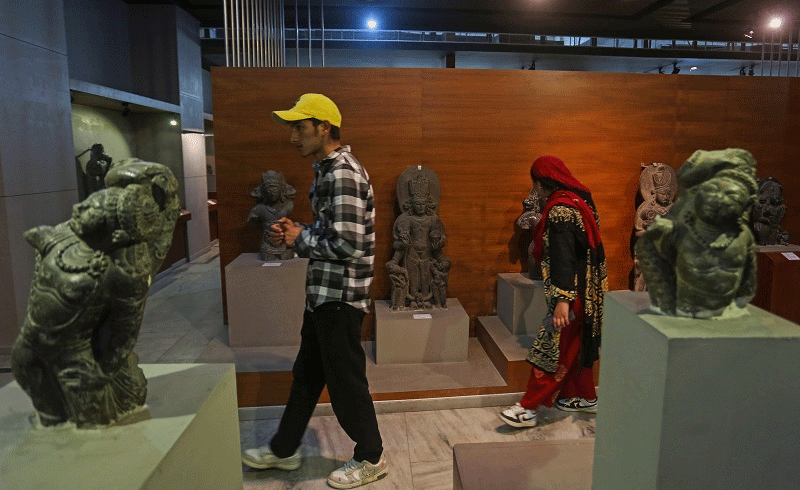
International Museum Day is celebrated on 18 May 2026. This year, it is being celebrated under the interesting theme “Museums Uniting a Divided World.” Coordinated by the International Council of Museums (ICOM), this 80th anniversary highlights the role of museums as bridges for cultural exchange, peace, and social cohesion, fostering dialogue across divisions. The year 2026 marks the 80th anniversary of ICOM, enhancing the significance of this year’s focus on sustainable development and global connection.
Keeping in view the role and significance of museums, particularly site museums, the Archaeological Survey of India (ASI) is learnt to have approved several more site museums for significant archaeological sites. ASI is also developing its existing museums and enhancing several key archaeological sites, including Lothal, Dholavira, and Adichanallur, with an estimated investment of ?1,481 crore under its DESH scheme. These sites will feature interactive “living cultural spaces” and curated walkways to boost tourism and showcase excavation sites.
The agency is also learnt to have approved new site museums for significant archaeological sites at Lothal (Gujarat), Chittorgarh (Rajasthan), Udayagiri (Odisha), Adichanallur (Tamil Nadu), Jhansi (Uttar Pradesh), and Dholavira (Gujarat). Unfortunately, Jammu and Kashmir is once again missing from this archaeological development and enhancement plan, as no site museum has been approved for any of its significant archaeological sites.
In fact, there is not even a single site museum existing at any significant archaeological site in Jammu and Kashmir, while there are already around 52 site museums established at important archaeological sites across the country, where excavated artefacts are not only preserved but also showcased for visitors.
Surprisingly, there exists no site museum, or even a dedicated site museum gallery, at any of the significant archaeological sites of this land, although nearly 80 archaeological monuments are notified and maintained by the archaeology departments.
The world-class Neolithic archaeological site at Burzahama, the Kushan-era terracotta sites of Harwan, the Lidder Valley, and Ambaraan Akhnoor have no site museums despite their worldwide archaeological importance and recognition.
In fact, proposals for site museums at the Burzahama Neolithic site, the Karkota-era Parahaspura site, the Kushan-era Harwan and Pahalgam sites, and Ambaraan had been moved from time to time, but no proposal has been approved so far. In the recently approved list of site museums, no archaeological site from Kashmir figures in the list.
Almost all other states in the country have multiple site museums at their respective archaeological sites, but perhaps Jammu and Kashmir is the only region which, despite possessing world-class archaeological sites, has not yet succeeded in establishing even one site museum.
The history of archaeological explorations and excavations in Jammu and Kashmir dates back to the early 19th century. European and local archaeologists discovered several archaeological sites and recovered thousands of significant artefacts belonging to the Palaeolithic, Neolithic, and historic periods.
The most significant archaeological artefacts were recovered from the excavations of the Neolithic site of Burzahama, the Kushan-era terracotta settlements of Harwan and Ambaraan Akhnoor, and the magnificent medieval remains of Parahaspura and Ushkar Baramulla.
Jammu and Kashmir possesses a wonderful heritage of built monuments, and most of these heritage sites are well maintained and preserved. However, all these sites remain without site museums. In fact, we are still engaged in the preservation and conservation process of our cultural heritage and have not yet moved into the development and promotion phase, through which these sites could have been equipped with proper archaeological infrastructure.
History records that during the colonial and Dogra periods, foreign travellers and tourists were deeply interested in exploring the architectural and archaeological heritage of this land. Their travelogues and administrative reports of that period testify that thousands of tourists visited its archaeological sites and museums every year.
The downtown streets of Srinagar city, Khanqah Shah Hamdan, the mosque and tomb of Madin Sahib, and the remains of Buddhist and Hindu monasteries and temples at Harwan, Parahaspura, Ushkar, Tapper, Martand, Avantipura, and other monuments in the Jhelum Valley were major tourist attractions.
Maharaja Pratap Singh is learnt to have closely monitored tourist flow and the facilities provided to visitors. He reportedly monitored the flow of tourists to SPS Museum Srinagar, and it was the duty of the museum superintendent to submit handwritten reports daily to Maharaja Bahadur regarding the number of foreign visitors.
Similarly, tourist flow to monuments was monitored seasonally. Until the 1980s, museums and archaeological monuments were considered major heritage tourism destinations in the region. Since the 1990s, however, tourist numbers declined considerably due to the uncertain conditions prevailing at that time. Even during those unfavourable years, archaeological work continued, and many archaeological sites and artefacts were discovered and documented.
Yet, to one’s surprise, not a single site museum was ever established at any significant archaeological site in the region. Jammu and Kashmir possesses several world-class archaeological sites with immense potential for establishing site museums. The famous Neolithic site at Burzahama, the Kushan-era site at Harwan, Kanishahr at Parahaspura, the Sun Temple at Martand, and the Kushan-era site and fort of Ambaraan Akhnoor are among the places where site museums could have been established.
Unfortunately, the rare Neolithic bone and stone artefacts recovered from Burzahama are still lying in the strong rooms of Purana Qila Museum in New Delhi. Similarly, terracotta tiles excavated from these sites remain stored in ASI strong rooms. Fortunately, a few terracotta tiles and heads recovered from these sites can still be seen at the Srinagar and Jammu museums.
Scores of terracotta sites excavated across the valley have now become inaccessible. The tile pavements once visible at these sites have been covered with soil, and no remains of these glorious pavements are left exposed for tourists. Similarly, the proposal for establishing a natural history museum in the old museum complex at Srinagar, using the already available collection of stuffed birds, animals, geological specimens, and mineral collections, has also gathered dust.
Usually, the concerned departments and administration are held responsible for such lapses, but I do not entirely blame these institutions. The cultural and heritage organisations engaged in the preservation and conservation of cultural assets have been doing commendable work, but there is a lack of a secure and sustainable heritage policy.
The government should formulate a progressive heritage promotion policy that focuses not only on preservation and conservation but also on the establishment of site museums at least at the region’s most significant archaeological sites.
It is better late than never. We can still make a beginning, and the first such site museums can be established at the historic Neolithic site of Burzahama, the Kushan-era site of Harwan Srinagar, and Ambaraan Akhnoor. However, this will only be possible when the artefacts of these sites are collected and showcased at their original designated locations.
The best way to celebrate this year’s International Museum Day in Jammu and Kashmir would be to establish a few site museums here to honour its significant archaeological heritage.
(The writer is a senior archaeologist)
 Follow our WhatsApp channel
