

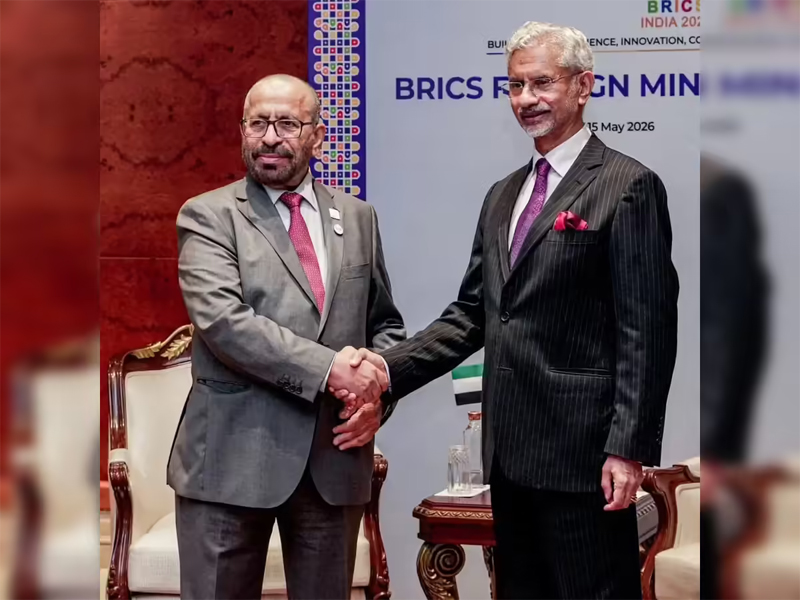
TEHRAN, May 16 : The United Arab Emirates categorically rejected allegations made by Iran accusing it of “direct involvement in aggression against Tehran” during the period of US strikes on Iran, and strongly condemned what it described as attempts to justify attacks on the UAE and other regional countries, calling them a “flagrant violation of the UN Charter, international law, and the principles of good neighbourliness.”
At the BRICS Foreign Ministers’ Meeting in New Delhi, UAE Minister of State Khalifa Shaheen Al Marar reaffirmed that such accusations, along with efforts at coercion or misinformation, would have no impact on the country’s principled foreign policy. He stressed that the UAE remains firmly committed to safeguarding its sovereignty, national security, and independent decision-making, and retains all rights under international law to respond to any hostile act.
The United Arab Emirates categorically rejected any allegations or threats targeting its sovereignty, national security, or independent decision-making, asserting that it “reserves its full sovereign, legal, diplomatic, and military rights to respond to any threat, allegation, or hostile act.”
He stressed that “attempts at coercion, levelling accusations, or promoting malicious claims will not undermine the UAE’s principled positions,” reaffirming that the country will continue to safeguard its supreme national interests.
Al Marar noted that since 28 February 2026, the UAE has been subjected to repeated attacks that it attributes to Iran. He said UAE air defences have intercepted “around 3,000 attacks involving ballistic missiles, cruise missiles, and drones” targeting civilian and critical infrastructure, including airports, ports, oil facilities, desalination plants, energy networks, service facilities, and residential areas.
He further stated that despite multiple international and regional condemnations, Iran has continued its actions, referring to United Nations Security Council Resolution 2817 (2026) and a resolution adopted by the United Nations Human Rights Council, which he said reflected a “clear international consensus rejecting these attacks.”
The UAE also cited resolutions from the International Maritime Organization, the International Civil Aviation Organization, the International Telecommunication Union, and the Food and Agriculture Organization, stating they collectively condemn attacks on civilian infrastructure and threats to global stability.
On maritime security, the UAE accused Iran of obstructing key sea routes, warning that interference in the Strait of Hormuz constitutes “an act of piracy” and a serious threat to global energy security.
The UAE further asserted that it does not seek external protection, stating it is “fully capable of deterring this unprovoked aggression,” and reaffirmed its right to self-defence under Article 51 of the United Nations Charter.
Concluding its statement, the UAE held Iran fully responsible for the consequences of the attacks and said that “respect for state sovereignty, dialogue, putting an end to terrorist attacks, and strict compliance with international law are essential foundations for achieving real and sustainable stability.” (UNI_
 Follow our WhatsApp channel
