

Dr Rekha Jad
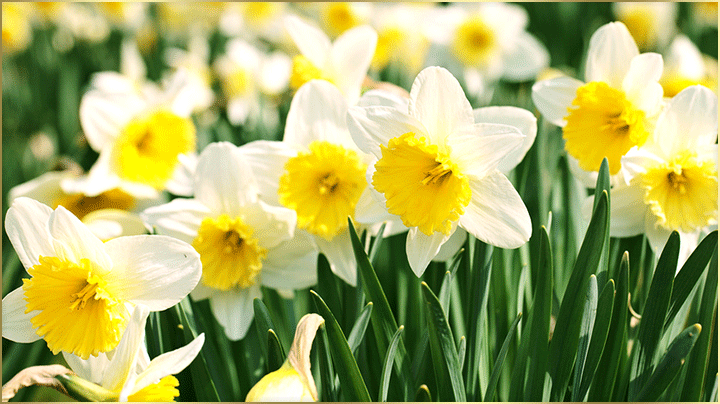
Daffodil, also called Narcissus or Nargis, carries profound symbolism across cultures, poetry, mythology, and spirituality. In Kashmir, the flower is fondly known as Yemberzal, around which revolve many romantic folk lores involving the bee, bambur, immortalised in the famous folk song “Bumbro Bumbro, Shaam Rang Bumbro.” In Kashmiri imagination, the flower evokes springtime, beauty, yearning, and romance.
The word “narcissist” itself originates from Greek mythology and the tale of Narcissus, an extraordinarily handsome youth with whom everyone fell in love. Among his admirers was the mountain nymph Echo, whose love he brazenly rejected. Angered by his vanity and arrogance, the gods punished Narcissus. One day, while passing by a pond, he caught sight of his own reflection in the still water. Enchanted by the image, he became utterly besotted with it, unaware that it was merely his reflection. Unable to leave, he remained there endlessly, consumed by self-obsession and longing, until he gradually withered away and died. At the very spot where he perished bloomed the narcissus flower — forever becoming an epitome of self-love, longing, vanity, and self-absorption.
In English literature, William Wordsworth immortalised the daffodil in I Wandered Lonely as a Cloud. Here, the flower becomes symbolic of beauty, dreamy eyes, springtime, and longing. More importantly, the poem celebrates the healing and rejuvenating power of nature. The sight of the golden daffodils leaves such a deep imprint upon the poet’s mind that the memory remains etched forever in his heart, later returning to comfort and soothe him in solitude. The daffodils thus emerge as symbols of joy, hope, emotional renewal, and nature’s enduring bounty, with the poet utterly enraptured by their beauty.
Yet, in Urdu poetry and Vedantic philosophy, the daffodil assumes an even deeper spiritual significance. Allama Iqbal writes:
Hazāroñ sāl nargis apnī be-nūrī pe rotī hai,
Baṛī mushkil se hotā hai chaman meñ dīdahvar paidā.
Iqbal portrays the blindness and absence of wisdom in society. “Nargis” here symbolizes vision and insight, while the rare dīdahvar represents the enlightened visionary who is born only once in ages. The flower thus becomes associated not merely with beauty, but with awakening and inner sight.
Interestingly, some Vedantic interpretations compare each stanza of Wordsworth’s poem with the different Yogas. The opening line, “I wandered lonely as a cloud,” reflects the spirit of Karma Yoga — the detached wanderer moving like a nomad in renunciation, untouched by worldly attachments. The comparison to a cloud itself is symbolic of sacrifice and selfless service, for clouds give away everything they possess in the form of rain, nurturing life and prosperity without expectation. This complete self-giving embodies Karma Yoga.
The line “That floats on high o’er vales and hills” suggests equanimity — floating peacefully above the dualities of life, unaffected by fortune or misfortune, joy or sorrow, honour or dishonour, pleasure or pain.
The subsequent stanzas, describing the poet’s intoxication with nature and his sense of oneness with all creation, reflect Bhakti Yoga, the path of devotion and pure love. The poet becomes enraptured by the beauty of existence itself.
Thereafter, the repeated phrase “Gazed — and gazed” is interpreted as Jnana Yoga, the path of knowledge and contemplation. Karma and Bhakti purify the mind, and the purified mind begins to reflect higher intellect and truth.
Finally, in the last stanza, when the poet lies in a “vacant or in pensive mood,” it resembles a meditative state culminating in spiritual enlightenment. Vacant of worldly thoughts yet deeply contemplative, the mind opens to the inner eye of the Supreme Self. The individual self dissolves into universal consciousness, and the poet metaphorically “dances with the daffodils,” merging with the all-pervading reality.
Thus, whether seen as a symbol of romance, beauty, longing, vision, self-reflection, or spiritual enlightenment, the daffodil remains one of the most richly symbolic flowers in literature and human consciousness.
 Follow our WhatsApp channel
