

Shamim Haque Mondal
shamimmondal709@gmail.com
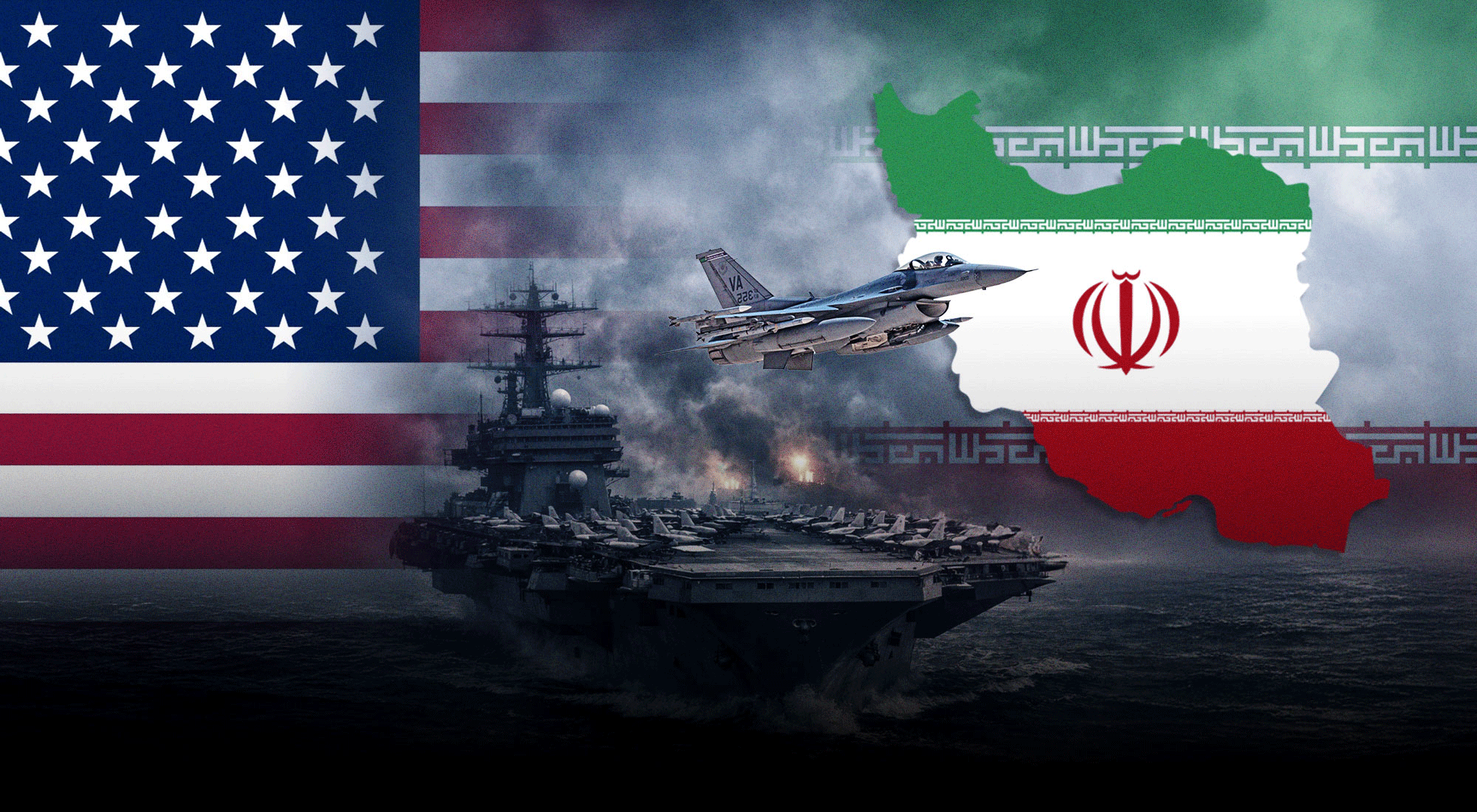
Even after 21 hours of meeting in Islamabad, there was no agreement between the two sides. In the international media, it is heard that both sides have not been able to come to a firm decision regarding the uranium stored in Iran. Is that really so? Did the war start only because of Iran’s efforts to enrich nuclear energy? According to experts, uranium is just a tool.
Last March, the chief of the US National Intelligence Agency stated Iran was not developing nuclear weapons, at least not without evidence. Then a few months later the Trump administration declared war on Iran. Then there’s the uranium enrichment process in Tehran. To know the veracity of this allegation we need to look back: Because it’s happened before.
During the 2015 nuclear deal, Tehran was supposed to shut down most of its centrifuges (uranium enrichment devices) in exchange for assurances that international sanctions on them would be lifted. In addition, Iran can enrich uranium up to 3.67 percent and has a maximum stockpile of 300 kg of low-enriched uranium. Until Trump’s withdrawal from the deal in 2018, Iran had complied with all the conditions, but after the US government withdrew from the agreement, Tehran increased its nuclear activities, even producing uranium enriched to 60% in its nuclear reactors within a few years. That’s where the fear starts. It should be noted that it is not possible to get nuclear energy directly from the uranium stored in Iran; its quality needs to be improved or enriched.
In the early 1970s, Iran signed the Nuclear Non-Proliferation Treaty, whose main purpose was to use nuclear energy for peaceful purposes. But after the Iranian revolution in 1979, they stopped working with the International Atomic Energy Agency. Since then, Western countries, especially the United States, have claimed that the Islamic Republic is secretly pursuing its nuclear program.
Later, in November 2011, the International Atomic Energy Agency claimed that Iran was continuing its efforts to develop nuclear weapons. Nearly a decade later, in 2022, the agency launched an investigation into what exactly Iran was doing with the nuclear materials. However, Iran has always maintained that its nuclear program is for peaceful purposes. But no one wanted to accept Tehran’s claim; in fact, the country whose uranium reserves are so rich has no ambition—it is hard to believe.
Nuclear weapons generally require 90 percent enriched uranium. The International Atomic Energy Agency ( IAEA ) estimated Tehran could only work with uranium enriched to 60 percent . They thought Iran could develop a 20-kiloton nuclear weapon at any time (the ‘ Little Boy ‘ dropped on Hiroshima was 13-16 kilotons) . When Iran signed the nuclear deal in 2015 it took Iran one year to generate one kilogram of uranium to make a nuclear bomb, and a decade later that time was cut to one week.
The development of nuclear weapons requires not only the enrichment of uranium but also the continuous improvement of explosives, detonators, weapons and firing systems, high-energy neutrons, and explosive lenses. Experimental explosions (as we did in Pokhran) are also needed—in a word, a long journey. But according to US intelligence, Iran had mastered nuclear engineering as well as enrichment. The situation had reached such a point that it would take Tehran several months to build a nuclear bomb capable of striking from raw materials.
Tensions between Washington and Tehran have risen steadily over the past few years, with Tehran deciding not to engage in direct talks with Washington after the United States cut a nuclear deal with Iran during Trump’s first term in office. Even then, Khamenei participated in several rounds of indirect talks in Vienna during Biden’s tenure in 2021. However, no solution was reached. The two sides held several rounds of talks this February, with some diplomats even suggesting that a settlement could be brokered by Oman, but the February 28 attacks thwarted all efforts. Iran’s top leadership claims that Tehran has repeatedly come to the negotiating table and agreements are being signed, but still missile attacks have been carried out on Iran. This has happened twice in the last eight years. The speaker of Iran’s parliament has publicly stated in a press conference that the Trump administration has not won the confidence of the Iranian delegation. Tehran only wanted assurances that once the agreement was signed, the bombing would not resume; the international agreement was not the product of a hasty settlement.
Recently, at the conciliation meeting in Islamabad, the US demanded that Iran completely shut down its uranium enrichment facilities and hand over its stockpile of highly enriched uranium to the US. Instead, Tehran wants to pursue a controlled nuclear program on its own soil, under the auspices of the International Atomic Energy Agency. The United States did not agree. It is true that both sides had bargained, but there was no ray of hope in that meeting mediated by Pakistan.
Here are some seemingly contradictory facts: Last year, the head of America’s own intelligence agency claimed that Iran was not developing nuclear weapons. However, the Trump administration feels that Iran is a nuclear threat to them, so they start a war against Iran anyway. Meanwhile, during the Iran-Israeli 12-day war of 2025, the United States attacked three major nuclear sites in Iran; at the time, Trump claimed that Iran’s nuclear program had been obliterated, but eight months later he resumed the war with renewed vigor. If, indeed, Iran’s nuclear program is dismantled, is there any justification for continuing the war? Is it because of nuclear weapons? Or is it one side’s intention to create political acceptability strategically in the face of nuclear power? The first ceasefire expires on April 22. Until then, keep thinking about the questions; hopefully, the next steps on both sides will provide the answers.
 Follow our WhatsApp channel
