

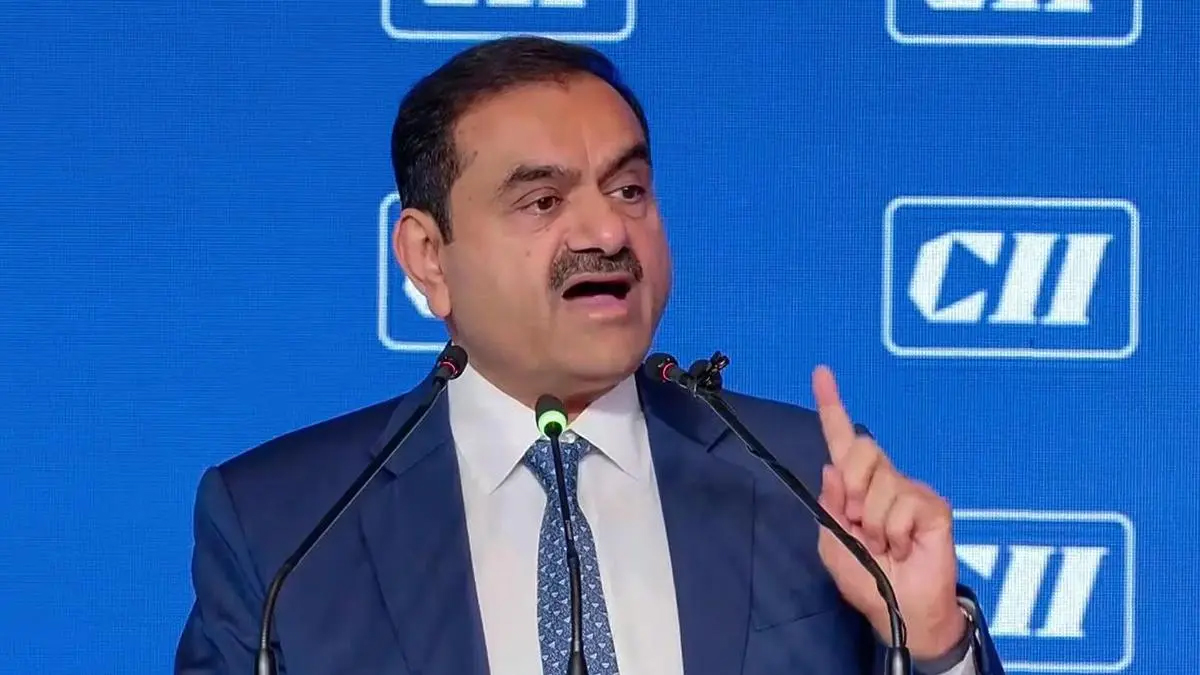
NEW DELHI, May 11: Billionaire Gautam Adani said on Monday that energy security and digital infrastructure would define geopolitical power in the coming decades, as he called on India to build sovereign capabilities across the artificial intelligence value chain.
Addressing the Confederation of Indian Industry’s (CII) Annual Business Summit 2026, the chairman of the Adani Group said the assumptions underpinning decades of globalisation were being dismantled amid rising geopolitical fragmentation.
“The world that is emerging is not flat. It is fractured and contested,” Adani said. “Semiconductors have become instruments of statecraft. Data is being treated as a national resource. Clouds are being weaponised. And Artificial Intelligence is being built behind the protective walls of data centres.”
Referring to recent geopolitical conflicts and attacks on infrastructure, Adani said “energy security and digital security are now the twin pillars of national power.”
“The country that controls its energy will power its industrial future. The country that controls its compute will power its intelligence future. And the country that controls both will shape the century ahead,” he said.
Adani said India should treat AI not merely as software, but as strategic infrastructure spanning energy, data centres, chips, networks, compute and talent.
“India must not rent the infrastructure of its intelligence future. India must build it, power it and own it on its own soil,” he said.
The billionaire industrialist said India’s scale of domestic demand across manufacturing, mobility, logistics and digital services positioned it uniquely to build large-scale AI and energy infrastructure with demand “already embedded into the economy”.
He noted that India had crossed 500 gigawatts of installed power capacity and said the country’s future AI economy would require massive investment in energy and compute ecosystems.
“India must build AI not as a force that removes opportunity, but as one that expands productivity, creates jobs, empowers entrepreneurs and gives Indians the tools to compete globally,” Adani said.
He reiterated his ports-to-energy conglomerate’s previously announced USD 100 billion commitment towards energy transition and digital infrastructure, including the 30-GW renewable energy project at Khavda in Gujarat and partnerships with Google and Microsoft in India’s data centre and sovereign compute ecosystem.
Reflecting on the group’s growth, Adani said he had spent decades building “from ports where there were only marshlands to power projects in regions that knew only darkness”.
“The future does not arrive. It is built,” he said.
He added that the next “freedom struggle” would be fought “in our grids, our data centres, our factories, our classrooms, our laboratories and our minds,” and that freedom in the AI era would mean “the capability to power ourselves, compute for ourselves and dream for ourselves”.
The Adani Group chairman said the US and China had both recognised that “energy and intelligence are now inseparable” and had made them strategic national priorities.
He said India’s growth trajectory positioned it uniquely to build large-scale domestic energy and AI infrastructure, citing rising electricity demand, rapid urbanisation and digital adoption.
“As of March 2026, India has crossed 500 GW of installed power capacity,” he said, adding that India was on track to quadruple capacity to 2,000 GW by 2047.
India’s AI-driven data centre capacity, projected at 5 GW by 2030, could rise to nearly 75 GW by 2047, he said warning that the country needed to prepare immediately for the surge in compute demand.
“AI is not just software. AI is infrastructure. AI is energy. AI is cooling. AI is chips. AI is networks. AI is data. AI is talent. AI is governance,” Adani said.
He rejected concerns that artificial intelligence would primarily destroy jobs, saying India should use AI to “expand productivity, create new jobs, empower small businesses and give Indians the tools to compete with the best.”
Drawing parallels with India’s digital payments revolution, Adani said the launch of UPI had enabled the emergence of companies such as Flipkart, Paytm, Ola, Swiggy, Meesho, Zepto, and PhonePe by making millions of Indians digitally visible and financially connected.
“AI will do the same but at a far greater scale,” he said.
Adani outlined a three-layer AI framework consisting of power generation, compute infrastructure and AI applications, saying sovereign ownership of data and compute infrastructure would become critical in the next phase of technological competition.
“If our data is processed on distant shores, it means our future is being written on foreign shores,” he said.
The billionaire industrialist also said India’s traditional IT outsourcing model would need to evolve in the AI era.
“The old IT model wrote code for the world. The new model must build intelligence and can afford to be largely sovereign,” he said.
Adani said the group had already commissioned 35 per cent of its planned 30-GW renewable energy project at Khavda in Gujarat, which he described as “the world’s largest single-site renewable energy plant”.
“Our total commitment towards the energy transition stands at 100 billion dollars,” he said.
He also reiterated a further USD 100 billion commitment towards the group’s data centre business, including a partnership with Google to build what he described as India’s largest gigawatt-scale data centre campus in Visakhapatnam.
Microsoft, along with companies, including Flipkart and Uber, were partnering with the group on data infrastructure initiatives, he added.
“India must not rent the infrastructure of its intelligence future. India must build it. India must power it. India must own it on its own soil,” Adani said.
“The real measure of AI will not be how many jobs it replaces. The real measure will be how many Indians it empowers,” he added. (PTI)
 Follow our WhatsApp channel
