

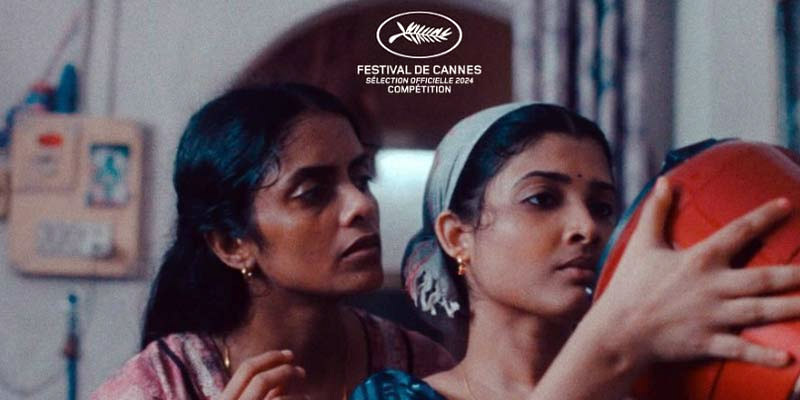
CANNES, May 10 : Two years after Indian cinema created history by winning the Grand Prix at the Cannes Film Festival, the world’s largest filmmaking country has virtually drawn a blank in the official selection for the festival’s 2026 edition.
There are no Indian films in any of the major categories in Cannes this year, except in the sections devoted to film schools and restored movies.
The absence of new Indian productions at the world’s most influential film festival is a major blow to the Indian film industry, especially following the Grand Prix, the second-biggest award in Cannes, for Mumbai-based filmmaker Payal Kapadia’s ‘All We Imagine As Light’ in 2024.
Indian cinema is represented in Cannes this year by ‘Shadows of the Moonless Nights’, a diploma short film by Film and Television Institute of India (FTII), Pune alumnus Mehar Malhotra, and the 1986 Malayalam film, ‘Amma Ariyan’ by John Abraham.
‘Shadows of Moonless Nights’ is part of the Cannes festival’s La Cinef programme for film school productions from around the world. ‘Amma Ariyan’ will be screened in the Cannes Classics section for restored movies.
The 79th edition of the Cannes Film Festival will be held from May 12 to 23 with the participation of several leading filmmakers from across the world, including Spanish director Pedro Almodovar, Iranian director Asghar Farhadi, and American director James Gray.
Kolkata-born Scottish screenwriter Paul Laverty, a long-time collaborator of award-winning British director Ken Loach, is a member of the competition jury headed this year by South Korean filmmaker Park Chan-wook.
Kapadia was a member of the competition jury that awarded the prestigious Palme d’Or, the top prize of the Cannes festival, last year. This year, Kapadia heads the jury of the Critics’ Week, a parallel selection of the Cannes festival.
‘Shadows of the Moonless Nights’, a Punjabi language short film (original Punjabi title ‘Parchave Masseah Rataan De’), tells the story of Rajan, a young factory warehouse worker whose long shifts don’t give him any chance of taking rest.
“I wanted to make the film because Rajan’s story felt like one we all carry but rarely name—the bone-deep fatigue of surviving a city that runs on sleeplessness,” says Malhotra, who joined FTII, Pune as a student of direction and writing in 2020.
“I approach Rajan not simply as a character, but as a vessel through which we explore the invisible wound of contemporary India and the human spirit’s fragile endurance under pressure,” she adds.
‘Shadows of the Moonless Nights’ is among 19 films competing for the top three prizes of La Cinef section this year. The 19 films were selected from 2,750 entries the festival received from film schools across the world.
In 2024, FTII, Pune alumnus Chidananda S Naik won La Cinef top prize for his course-end short film, ‘Sunflowers Were the First to Know’.
John Abraham’s ‘Amma Ariyan’ marks the fifth successive year for Indian cinema in the Cannes Classics section.
Satyajit Ray’s 1970 film, ‘Aranyer Din Ratri’, was part of the Cannes Classics last year. ‘Aranyer Din Ratri’ was presented to the Cannes audience by American filmmaker Wes Anderson, a self-confessed fan of Ray, in the presence of the film’s actors Sharmila Tagore and Simi Grewal.
Hindi film, ‘Manthan’ by Shyam Benegal in 2024, Manipuri film, ‘Ishanou’, by Aribam Syam Sharma in 2023, and Ray’s 1970 film, ‘Pratidwandi’, and the 1978 Malayalam film, ‘Thampu’ by G Aravindan were part of Cannes Classics in 2022.
The India pavilion will be part of the Cannes Film Market, the world’s biggest film market, which is held along with the main festival.
Another Indian filmmaker, London-based Mansi Maheshwari, will participate in the Cannes festival this year as part of Cannes Residence 2026, a festival programme that helps young filmmakers from around the world develop their first feature projects.
Meerut-born Maheshwari’s project, ‘Royal Palace Bageshwar’, a mix of live action and animation, will be shot in India. It is one of the six selected projects in Cannes Residence this year. Set in India at the beginning of the new millennium, the film is about a family heading to the mountains to escape city chaos, but finds their simple getaway turns instead into an unexpected test of survival in the face of a series of incidents.
“I made this film from my own experience of these holidays,” says Maheshwari, whose animated graduation short film, ‘Bunnyhood’, made at the end of her Master’s programme in animation direction at the National Film and Television School in the United Kingdom, won the third prize at La Cinef in Cannes last year.
“Every year, the trip feels impossible; everything goes wrong. But enduring this chaos with my family has become addictive. In this film, I want to capture not only the joy and laughter, but also the frustration, the moments of doom, and the faith we cultivate that things will work out,” Maheshwari says in her director’s statement.
As many as five women directors are competing for the Palme d’Or this year in the competition category that has 22 films this year, including Almodovar’s ‘Bitter Christmas’, Farhadi’s ‘Parallel Tales’, and Gray’s ‘Paper Tiger’.
The women directors in the competition section are German filmmaker Valeska Grisebach (‘The Dreamed Adventure’), Austrian Marie Kreutzer (‘Gentle Monster’), and French filmmakers Charline Bourgeois-Tacquet (‘A Woman’s Life’), Jeanne Herry (‘Another Day’) and L a Mysius (‘The Birthday Party’).
‘Elephants in the Fog’ by Nepali director Abinash Bikram Shah is part of the Cannes festival’s Un Certain Regard section for fresh voices in world cinema. The Nepali and Bhojpuri language film is the first feature film from Nepal to be selected for the Cannes festival.
(UNI)
 Follow our WhatsApp channel
