

Kumar Rohit
write2kumarrohit@outlook.com
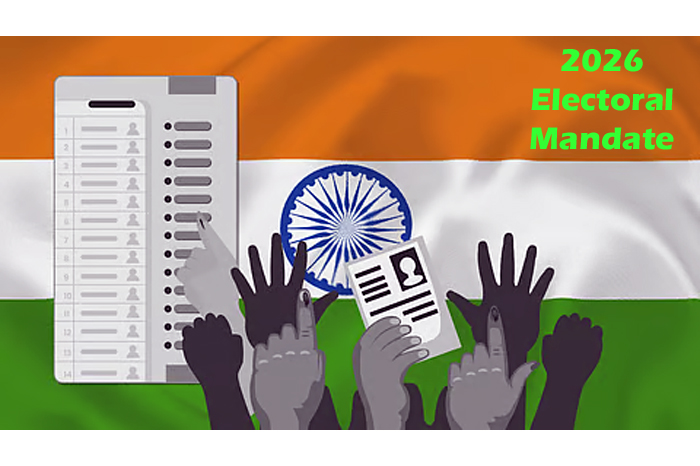
The 2026 electoral mandate in Tamil Nadu carries a resonance far beyond the Coromandel Coast. Its echo can be heard in the valleys of Jammu and Kashmir-not as coincidence, but as convergence. For decades, these two regions were framed through narratives of political exceptionalism: one as a “Dravidian fortress,” the other as a sensitive Himalayan frontier. Today, that framing is steadily giving way to something more consequential-a shared architecture of aspiration aligned with the vision of Viksit Bharat 2047.
This shift is neither about erasing identities nor enforcing uniformity. It is about redefining the relationship between regional pride and national purpose-through performance, participation, and partnership.
From Political Silos to Performance Networks
From Political Silos to Performance Networks
The Tamil Nadu elections signal a gradual but unmistakable transition. The long-standing “Dravidian duopoly” is being challenged not merely by new political actors, but by a new political grammar-one that privileges governance delivery, economic dynamism, and global competitiveness over legacy-driven narratives.
The emergence of formations like Tamilaga Vettri Kazhagam (TVK) reflects a generational churn. Youth aspirations are no longer anchored in ideological binaries; they are driven by opportunity, entrepreneurship, and institutional efficiency.
Equally significant is the changing tone of Centre-State engagement. When newer regional leaders openly express, “Thank you, PM Modi… looking forward to the Centre’s support,” it signals more than courtesy-it reflects a deeper political shift. Engagement with leadership at the Centre, is no longer framed as compromise but as collaboration. It marks a move away from confrontation toward a recognition that regional pride becomes the most potent engine of national growth when aligned with national priorities.
In Jammu and Kashmir, a parallel transformation is underway. Since the constitutional changes of 2019, the region has been moving-gradually but decisively-from a security-centric discourse to one focused on grassroots democracy, infrastructure, and economic integration. Institutions such as IIT Jammu and IIM Jammu symbolize this shift: from uncertainty to aspiration, from isolation to integration.
Together, these developments indicate a deeper structural evolution: India is transitioning from a federation of political silos to a network of performance-driven regions contributing to a common national project.
A Civilizational Continuum: From Kashmir to Kanyakumari
This political convergence rests on a much older foundation-a civilizational unity that has long connected the subcontinent.
Few lives illustrate this better than that of Swami Vivekananda. His journey-from the spiritual awakening at the Kheer Bhawani Temple to his meditative resolve at the Vivekananda Rock Memorial-was not merely geographical. It was a traversal of India’s inner unity.
At Kheer Bhawani, Vivekananda experienced a moment of humility before the Divine Mother. At Kanyakumari, standing at the confluence of three seas, he envisioned India’s resurgence. Between these two points lies not just distance, but the very idea of India-diverse, interconnected, and spiritually coherent.
What was once articulated through spiritual insight is now finding expression in democratic behaviour. Electoral choices across regions increasingly reflect a preference for development, governance, and national integration-echoing that deeper unity.
Redefining Regional Pride
The most significant insight emerging from this moment is simple yet transformative: regional identity and national unity are not opposing forces-they are mutually reinforcing.
Tamil Nadu’s industrial strength, innovation ecosystems, and human capital are central to India’s global ambitions. Jammu and Kashmir’s evolving role in green energy, tourism, and high-value agriculture positions it as an important contributor to future growth.
This is convergence not through similarity, but through complementarity.
If sustained, this alignment can reshape India’s growth into a collaborative, shared model-turning cooperative federalism from a slogan to a lived reality.
The Youth Question: Breaking the Old Mould
At the heart of this transformation lies India’s youth. But for this demographic dividend to translate into national strength, a shift in mindset is essential.
For too long, success has been narrowly defined. The relentless pursuit of limited professional pathways has created what may be called the “NEET Trap”-a high-pressure funnel that often leaves many disillusioned. Alongside it runs the equally restrictive “government job treadmill,” where security is prioritised over creativity.
This model is no longer sustainable for a nation aspiring to be a global economic powerhouse.
The future calls for a shift toward innovation, entrepreneurship, and diverse skills. From Chennai to Srinagar, youth must look beyond conventional paths. Emerging ecosystems in Jammu & Kashmir and Tamil Nadu signal this shift-their convergence can drive India’s next phase of growth.
The End of Old Fortresses
The metaphors that once defined these regions are fading. The “Dravidian fortress” no longer implies isolation, nor is the “Himalayan frontier” seen as vulnerable. Both are evolving into active partners in a shared national mission-reflecting a quiet yet enduring shift where governance, opportunity, and national alignment increasingly guide public choice.
The Path to 2047
The journey to Viksit Bharat 2047 is not without challenges. It demands discipline, clarity, and persistence. Yet India’s strength lies in its ability to navigate complexity. Its diversity is emerging as a source of resilience. Its regions, once seen as disparate, are aligning through shared aspirations. This is the essence of a new India: not uniform, but united; not centralised, but coordinated; not imposed, but collectively realised.
A Nation in Alignment
Bharat’s future will be shaped not by one voice or region, but by the convergence of its many identities. Across the country, a quiet shift is visible-in how people vote, aspire, and increasingly value collaboration over conflict. This reflects a deeper truth: the idea of India is dynamic, strengthened by participation and shared purpose. Swami Vivekananda’s call to “Arise, awake, and stop not till the goal is reached” now carries a national resonance. Viksit Bharat 2047 is not a distant promise-it is a journey already underway, drawing the nation together into a more integrated and confident future.
(The author serves as Additional Central PF Commissioner (HQ) and Director at PDUNASS, New Delhi.)
 Follow our WhatsApp channel
