

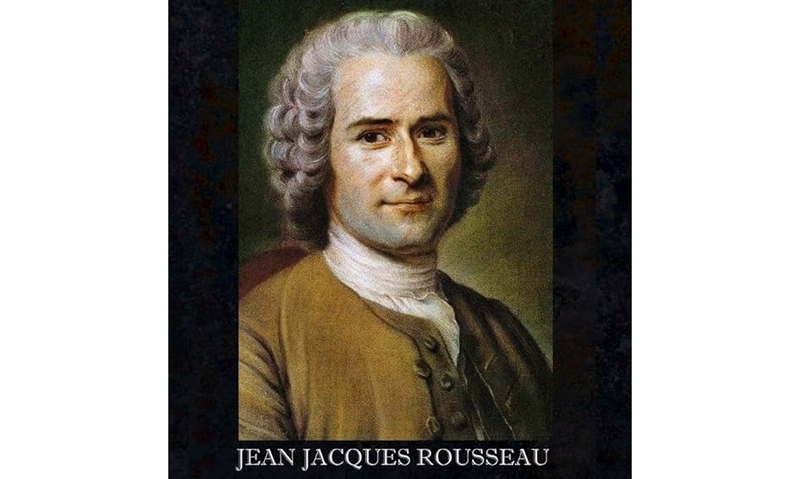
Voluminous though it is, the Confessions of Jean-Jacques Rousseau renders value for the reader’s time. In this two-volume work that comprises 12 ‘books’ (Book I to VI in Vol. 1 and Books VII to XII in Vol. 2), the author takes us through the journey of the first 53 years of his chequered life. An orphan of scant formal education and virtually no means to thrive, Rousseau (1712-1778) became in time ‘probabily the most popular and widely read intellectual revolutionary in France.’ His Confessions records his perambulations. It is an autobiography – the first of its kind in the modern times – in which the author bares his soul, acknowledging all his follies and foibles. You wonder whether the road to greatness could really be that bumpy and tortuous.
Rousseau wrote Confessions in French language – the first part between 1765 and 1767. It was published in 1782, four years after his demise. He wrote the second part during 1769-1770, and that was published in 1789. The present text is based on ‘the first completely translated English version’ that was privately published in London for Members of the Aldous Society in 1903. The e-book is available for free on the internet by the courtesy of the Project Gutenberg.
Jean Jacques Rousseau was born on 28 June 1712 in Geneva. His entry into the world did not seem promising. He was ‘a very weakly and infirm’ babe. Susannah Bernard, his mother, died shortly after his birth. His father, Issac Rousseau, though a respected watch-maker and a man of deep sentiments, showed little aptitude for parenting. Issac’s older son, seven years senior to Jean-Jacquess, felt neglected and ran away from home, severing all connections with the family. Jean-Jacques himself could not have survived but for the tender care of Isaac Rousseau’s sister, Suzanne Bernard, and the nurse, Jaqueline. Jean Jacques remained grateful to those two women throughout his life (they were in their eighties when he wrote the Confessions).
He was growing into a handsome and healthy lad. Tears ran down cheeks of the widowed Isaac in the memory of his dear departed wife, every time that he saw Jean Jacquess. The Senior Rousseau took in his head to educate little Rousseau. His wife, Susannah, who was the daughter of a clergy man, was a lady of taste. She had left behind her a few romances. Issac began to read those fictional works to his son. The imaginary stories of love and high sentiment were way beyond the ken of the 5-6-year old child. Decades later, Rousseau recalled his confused state of mind during that period: ‘I had conceived nothing – I had felt the whole.’ When the stock of ‘romances’ got finished, Issac Rousseau delved into his own library containing philosophic works of the Greek and Roman authors such as Agesilaus, Brutus, and Aristides et cetera to continue with the education of his son. To his credit, Jean Jacquess, now all of 7 years, ‘daily read them, with an avidity and taste uncommon.’ The highly elevating reading planted in his developing mind ‘the republican spirit and love of liberty’.
But, as luck would have it, Rousseau had to part with his loving father too soon. The Senior Rousseau had a tiff with someone influential and was banished from his home town. As a consequence, Jean Jacques had to stay on with his uncle, Bernard. Here, he found good company in his cousin, Bernard’s son. Both the boys were of the same age and temper. Bernard sent them to Bossey, there to study as boarding students at the residence of a clergyman, Monsieur Lambercier. As boys anywhere would do, they resorted to their childish pranks in the house. It was for M. Lambercier’s sister, Miss Lambercier, to discipline them. Characteristically, Jean Jacques took sensual pleasure when the maiden struck him in her feminine fashion.
The boys returned to Geneva not long after that. Back at home, they continued to enjoy each other’s company, engaging in all sorts of playful activities. M. Bernard realised even so that it was time to prepare them for their future. He sent away his son to study drawing and geometry. Rousseau was keen to study for priesthood, but did not have sufficient means for that. He was sent instead to train under M. Masserson, the City Registrar, to become a scraper – some sort of a clerk whose duty it was to tidy up documents. Rousseau did not like the position, nor did his boss like him. He was expelled from the office as being unsuitable for the job. Uncle Bernard then sent him as an apprentice to an engraver. What with the cruelty of the man and his own antics, Rousseau decided to run away from him.
During that period, he had picked up juvenile habits such as petty thievery and telling lies, though he was never greedy, nor did he steal money or valuables such as gold and silver. Money never attracted him in all his life. “…none of my predominant inclinations centre in those pleasures which are to be purchased: money empoisons my delight,’ he clarifies. Yet, a wrong committed by him in his boyhood continued to rankle him till his old age. He had served as a footman to an old lady of substance. When her household was being wound up after her death, he stole a pink-and-silver ribbon that had belonged to her. On being caught, Rousseau falsely claimed that the trinket had been given him by a maid of the house. The hapless girl was expelled from the house in disgrace.
By now, he had begun to think of himself as a beau. Highly selective in his choice, he courted women much older than he was. ‘Seamstresses, chambermaids, or milliners never interested me’, Rousseau says, I sighed for ladies.’ Chance brought him to Madam de Warens, who kept a modest house at Annecy, Turin. (They had to move later to a less welcoming place house at Chamberi). Ten-twelve years older to his sixteen years, she was as comely and compassionate as only a woman can be. She was ‘mamma’ to Rousseau, and he a ‘child’ to her.
If there was voluptuousness in this relationship, both of them kept themselves within their limits. Yet, in the end, Madam de Warens literally proved generous to a fault. It happened when she discovered that Rousseau was gradually sinking into the quicksand of his fascination for attractive women whom he met as a music teacher. She prevented his ruination with the only means she could adopt, and that was to offer him free access to her own body. Ironically, this very generosity of her temperament proved the cause of their separation when another young man supplanted Rousseau in her favours.
Rousseau calls himself a libertine quite often. Yes, he was a ladies’ man. But then he was a man much more besides. In his mid-twenties (Vol.1 of the Confessions deals with the first 26-27 years of his life), he was a musician, an herbalist and an engraver. Above all, he was a devoted scholar. ‘I imagined,’ he recounts, ‘that to read a book profitably, it was necessary to be acquainted with every branch of knowledge it even mentioned…’ Philosophy, logic, geometry, algebra, astronomy, ornithology and even Latin (which he found difficult to wade through) – all proved to him grist to the mill. ‘The best means to obtain what is necessary from the Giver of every perfect good is rather to deserve than to solicit…’ he observes.
Jean Jacques Rousseau was set out to be an extraordinary man. In the next part of the series we will see how he strove to rise above his ordinariness. (to be continued)
 Follow our WhatsApp channel
