

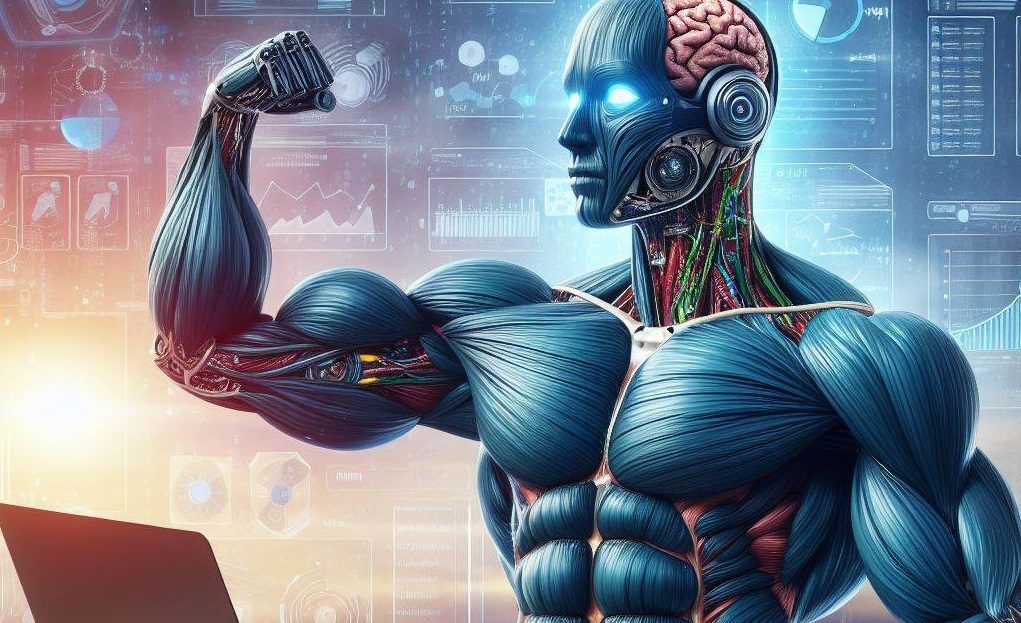
Elite sport was once defined by physical dominance alone, where strength, endurance, and repetition determined outcomes.
That model no longer explains performance at the highest level. As competitive margins narrowed and calendars intensified, physical preparation became inseparable from computational decision-making, with data systems guiding how strength is applied rather than simply increased.
Machine intelligence entered sport not to replace athletic ability, but to manage it. Training, recovery, tactical execution, and career planning are now influenced by algorithms that evaluate efficiency, probability, and long-term sustainability.
This logic extends beyond teams into adjacent analytical ecosystems, including wagering and modeling environments used by platforms such as Rajbet casino site, where athletic output is increasingly treated as a system of repeatable inputs rather than raw physical expression.
Physical Output Becomes a Managed Variable
The transition from muscles to machine intelligence began when physical output stopped being pushed to its limits and started being regulated as a finite resource. In elite sport, strength, speed, and endurance are now distributed across time through continuous measurement rather than exhausted within individual sessions.
This shift is clearly visible in the widespread use of load-monitoring platforms such as those developed by Catapult Sports, which are deployed across football, rugby, and American sports to manage training and match exposure during seasons that often exceed 55–75 competitive events per year.
How Machine Intelligence Reframed Physical Preparation:
| Variable | Muscle-First Model | Machine-Intelligence Model | Performance Effect |
| Strength | Maximize output | Optimize application | Reduced fatigue accumulation |
| Speed | Repeated maximal exposure | Dose-controlled stimulus | Lower soft-tissue injury risk |
| Endurance | Linear volume increase | Stress–response modeling | Sustained match intensity |
| Recovery | Rest days | Recovery velocity tracking | Faster turnaround |
| Season load | Calendar-driven | Cumulative risk forecasting | Career longevity |
The practical consequences of this shift extend directly into daily preparation and competitive planning:
- Weekly training loads are redistributed rather than reduced, preserving intensity while keeping cumulative stress within modeled tolerance bands
- Load escalation is capped within narrow week-over-week ranges, typically preventing sudden spikes that correlate with soft-tissue injuries
- Return-to-play decisions are gated by multi-metric stability, not by time elapsed since injury
- Late-season performance decay is delayed, as fatigue accumulation is identified weeks earlier through rolling load windows
- Athletes receive transparent feedback loops, linking subjective sensation with quantified stress and recovery signals
Physical preparation therefore becomes less about proving resilience and more about sustaining availability, where performance longevity is determined by how intelligently physical output is managed rather than how aggressively it is consumed.
Technique and Movement Become Computational Problems
The second shift occurred when technique stopped being evaluated purely through visual correction and became a computational problem defined by efficiency, repeatability, and risk exposure.
Machine intelligence allows coaches and athletes to understand not only what movements look like, but how costly they are over time.
In elite baseball, biomechanical analysis reshaped pitching mechanics to reduce elbow and shoulder stress by measuring joint torque and release angles rather than relying on subjective smoothness.
In football, clubs using motion-tracking systems analyze sprint mechanics and deceleration patterns to adjust stride length and contact angles, reducing soft-tissue injury incidence without sacrificing explosiveness.
This approach is visible in organizations that integrate biomechanics with analytics, where athletes are coached to operate within efficiency bands rather than chase maximal output on every repetition.
Machine Intelligence in Movement and Technique:
- Biomechanical load mapping, identifying joint stress accumulation across repeated actions
- Motion-capture efficiency scoring, quantifying wasted movement and imbalance
- Technique degradation alerts, flagging mechanical drift under fatigue
- Asymmetry detection thresholds, often set at 8–15% deviation between limbs
- Movement cost models, linking technique choices to recovery debt
Technique becomes less about aesthetic correctness and more about sustainable execution, where marginal gains are achieved by removing inefficiency rather than adding effort.
Decision-Making Under Fatigue Becomes Predictable
The final stage in the shift toward machine intelligence is decision-making under fatigue, where cognitive and physical decline intersect. Machine learning models now estimate not only whether an athlete can perform an action, but how decision quality degrades as load accumulates.
Machine Intelligence in Competitive Decision Loops
| Input Stream | Data Collected | Decision Supported |
| Load history | Rolling 7-, 14-, 28-day stress | Rotation planning |
| Cognitive markers | Reaction time variance | Tactical simplification |
| Movement efficiency | Fatigue-adjusted output | Role reassignment |
| Injury probability | Multi-factor modeling | Risk-managed substitution |
| Performance decay | Real-time trend analysis | Game-state adaptation |
Athletes increasingly operate within these predictive boundaries, pacing effort, choosing lower-risk actions, and adjusting tactical involvement based on feedback that anticipates decline before it becomes visible.
Conclusion
Sport moved from muscles to machine intelligence when physical dominance stopped being sufficient and efficiency became decisive.
Data systems now regulate how strength is applied, how technique evolves, and how decisions degrade under fatigue. Machine intelligence has not diminished athleticism; it has redefined it as a managed, sustainable system rather than a test of exhaustion.
 Follow our WhatsApp channel
