

NEW DELHI, May 6: Operation Sindoor has not only redrawn red lines when it comes to India’s response to acts of terrorism, but also offered some key military lessons, including joint and cohesive use of air power, bolstering of drone technology and building a robust communication system, say experts.
Recalling the decisive military action launched exactly a year ago on the intervening night of May 6-7, several defence and strategic affairs experts concurred that the military operation also emphasised that future conflicts would play out not only in airspace, but also in cyberspace and information and cognitive domains.
And, indeed, the Indian military wasn’t just battling against a barrage of hostile drones that came from across the western border, from Leh to Sir Creek, in multiple waves during the nearly four-day conflict, but also countering an intense misinformation campaign that sought to damage the morale of the forces and the masses.
Air Commodore Gaurav M Tripathi (retired), who also played a role during the operation, while acknowledging the criticality of air power in deciding the outcome of a conflict, underlined that in any future scenario, “combined air power” of the three services should be leveraged so that it can work cohesively against a “capable adversary.”
“During (Operation) Sindoor, we saw a mass of drones used by Pakistan. Most of them were harmless, just to engage Indian weapons and munitions so that attack drones could come in later.
“But the enemy is smart. Next time, what they will send will be hardened drones, which will probably be more difficult to jam… have better navigation at the end, might not need GPS, (and) they might have electro-optical homing devices. And, they will probably collaborate as a swarm,” Air Commodore Tripathi told PTI.
The former IAF officer, who took an early retirement last August, has flown multiple kinds of fighter jets and commanded a Hawk Mk 132 squadron, and also served as a chief operations officer of a fighter base.
In the IAF, there has already been some investment in anti-drone capabilities, “but anti-drone capabilities will really have to be proliferated, and cover all important points,” he said, on the military lessons learned from the operation.
The former air officer praised the S-400 and Akash weapon systems, BrahMos and other missiles, in securing the Indian skies and dealing a potent blow to the adversary, which also allowed Indian fighter jets to play their role.
“We used them (S-400 system) very offensively; we moved them around very frequently. We camouflaged them as well and used their decoy forms to deceive the adversary. This technique in military parlance is called camouflage, concealment and deception or CCD,” he said.
Sharing his own experience of being part of the operation last year, the former IAF officer underlined that what was “probably pioneered in this operation, and I think it will become part of IAF’s concept of operations, is offensive utilisation of long-range surface-to-air missiles”.
Military experts said another lesson from the operation is to “expedite and complete the networking of aerial assets”, which the Indian Air Force would draw from it.
Former Army officer Lt Gen Dushyant Singh (retd) said Operation Sindoor has demonstrated that “red lines have been pushed further” when it comes to counter-terrorism stance of India, and New Delhi is ready to “call the nuclear bluff of the adversary.”
“One of the major military lessons from Op Sindoor is that we moved from strategic restraint to strategic proactiveness. We have to be prepared to respond in a very, very quick time, in case something like that happens next time,” he told PTI.
The retired army officer, also the director general of Delhi-based think-tank Centre For Land Warfare Studies (CLAWS), underscored that “speed, depth and level of response, all those red lines have increased” and that requires military preparedness.
In that context, certain structural lessons and military policies have emerged from it. And certain logistic lessons can also be derived from the conflict, he said.
Operation Sindoor was launched to avenge the deadly Pahalgam terror attack, with Indian forces conducting precision strikes on multiple terror infrastructure in Pakistan and Pakistan-Occupied-Kashmir (PoK).
After launching the decisive military operation, the Indian Army in a post on X at 1:51 am on May 7 had said, “#PahalgamTerrorAttack Justice is Served. Jai Hind!”
Pakistan later also launched offensives against India, and all subsequent counter-offensives by India were also carried out under Operation Sindoor.
The military conflict between the two nuclear-armed neighbours, lasting nearly 88 hours, halted after they reached an understanding on the evening of May 10.
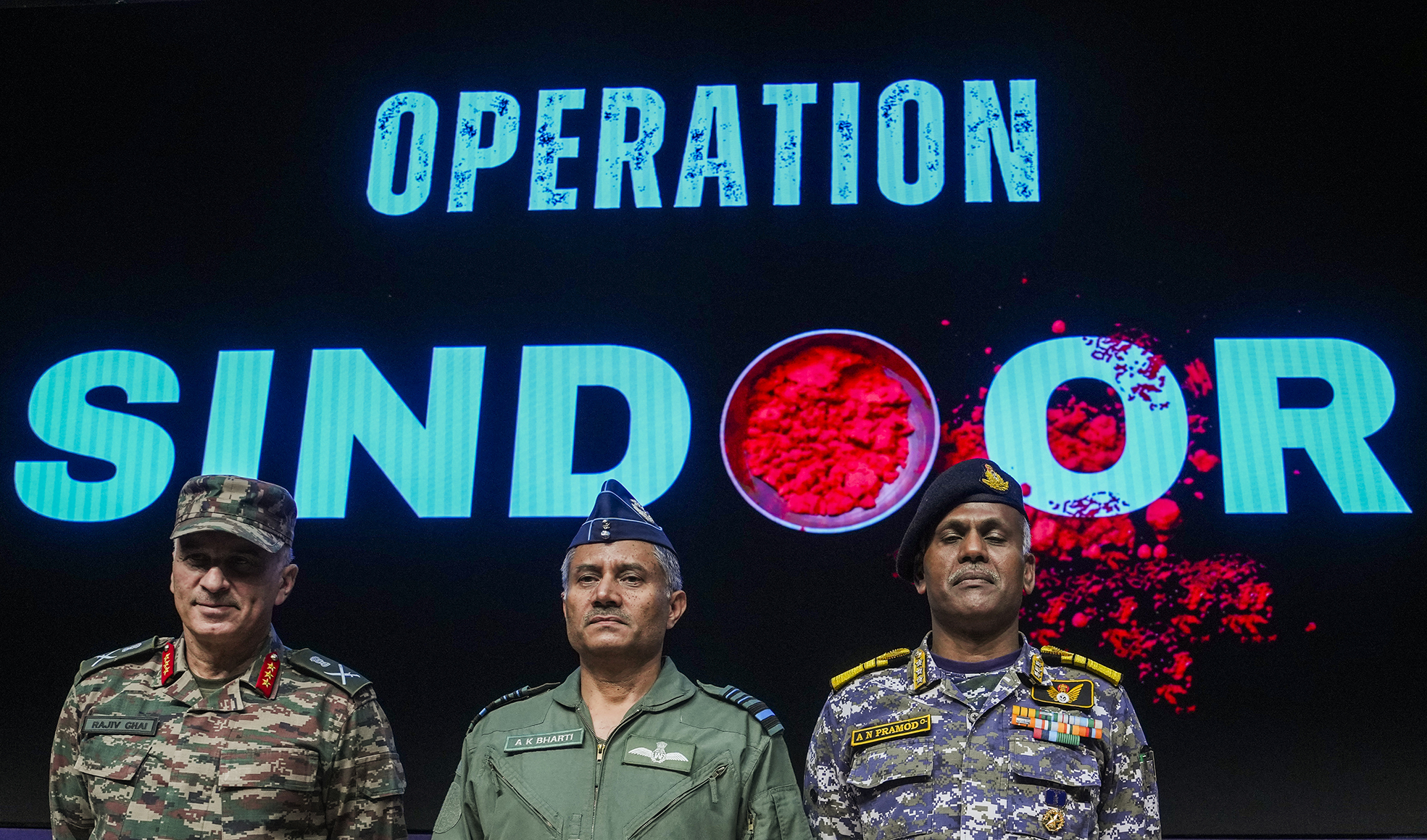
On the first anniversary of the Pahalgam attack, the Army in a post on X said, for acts against India, “the response is assured”, and carried a digital poster bearing an image portraying three armed soldiers in uniform standing next to each other against a backdrop that depicted a large red circle, with a caption “OPERATION SINDOOR CONTINUES…”.
One of the ‘Os’ in the word ‘SINDOOR’ was depicted by a bowl carrying a dash of ‘sindoor’ (vermilion), and a red line at the bottom printed in crimson hue.
Lt Gen Singh (retd) underlined that future operations are going to be multi-domain, “from space to undersea”, with a “web of communication” functioning simultaneously and not just as a “chain communication”.
Therefore, military communications will have to be robust and resilient to electronic warfare, cyber warfare and disruptions from space, he said, pitching for speeding up the indigenisation process.
Dinakar Peri, Fellow, security studies programme at Carnegie India, argued that “Op Sindoor was a watershed moment for India and the subcontinent in the way it established a military threshold, and the asymmetry between India and Pakistan.”
“That said, it also holds several lessons for India to maintain that superiority in the next conflict. Pakistan, and by extension China, knows what the Indian military is capable of and, more importantly, what the limitations are. The next conflict or Op Sindoor 2.0 will not be like the last one,” he said.
Days after the operation, the defence ministry approved several emergency procurements, including precision munitions, replenishing S-400 missile stocks, several drones, counter-drone systems, loitering munitions and Javelin anti-tank guided missiles, which would be under induction now as per the provisions, Peri said, underlining how India is implementing some of the key lessons.
“These will plug immediate gaps while several major capital procurement programmes approved recently, like the 114 Rafales under the medium multi-role aircraft deal, additional S-400 systems, new air defence guns, (and) aircraft, among others, take shape over the next few years,” he said. (PTI)
 Follow our WhatsApp channel
