

Excelsior Correspondent
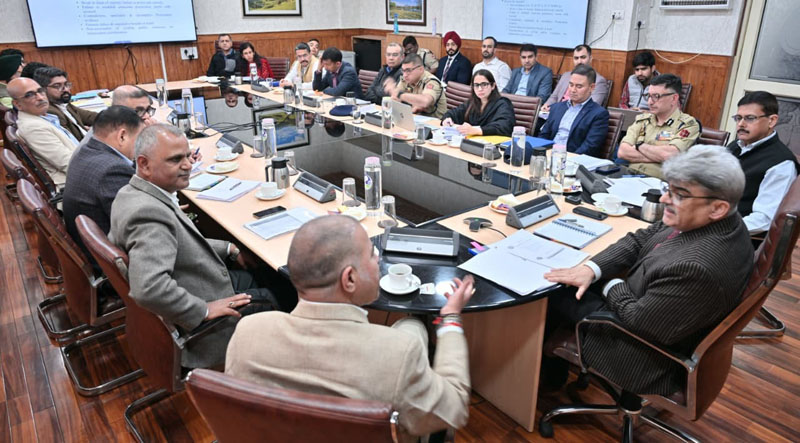
SRINAGAR, May 5: The 17th Union Territory-level meeting of the Narco Coordination Centre (NCORD) was today chaired by Chief Secretary Atal Dulloo, who undertook a comprehensive review of the Union Territory’s performance in stringent enforcement of drug laws, prosecution of offenders, and treatment and rehabilitation of victims affected by substance abuse.
The meeting was attended by the Director General, Police; Director General, Prosecution; Principal Secretary, Home; Administrative Secretaries; Divisional Commissioner, Jammu/Kashmir; and other senior civil and police officers, while Deputy Commissioners and Senior Superintendents of Police from all districts participated through video conferencing.
During the deliberations, the Chief Secretary laid emphasis on strengthening the legal framework and plugging procedural gaps in handling NDPS cases. He directed the Law Department to explore the feasibility of recording statements of in-service witnesses through video conferencing, particularly in cases where officials are transferred outside their districts, to ensure continuity and avoid delays in trials. Stressing accountability, he called for a thorough analysis of acquittals in NDPS cases and fixing responsibility wherever investigative or procedural lacunae are identified.
Highlighting the need for a more impactful enforcement strategy, the Chief Secretary underscored the importance of investigating both backward and forward linkages in drug trafficking cases and actively challenging bail orders to enhance deterrence. He called for a well-defined strategy to dismantle drug peddling networks, with strict action against identified offenders by law enforcement agencies.
Advocating a broader approach, he stressed the use of non-kinetic measures against violators, including cancellation of driving licences, passports, and vehicle registrations, besides scrutiny of financial transactions through bank accounts to choke illicit proceeds.
The Chief Secretary also enjoined upon Deputy Commissioners to ensure the functionality of inpatient (IPD) facilities in drug de-addiction centres in all district hospitals and asked the Health Department to strictly adhere to protocols for the availability of essential medicines at all health institutions.
Additionally, he called for strict action in cases involving seizure of vehicles under Section 52A of the NDPS Act to ensure effective enforcement of legal provisions.
On the occasion, Commissioner Secretary, Law, Achal Sethi, gave a detailed presentation on the incidence and categorization of NDPS cases across districts, highlighting trends in intermediate and commercial quantity cases. He elaborated on delays in disposal of such cases, the ratio of cases instituted versus those disposed of in special NDPS courts, and the stages at which these cases are pending. He also suggested a series of remedial measures aimed at reducing backlog and ensuring expeditious disposal of cases.
Earlier, IGP Crime, Sarah Rizvi presented a comprehensive overview of enforcement efforts, acquittals, and actions taken by law enforcement agencies to combat the drug menace in Jammu and Kashmir.
She informed that during 2026 so far, 542 NDPS cases have been registered across police stations, leading to the arrest of 716 individuals and seizure of 640 kilograms of narcotics valued at approximately Rs 18.49 Cr.
The participants held detailed deliberations on strengthening enforcement mechanisms, enhancing rehabilitation measures for affected individuals, and ensuring speedy disposal of cases to secure maximum punishment for offenders, thereby creating an effective deterrent against drug trafficking and abuse in the Union Territory.
 Follow our WhatsApp channel
