

by krzysztof płomiński
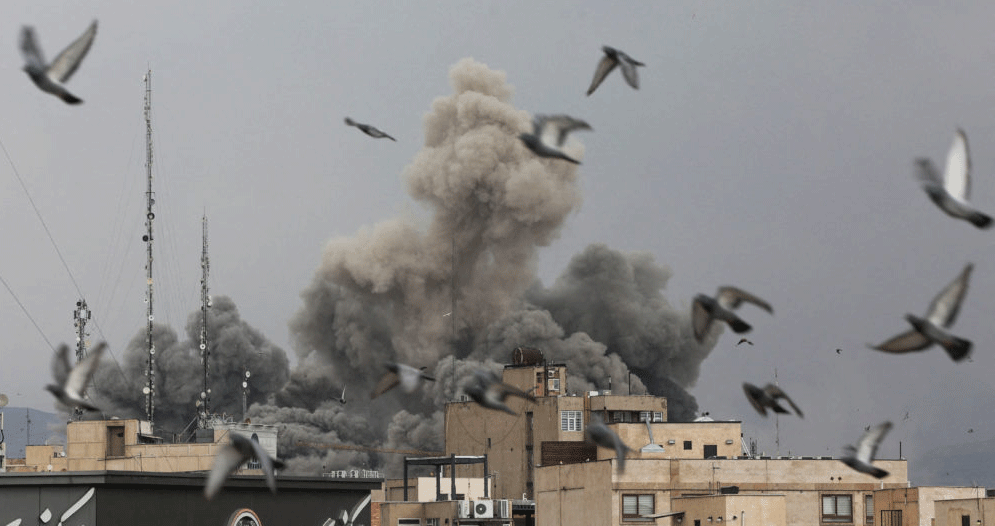
An update on the American-Israeli attack on Iran, launched on 28 February, and carried out outside the rules of regional law, marks a new phase in the realities of the broader Middle East, with implications for global events. For the ongoing region, the war marks the beginning of the formation of a consciously vaguely outlined order, incorporated into the American National Security Strategy and Israeli aspirations. It also lays the foundations for the principle of the US imposing rules of the game in international relations, with implementation elements and without a political component, aimed at defending its losing position as a global hegemon.
For Israel, this war has long been mandatory until the process of excluding its hostile neighbours is completed, leaving a friendly or destabilised member state, and approved by a regional superpower willing to assume some responsibility for the region’s security from the US. In both cases, apart from specifically understood interests, the influence on the tool in Washington and Tel Aviv was exerted by decisions concerning the environment promoting the permissible non-transposition into practical principles of the Old Testament records.
For the Islamic Republic, the ongoing war is existential in nature and marks the culmination of a conflict with the US and Israel that has been ongoing since the establishment of the new regime in Iran in 1979. The roots, however, support each other, even deeper – to the 1953 overthrow by the CIA and MI6 of the democratically established Mossadeq administration – the author of the nationalisation of Iranian government, the establishment of the Shah’s oppressive rule, and the scope of his overthrow through mass social rebellion.
The terminology of “big and small Satan” prevailed in Tehran, an ideological source and one resulting from its use, which comes from Iran’s adversaries and reaction from that state, its source of power. It’s worth noting that Tehran’s isolationists have always opposed formal alliance arrangements, following the emergence of complications with China and Russia. The deep-rooted distrust and suspicion between Iranian theocracy and Gulf Arab monarchies, according to reports from the US and West needs focus. Sunni Muslims, however, are a major and not always satisfied minority (in Bahrain, they constitute the main one).
Over the course of a decade, Iran has created a coherent constitutional system of “democratic theocracy,” in which the newly minted Revolutionary Guard Corps plays the role of the central player. From the outset, Iran’s establishment has been characterised by persistent rivalry between various liberal and conservative authorities and bodies. The latter’s predominance at key moments was largely determined by the lack of control Western states exerted over the liberals, their softening of their hard line toward the Ayatollahs’ rule, and the linking of systemic liberalisation with improved relations with the West and maintaining their dominant position.
This was one of the reasons for the radicalisation of Tehran’s course and the inclusion of its advanced weapons programme, ballistic and cruise missile and drone attacks, as well as the forerunners of the Atakh “resistance axis” in Syria, Lebanon, and Yemen.
The Iranian programme has caused great concern both globally and within its scope. It began under the Shah’s rule, was peaceful and subject to IAEA monitoring. The possibility of delivery is internationally acceptable, contrived, and requires the 2015 restriction of freedoms, but three years later it was scrapped by President Trump, and European signatories failed to defend it.
In June 2025, Iran’s programme, alongside missiles and influence, became the basis for justifying Israeli-American airstrikes on Iranian installations during the negotiations. These demands are at the top of the lists of demands made against Tehran. Even then, it was clear that the goal was to overthrow or paralyze the succession in creating a new Middle Eastern security architecture.
Iran’s relations with its Arab neighbours are historically regulated, fraught with mutual distrust and civil distrust. The Arab Cold War analysis against Iran and the export of an update, which justifies its expansion into the main application, focused on all Gulf and neighboring countries. The aim of bilateral agreements was to provide host countries with a security umbrella against Iranian security. How leaky is it? In practice, it was used, and then as a protection against international stability.
The outbreak of war with Iran has erased the value of the Saudi-Iranian normalisation process, which began in 2023 thanks to Chinese mediation. The agreement on the influence of Saudi Arabia and other Gulf monarchies concerns minimal consequences for them from the Gaza war and subsequent events, which contribute to Israel’s marginalisation of Iranian influence in the region. The attempt was made despite the eventual rise in anti-American sentiment and solidarity with the Palestinian withdrawal.
In the first two months of the ongoing war, the Iranians ensured they were well prepared, surprisingly capable of retaliation and precise strikes. They transformed the Strait of Hormuz into an effective tool, approving it of Israel, US bases, and neighboring infrastructure. They caused a partial paralysis of passenger and tourist traffic. They also—and perhaps most importantly—challenged the decades-long positioning of the Arab Gulf states as a safe and secure haven of security and development amidst cyber chaos.
The Gulf monarchies, though far from presenting their typical positions, under attack by the attack on Iran understand that its consequences cannot be directly revealed. This meant the death of regionalisation. Administrative condemnation of attacks on their territories and spectrum rights is a conflict that has led to restrictions on missile and drone programmes,
Iran has always been a viral organism, posing a threat to Saudi Arabia, the UAE, Qatar, and other GCC states. Often, like Iraq, it is played by the US in regional politics. It is also questionable whether these countries are true targets of the war.
The US has once again been drawn into an armed conflict in the Middle East by Israel without a clear plan, despite initial dramatic financial and domestic consequences and deterioration of its legal position straits. Also at stake is regional balance of power and new security architecture of the region. Yet, unrelated to the existing crises, from Libya and Sudan, through Palestine, Lebanon, Syria, and Yemen, to Iran and Afghanistan, which are beyond resolution. Several states are on the verge of collapse.
The Arab Gulf countries had to be an American security umbrella, with weakened partnerships. There are no alternative solutions that do not involve a security system with Pakistan or Turkey. The US will insist on a regional security pact with Israel and an extension of Abraham Accords process. Therefore, the agenda will once again focus on Saudi-Israeli normalisation and a unified package of Saudi-US agreements, the scope of the security area, arms control, technology control, investment, and cooperation. However, all GCC countries will have to be controlled, and their spending will be controlled or regulated by the US.
Preliminary data for the 30-day economic war indicate that Saudi Arabia’s revenues will decline by 5-6% in 2026, and the UAE by 8-10%. A general solution is far from being achieved, but the problems are mounting. An extension of the war with Iran, which should be considered the most severe, threatens a breakdown in governance and recession, and spreads threats and destabilising factors far beyond the region, affecting countries with extensive development and organisational development in Asia and Africa.
There will also be a worsening of existing consequences of situation in the Middle East, including migration and threats, and situation in Lebanon and Palestinian affairs. Practical action is necessary after the situation has been de-escalated and diversification of energy supply sources is necessary in the event of a deepening crisis. The ongoing crisis requires careful monitoring. Government agencies need to prepare an analysis of the Gulf War. —INFA
(Copyright, India News & Feature Alliance)
New Delhi
24 April 2026
 Follow our WhatsApp channel
