

Vishal Sharma
Iran has taken on two of the preeminent military powers of the world and still come out as more than also- ran in the fight. In fact, if anything, its resilience and retaliatory strikes on Israel, Gulf countries and on the US assets in and around Gulf region has shown that wars are not won with the cutting edge war fighting technologies and resource rich militaries alone. A little bit of character and pride in country’s values is also needed. When a country collectively decides to fight it out not that it has to because there is a war thrust on it, but because the adversary is hell bent on berating its civilizational heritage and wiping it out from the face of the earth, the writing on the wall for the adversary is too clear to be missed. When the battle becomes existential, the character of a nation comes to the fore and the clarion call from the powers that be to rally around the flag becomes more than a rallying cry, deriving its sustenance from the perceived greatness of a nation; it’s millennia old history. The war whoop becomes a holy gospel for the people of the country and in some cases even for those who until then may not have even made up their minds.
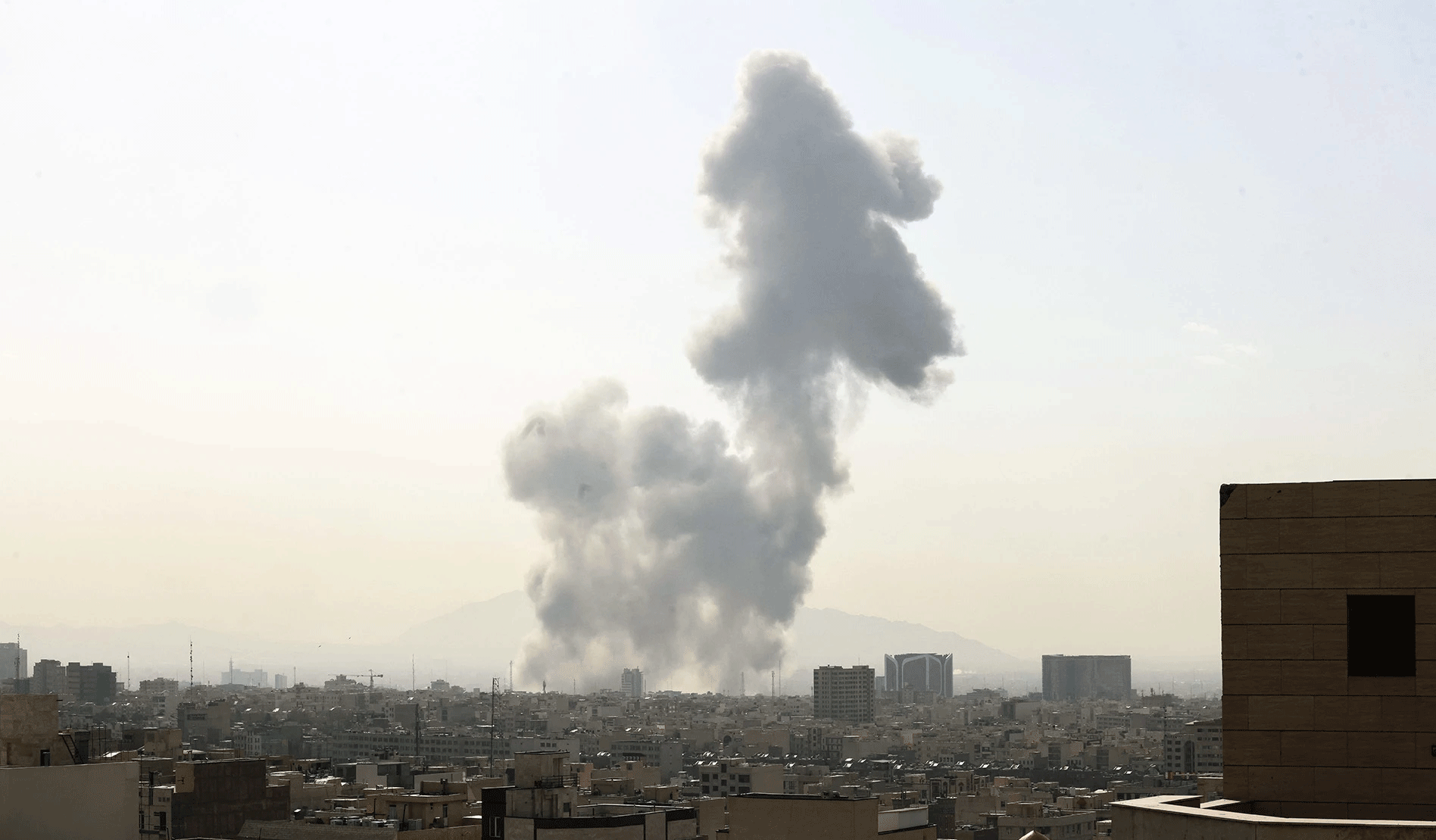
Before 27th Feb when the first bombs dropped on Tehran, Iran was reportedly faced with some measure of dissension from within. There were reports that some sections of people hostile to the establishment demonstrated on the streets beginning in late December 2025 and continuing into early 2026. These demonstrations were met with a violent crackdown by security forces. Some media reports indicated that thousands of people were killed, with over 2,000 deaths reported by the Human Rights Activists News Agency by mid-January.Protests took the shape of street demonstrations, nightly rooftop chants, and defiance of restrictions despite intense security presence and internet shutdowns. Before the heavy hand of the Iran’s Basij militia squashed these demonstrations, the agitators even urged the US president, Donald J Trump to intervene and liberate Iran from IRGC. After reports of deadly force against protesters hit the international media headlines, Trump threatened to intervene, stating in early January that if Iran killed peaceful protesters, the U.S. would come to their rescue, famously tweeting that the U.S. was “locked and loaded and ready to go”. On January 13, Trump even directly addressed Iranian demonstrators, telling them “Help is on its way” and urging them to “take over your institutions”.Even Israeli Prime Minister Benjamin Netanyahu called on Iranian citizens to overthrow the Tehran regime during a televised address dedicated to the joint military operation against Iran launched by Israel and the US on 28th Feb.
“In the coming days, we intend to do everything we can to give the Iranian people the opportunity to gain freedom, so I am once again addressing the Iranian people and saying: do not sit idly by, very soon the moment will come when you must take to the streets to finish the job and overthrow the totalitarian regime,” Netanyahu said in a speech broadcast on Israeli TV
Help did arrive, but it was too little too late. By then the protestors had paid with their lives.
There have not been reports of any mass protests in Iran ever since. Since IRGC has made Iran net blind, there may be a possibility that some dissensions may have happened, but curbed immediately. Be that as it may, it does not appear that any protest against IRGC has been able to reach the critical threshold where it could become a nuisance for the IRGC and, as a result, throw spanner in its war plans. Remember, IRGC has had its hands full any way on the war front. For the most part, it has been running around the country to save itself and its assets from the continuous US-Israeli bombing until the ceasefire intervened. Furthermore, IRGC controlled Basij militia has also not had a free run to really go around bullying the anti IRGC people into submission. With its leader assassinated, its cadres for the most part have been busy avoiding bombs that kept raining on them until a few weeks ago. This then raises a question: why have the anti -establishment sections in Iran not so much as even tried to rally their supporters and ramp up protestations across Iran? If they could do so when IRGC leaders were alive and in control and when Tehran had unfettered control of power levers, why have they not been able to raise a banner of revolt against the IRGC? They did it when IRGC death squads were more likely to hunt them down and kill them. In contrast, odds on them being persecuted on a scale comparable to that before Feb 28 were low by all imaginable calculations.
There would have been another added benefit of anti IRGC or establishment chaos on the streets of Tehran and elsewhere now when there is understandably considerable disarray in the ranks of IRGC and the political establishment. It would have emboldened both Trump and Netanyahu to press ahead with the kinetic campaign. It is less likely that Trump would have announced the ceasefire and begun parleys with Tehran if civil strife within Iran had been all too visible. To Trump’s dismay, he did not get what he came looking for in Iran, upending in many ways predominantly the rationale for war against Iran.
There is a widespread view that Tehran was not bending over backwards to seek cessation of hostilities with the US and Israel although by all measures it has suffered immense death and destruction in the now paused air campaign. Trump’s hands in many ways have been forced by the resilience and counter action shown by Tehran and inexplicable absence of anti establishment cries on the streets of Iran. The logic that partially guided the initiation of war against Iran( the other strand of logic being denuclearising Iran)would have only got buttressed by a series of protests against the Tehran establishment during the war. For Trump, therefore, it couldn’t have more bitterly humiliating as he finds that his prognosis on quick Venezuela type operation in Iran has been bereft of vacuity.
The two week ceasefire announced on April 8 has been indefinitely extended by Trump on April 21-22. Trump’s extended the ceasefire hoping that Tehran will submit a plan to end the war permanently. But he wants the war to end on his terms, based on his 15 point formula. He is not willing to consider Tehran’s counter plan of 10 point programme. In the meantime while guns have fallen silent and skies over Tehran and in Gulf and Israel are calm, Trump has laid a siege on Strait of Hormuz with the objective of choking Iran’s economy. Economic blockade is an act of war and Tehran’s made its position on it very clear. First round of talks in Islamabad has failed as Tehran refused to agree to one sided concessions. Having burnt his fingers in air campaign, Trump now thinks that Tehran can be forced to cut a deal with an economic blockade. His first assumption as regards internal dissension acting as a fifth columnist in Iran has miserably failed. Let us see whether his second assumption on Tehran capitulating to an economic blockade will turn out to be true.
 Follow our WhatsApp channel
