

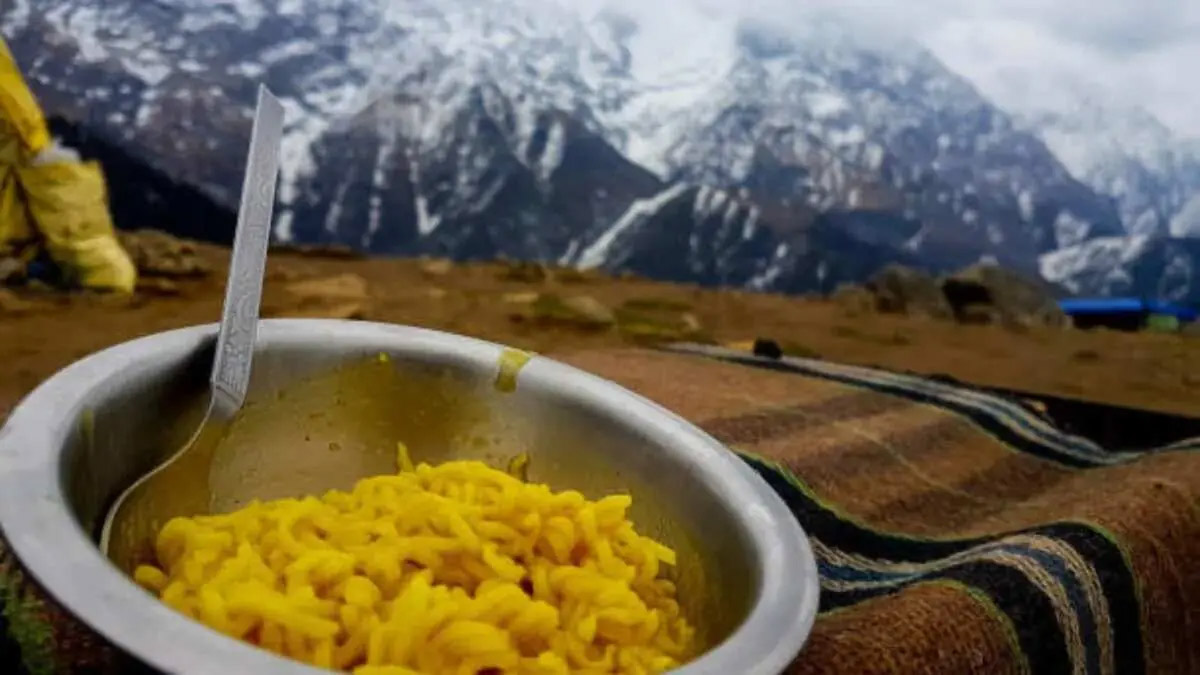
You don’t go looking for it. It finds you — at a bend in the road, in the cold, just when you need it most. From Shivpuri to Landour, Maggi has been following Sujoy Dhar up every hill
I was standing at Shivpuri near Rishikesh, soaking wet, about to jump off a rock into the Ganga after a white water rafting run, when I truly understood what pahari Maggi was about. Someone had set up a small stall by the riverbank on the rock — a gas cylinder, a battered pot, and a view of the river that no restaurant in any city could afford to put on its menu. The Maggi came in a steel bowl, slightly soupy the way hill Maggi always is, steam rising in the cold air. I ate it standing up, wet swimsuit, river water still dripping off my chin, mountains watching.
It was, without any exaggeration, one of the best things I have ever eaten.
I have thought about why since. The honest answer is that food is mostly context, and that was possibly the best context food has ever had.
The Egg on Top of Maggi: Notes from Char Dukan, Landour
Shivpuri was in 2015. Years later in April 2026, I found myself on the steep, narrow road up to Landour — the quiet hill station above Mussoorie that somehow still feels like it belongs to people who actually love mountains rather than those who want photographs of them. And all the way up, before I even reached the famous Char Dukan, Maggi stalls kept appearing at the roadside like little beacons. A tarpaulin, a gas stove, a pot, sometimes a plastic bench. A dog nearby, always. Each one a small argument for stopping. I made a mental note and kept climbing.
Char Dukan was worth the wait. Four shops—five or six if you’re counting generously—sit together at a point where Landour’s road briefly loses its ambition and flattens out, smelling of pine and woodsmoke and something frying. Taking a seat at the Char Dukan Cafe, I ordered Maggi with a scrambled egg on top, sat outside with a coffee, and watched the hills settle into their afternoon arrangement. The egg upgrade is not a gourmet decision. It is simply the right one — the yolk breaks into the noodles and turns something humble into something that actually fills you. I ate slowly. No one was waiting for me anywhere. That is the best thing about travelling alone and I never take it for granted.
I have wondered, genuinely, why Maggi became the hill station food of India. A country with the depth and variety of our culinary tradition reaches for a Swiss-origin two-minute noodle—introduced by a multinational in 1983—when cold and hungry, sometimes at 6,000 feet. There is something almost funny about it, until you think about it properly.
A Swiss Import, an Indian Obsession
Nestlé launched Maggi in India targeting busy urban households. It found its real home somewhere else entirely — in small dhabas and roadside stalls where speed and low cost and a gas cylinder were the whole kitchen. The hills adopted it quickly and completely, and for practical reasons that made obvious sense. Altitude, cold, a hungry tourist, a packet that costs almost nothing and takes two minutes — the economics were impossible to argue with. But economics alone do not explain devotion, and what Indians feel for pahari Maggi is closer to devotion than preference.
Cold air does something to the appetite that is hard to explain until you have experienced it. Things taste sharper, more essential. And Maggi in the hills — slightly watery, arriving too hot to eat immediately, in a steel bowl with a spoon that has clearly had a full life — tastes like the mountain has decided to take care of you. That is the only way I know how to put it.
Celebrities have said versions of this on camera more times than anyone has counted. Virat Kohli has mentioned it. Ranbir Kapoor has talked about it. Every travel person who has ever been to Manali or Kasol or Chopta has the Maggi photograph — steam rising, peaks behind, expression of exaggerated bliss. The format is so established it is practically a genre of its own now. And yet it keeps landing, because the feeling underneath it is real. People are not performing. They genuinely feel that way.
Even the 2015 ban told you everything you needed to know. When the government pulled Maggi from shelves over food safety concerns, the country reacted with a grief that was entirely out of proportion to the object in question. People stockpiled it before it disappeared. They talked about it like something had been taken from them. When it came back nine months later, the scenes outside shops were reported like a homecoming. That is not brand loyalty. That is something more personal.
Not Just Noodles
Here is what I think is actually happening, though, when someone sits at a roadside stall in the hills and eats a bowl of Maggi and feels, briefly, that everything is fine.
Solo travel in India can be a relentless experience. The noise, the crowds, the constant negotiation with the world, the energy of a country that is never quite switched off. And then you find a bench somewhere — at Char Dukan, or above Rishikesh, or on some half-forgotten road to Kedarnath — and a bowl arrives, and for ten minutes everything simplifies down to just you and the steam and the mountains and the noodles. Nothing is required. Nothing needs deciding. The trip, which has been a series of logistics and plans and minor complications, becomes for a moment exactly what you hoped it would be when you first thought of going.
That is what pahari Maggi is selling. Not noodles. The permission to stop being in a hurry.
I finished my bowl at Char Dukan, ordered another coffee, and watched a dog arrange himself in a patch of afternoon sun with the focused dedication of someone who has found their purpose — while inside the open café, a cat he had been chasing sat curled and perfectly safe, the matter settled. Somewhere far below, Mussoorie was loud, crowded, and entirely itself. Up here the road was empty, the trees were tall and unhurried, and I had nowhere to be for the rest of the afternoon.
I cannot think of a better way to eat Maggi. I am not sure there is one.
Not In Town News (NITN) /TWF
 Follow our WhatsApp channel
