

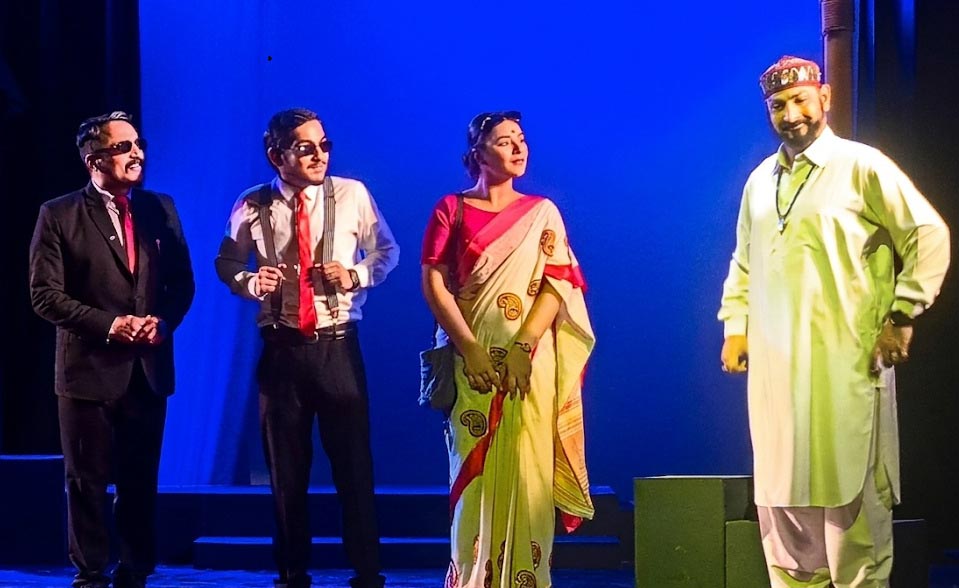
‘Ek Tha Gadha’
Ravinder Kaul
JAMMU, Apr 18: ‘Ek Tha Gadha’, the play presented by Rangyug at Abhinav Theatre on Saturday is one of the most profound satires of Indian theatre that has been performed by several theatre groups across the length and breadth of not only India but globally. Written by Sharad Joshi, one of the most admired satirists of our country and first published and performed in the year 1979, the fact that the play is still found relevant by the theatre groups today is a sad commentary on the state of affairs in not only in our own country but across the world.
The play is a biting critique of political opportunism, bureaucratic absurdity, and the manipulation of the common man.
The story is set in a small kingdom ruled by a wily and vain Nawab. The plot is set in motion by a simple event in which Juggan Dhobi’s donkey, named Aladad Khan, dies. Distraught by the loss of his livelihood, Juggan laments loudly. A local Kotwal (police officer), more interested in impressing the Nawab than investigating facts, hears the name Aladad Khan and assumes that a prominent citizen has died. He informs the Nawab, who, sensing an opportunity to gain public sympathy, declares a state funeral for this ‘great man’.
When it is eventually discovered that Aladad Khan was actually a donkey, the Nawab faces a crisis of reputation. Rather than admitting the mistake, the state machinery takes a ruthless turn. They decide that since a funeral for Aladad Khan has been announced, a man by that name must die. They find a commoner named Aladad Khan, kill him, and proceed with the royal funeral to prove the Nawab’s concern for his subjects.
The play is timeless because it highlights how the state treats citizens as beasts of burden or mere props for political theater. Sharad Joshi used humor to mask a terrifying reality: that in a corrupt system, a ruler’s image is worth more than a commoner’s life.
Today’s performance by Rangyug was, once again, a compelling example of the seriousness and devotion with which it pursues its theatrical commitment. The play had been mounted on a symbolic stage with the artistes also donning symbolic costumes, not strictly in tune with the times of the Nawabs, denoting the timelessness of the theme.
Raj Kumar Behrupia lived the role of the vain, image-conscious ruler. His histrionic abilities were in full display while delivering some of the most profound and, at the same time, hilarious dialogues of Indian theatre. His mannerism, style and dialogue delivery was perfectly suited to the character that he was portraying.
Soham Kashyap, in the role of Kotwal, was successful in presenting the image of a debauch, corrupt and ruthless Kotwal. Pradeep Sharma, Akshar Vashisht and Anandita Dutta were effective and convincing as the three sycophantic Chintaks whose only role is to feed the fancy of the wily Nawab. Ashish Sharma as Juggan, the Dhobi endlessly mourning the loss of his donkey, was impressive in portraying his pain and agony. Vivek Sangotra representing the viewpoint of the artistes was effective and convincing.
Music by veteran Suraj Singh was effective and as per the theme of the play. The singers too gave a good account of themselves.
Deepak Kumar, the director of the play, has built a reputation for himself over the years as a thinking and committed Director.
One more positive feature of today’s performance was a jam-packed auditorium in which people had bought tickets to watch this play.
 Follow our WhatsApp channel
