

Gautam Sharma
An Epoch of Spiritual Awakening
The 15th century in North-West India was a time of political complexity and social flux. Amidst this backdrop, the spiritual sun of Sadguru Baba Kanshi Giri Ji rose, illuminating the region with a powerful resurgence of Sanatan Dharma. His path was not just one of personal enlightenment; it was a tireless mission to restore the ancient Guru-Shishya Parampara and embed the values of selfless service (Seva) and right living (Dharam) into the heart of society.
The Foundation: Katas Raj Tirth and the Call to Bhagwan Shiv
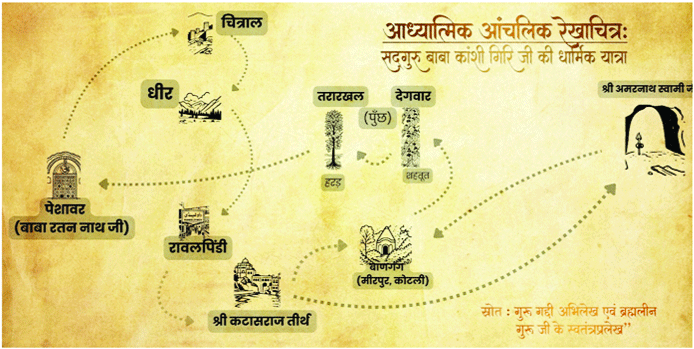
Baba Ji’s spiritual journey began with an initial pilgrimage to the ancient and sacred Katas Raj Tirth ( Pakistan Punjab ) undertaken with his two brothers. The sacred pools and shrines, deeply associated with Bhagwan Shiv, served as the launching ground for his quest. It was here, amidst the divine vibrations of the Tirth, that Baba Ji received a profound inner calling to venture toward the holy Amarnath Cave. This spiritual pull marked the beginning of his deep introspection and set the stage for his most foundational pilgrimage.
The Tapasya at Amarnath: Enlightenment and Ashirwaad
Drawn by that divine call, Baba Ji ventured deep into the formidable Himalayan ranges. It was during this journey to the holy Amarnath Cave that a critical turning point occurred: Baba Ji became separated from his two brothers. This solitude allowed him to enter the sacred cave alone, he performed extraordinary Tapasya (intense meditation) dedicated to Bhagwan Shiv.
Pleased with his unwavering devotion, Bhagwan Shiv appeared and granted him divine Ashirwaad (blessings). Along with several other Vardans (boons), he was commanded to establish and lead a spiritual seat, the Guru Gaddi, to guide humanity.
Establishment of the Guru Gaddi at Bangang
Following his enlightenment, Baba Ji returned to the village of Bangang (Munjwal, Tehsil Kotli, Mirpur-now in POJK). He established the Guru Gaddi here, transforming this tranquil spot into the foundational center for his teachings. This Guru Gaddi became the spiritual epicenter from which he launched his Dharam Yatras.
The Dharam Yatras: Propagating the Faith
From Bangang, Baba Ji began an extensive circuit to strengthen the people’s connection to Sanatan values These details of his travels, preserved and presented by the Guru Gaddi 1008 Sadguru Baba kanshi Giri ji Banpuri (Sunderbani), highlight his mission:
Degwar (Poonch): Accompanied by his two brothers and mounted on horseback, Baba Ji’s first major stop was Degwar. Here, he delivered his inaugural sermon after attaining enlightenment and divine blessings from Bhagwan Shiv. A miraculous legend survives from this visit: after bathing, the Guru planted a twig used for cleaning his teeth (datun) into the earth. Within no time, this twig blossomed into massive mulberry trees-a living testament to his divine power. Even today, this site remains a point of reverence for the local Gujjar community, transcending religious boundaries.
Trarkhel (Sudhnoti): In Trarkhel, another miracle unfolded. Baba Ji anchored his horses using a log of Harad (Myrobalan) wood. This dry log was transformed by his divine presence and took root, growing into a flourishing Harad tree. In the Vedic tradition, Harad symbolizes healing and purification; by manifesting this tree, the Guru signaled that true religion is about the tangible well-being and “Arogya” (health) of society.
Peshawar (Purushpur) and Chitral: The Baba ji’s resolve took him further into the frontier provinces. In the multicultural hub of Peshawar, he engaged with diverse populations and accepted Baba Ratan Nath Ji as his disciple, entrusting him with the spiritual stewardship of that region.His journey then turned toward the formidable heights of the Hindu Kush. Traveling through Chitral and Dir-areas characterized by tribal complexities and treacherous mountain passes-Baba Kanshi Giri Ji worked tirelessly to weave the fabric of Sanatan values into the local culture. His presence in these remote outposts served as a vital bridge, connecting the frontier tribes with the core tenets of selfless service (Seva) and right practice
The Circle Completes: The Divine Vision at Katas Raj Tirth
A pivotal anchor of his travels was Katas Raj Tirth. This site held deep personal significance, as Baba Ji’s birthplace was the village of Khari, located near the Tirth. Believed to be created from the tears of Bhagwan Shiv, Katas Raj served as a place of spiritual recharging.
Upon returning to Katas Raj Tirth after his extensive travels, Baba Ji experienced a divine realization regarding the future of the Guru Gaddi. As a Bal Bhramchari (lifelong celibate), he contemplated how to ensure the discourse and service of the Gaddi would continue for generations. Consequently, when he returned to Bangang, he requested his brothers to marry and raise families, ensuring a lineage that would sustain the Guru Gaddi’s mission to teach and serve disciples indefinitely.
A Legacy of Selfless Seva and Modern Continuity
The significance of Baba Kanshi Giri Ji’s mission lies in his three pillars:
* Dharam (Righteousness): A moral compass based on ancient wisdom.
* Vyavahar (Right Practice): Moving beyond rituals to ethical living.
Seva (Selfless Service): Viewing the service of humanity as the highest worship.
The Seat at Banpuri (Sunderbani)
The flame lit by Baba Ji continues to burn. Following the partition, the original seat remained in POJK. To ensure continuity, Bharamleen Guru Gosain Mela Ram Ji established the Guru Gaddi at Banpuri, Sunderbani.
Under the present guidance of Guru Gosain Brij Bhushan Ji , the Guru Gaddi at banpuri sunderbani remains a spiritual beacon. This year marks the 60th Annual Mahayagya at Banpuri Sunderbani celebrating six decades of service and the enduring legacy of Sadguru Baba Kanshi Giri Ji Maharaj.
 Follow our WhatsApp channel
