

Excelsior Correspondent
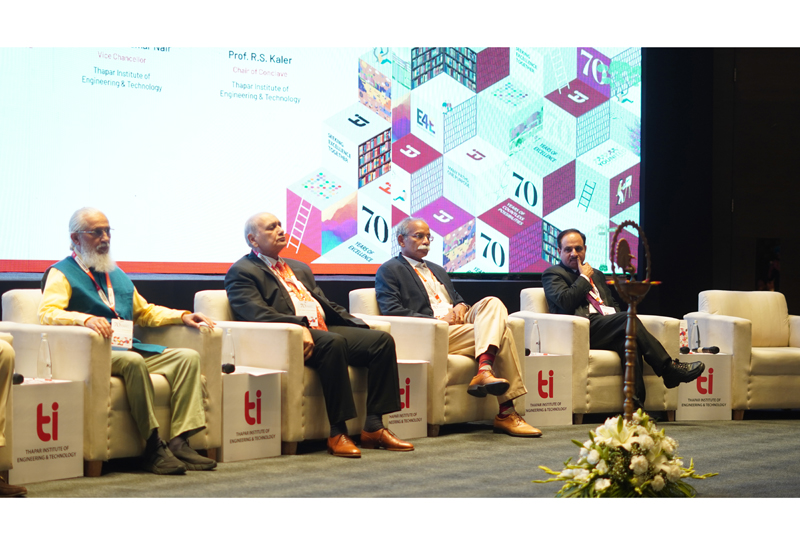
PATIALA, Apr 13: A two day long, ‘The Global Academic Leadership Summit 2026’ organised by Thapar Institute of Engineering & Technology (TIET) at Patiala was concluded here today.
The summit was convened under the patronage of Gautam Thapar, Managing Trustee, Thapar Education Trust and president, TIET and Rajeev Ranjan Vedrah, Member, Board of Governors, TIET, with Prof Padmakumar Nair, Vice Chancellor, TIET, as Patron and Prof Ajay Batish, Pro Vice Chancellor, TIET, as Co-Patron.
The summit was graced by Prof Anil Sahasrabudhe, Chairman, National Educational Technology Forum (NETF) and Chairman, Executive Committee, NAAC, as chief guest and senior industry leaders from Google, Atos and American Express.
The opening day’s two flagship sessions set a compelling tone.
“Viksit Bharat @2047: Role of Universities in Nation Building” explored how institutions can drive India’s long-term development agenda, while Artificial Intelligence and Digital Transformation in Higher Education challenged leaders to move beyond incremental thinking, redesigning curricula, integrating emerging technologies and building genuinely future-ready learning ecosystems.
Gautam Thapar eloquently traced TIET’s journey from its founding through periods of crisis to its present standing, grounding his remarks in the institute’s enduring commitment to resilience, relevance and social responsibility.
“The Global Academic Leadership Summit 2026 reflects our commitment to fostering meaningful dialogue on the future of higher education. As institutions navigate rapid technological and societal changes, it is essential to build frameworks that are inclusive, adaptive, and globally relevant – while contributing to national and global priorities” said Prof Padmakumar Nair, Vice Chancellor, TIET
Day 2 at the TIET campus deepened the conversation with sessions on Research Impact and Global Rankings, stressing the imperative for Indian institutions to raise their global research visibility and Sustainable Development Goals (SDGs) and Academia-Industry-Society Collaboration, which examined how universities and industry can forge more purposeful partnerships to address global challenges.
The summit concluded with a valedictory session celebrating two days of extraordinary exchange.
 Follow our WhatsApp channel
