

Rajinder Chand Anthal
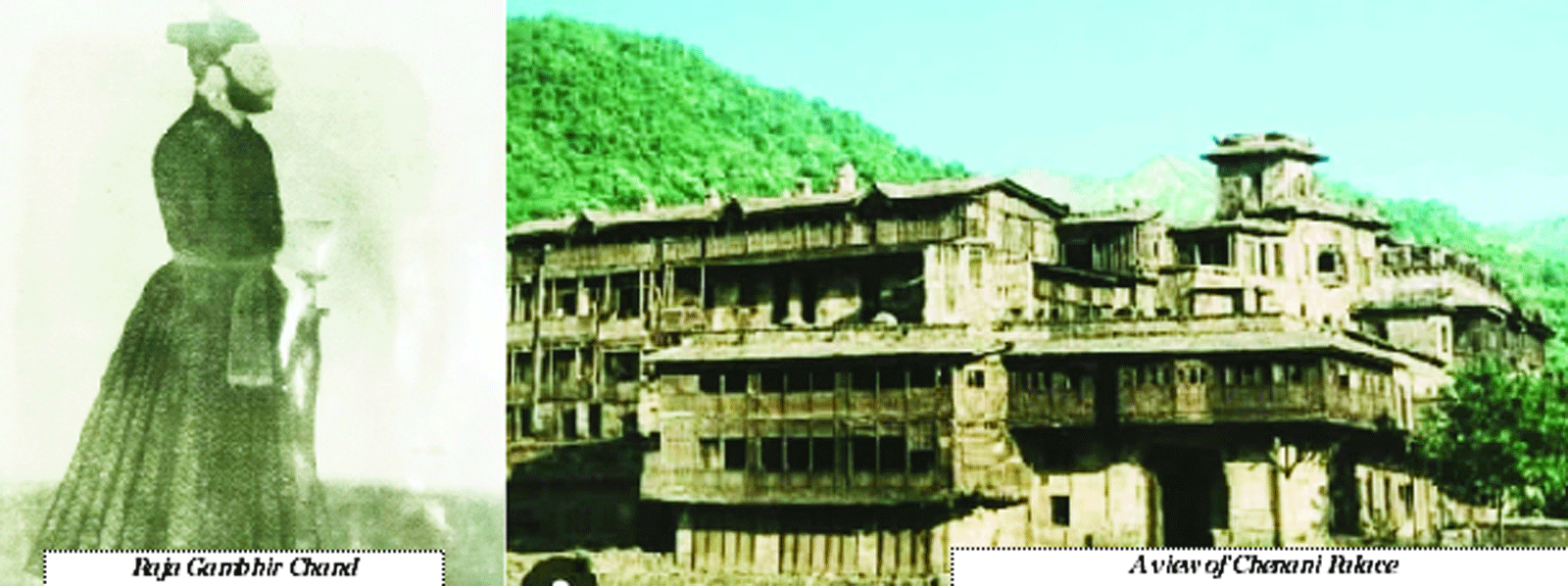
Chenani state has remained an important political entity in Udhampur district of Duggar Pradesh from a very early period of history. Chenani was a parent state established by Chandel dynasty Raja Gambhir Chand in about 9th Century A.D. Raja Gambhir Chand was son of famous Chandel dynasty king Raja Harihar Chand of Chanderi, Bundelkhand (M.P.). His rule has been described in about 8th Century A.D as 77th King of Chanderi.
Leaving his eldest son Govind Chand to rule Chanderi, Raja Harihar Chand proceeded on a pilgrimage of Mata Jawala ji in Kangra, Himachal Pradesh, with his remaining four sons namely Bir Chand, Gambhir Chand, Kabir Chand and Sabir Chand. On reaching Kangra, Raja Harihar Chand had darshan of Mata Jawala ji and remained the guest of Raja Kangra. During the course of playing friendly matches with the Katoch Raja, the armies of Raja Harihar Chand and Raja Kangra clashed when Chandels detected some trick played by Kangra army to ensure their victory. In the battle both Raja Kangra and Raja Harihar Chand were killed along with the youngest Chandel Rajkumar Sabir Chand.
After this incident, remaining three Rajkumars, Bir Chand, Gambhir Chand and Kabir Chand decided not to go back to Chanderi but to leave their future at the patronage of Mata Jawala ji. It is said that one day in the evening prayer, Raj Kumar Bir Chand and his brothers prayed before Jawala ji by saying “O Mata ji, we along with our father had come on your pilgrimage with pious heart, but we lost our father and brother without any fault on our own side. Now please show us the way ahead.” After the prayer they went to sleep. In the mid-night Mata Jawala ji appeared in the dream of Raj Kumar Bir Chand and said that this happened as per “BIDHI-KA-VIDHAN” (will of God) and thereafter she alloted them three separate kingdoms to rule. The vardhan of Jawala Mata came true and Bir Chand established a kingdom in nearby Kehlour area and Gambhir Chand and Kabir Chand stayed with him.
During the same time, Himta (Chenani) region of Duggar was ruled by Megh dynasty Raja Kunnu Ram with his capital at Mantlai. (Sources: Unpublished papers of R.K. Lachhman Chand of Chenani). The history of this kingdom tells us that Lord Shiva was pleased with the devotion of Megh community. After his marriage with Goddess Parvati, Lord Shiva handed over the kingdom of Mantlai to the ancestors of Megh Raja and went to Kailash parvat. In this way the kingdom of Mantalai came under the rule of Megh dynasty rulers, who ruled Himta region for centuries in a peaceful manner. Megh Raja has been described as weak ruler. He devoted most of his time in the worship of Lord Shiva. As a king he lacked administrative skills and capabilities. The Himta region was dominated by Ranas and Thakkar communities. They were original inhabitants of Himta. They were in the possession of big landed estates in almost all villages. These Thakkars and Ranas usually fought against each other over land disputes but also maintained matrimonial relations with each other. They considered themselves independent and frequently refused to accept the authority of Megh Raja being of low caste. There were frequent revolts against the king. The lawlessness caused revenue loss to the state and Megh Raja was helpless to provide safety and security to his people.
Being a well-wisher of his subjects and God fearing, Megh Raja thought to seek help from some outside king to control the situation. He had heard about brave kings of Rajasthan and Central India. He called his confidants and told them his plan. Secretly he carried large quantity of gold coins with him and moved out of Mantlai on the pretext of pilgrimage. He reached Jawala ji after some days. He worshipped the deity and stayed for some days in the temple.
One evening he saw some strangers coming towards the temple on horses. By appearance they looked like Rajputs. Megh Raja and three strangers participated in the evening prayer in temple. Megh Raja was unaware of the fact that his destiny was bringing him near his cause. After the evening prayers, the Megh Raja bowed before them and asked them about their identity. The elder one told him their story of unfortunate events at Kangra and also that he has established a kingdom in nearby Kehlour (Bilaspur) area and younger brothers are staying with him. Thereafter, they asked the Megh Raja about his identity. He told them that he belongs to Megh dynasty and Lord Shiva has given the kingdom of Mantlai to his ancestors and he is the present Raja of Himta region with his capital at Mantlai. To prove his identity, he unstitched his secret clothing and showed them heaps of gold coins in his possession. He told them about the revolts and civil unrest in his kingdom created by outlaws and he expressed his desire that he would prefer to handover his kingdom to some God fearing and brave king. He requested Raja Bir Chand for help.
After detailed discussion, Bir Chand asked his younger brother Gambhir Chand to accompany Megh Raja to Mantlai with some army. Upon reaching Mantlai, Gambhir Chand realised that the situation requires deep strategic planning to control the revolt and to restore rule of law in the area.
The Ranas and Thakkar groups got the information about the developments at Mantlai. They started secret meetings to meet the challenge of new armed command of Gambhir Chand. The Ranas and Thakkars intensified minor conflicts with the state forces at various points, initiating sudden attacks in hit and run manner. By way of repeated defeats, the Ranas and Thakkars decided to leave their differences aside and fight jointly with the army of Gambhir Chand.
One day Gambhir Chand got information that hundreds of Ranas and Thakkars have assembled in a large house ahead of Sudh Mahadev town with their arms and ammunition for sudden attack at Mantlai in the wee hours of next morning. On the basis of this information, Gambhir Chand prepared a plan for final attack on the hide out of hill chiefs. In the dark of night, Gambhir Chand laid the siege on fortification of Ranas. The hill chiefs were unaware of this. At mid-night Gambhir Chand asked his army to attack the stronghold of enemy immediately. Due to sudden attack, the enemy got confused and everybody ran for safety, but got killed while escaping behind shield of ladies and children. The forces of Megh Raja later set the building on fire. The ladies and children were given safe passage. Till morning everything was calm there and the army of Gambhir Chand attained victory. The remaining Ranas and Thakkars crossed hills for safety and settled at far off places in Doda area. Others who pledged loyalty to the king were allowed to remain in their villages to live peacefully.
After this victory, the Megh Raja realised the contribution of Gambhir Chand to save his area from the clutches of outlaws, so in consultation with his men, he announced for the coronation of Gambhir Chand as Raja of Himta region. The Raj tilak of Gambhir Chand was held in the temple of Lord Shiva at Sudh Mahadev by the Nath yogi peer. Megh Raja, along-with his family retired to the worship of Lord Shiva for the remaining period of his life.
By the same time the third brother Kabir Chand also established separate kingdom for him in Kumaon (Uttrakhand) region. In this way the Vardaan of Jawala came true and all three brothers got three separate kingdoms to rule.
Raja Gambhir Chand built his palace at Liensoo near Mantlai. He pledged to rule in the name of Lord Shiva. He announced a dress code for himself and future kings with saffron colour turban. The first and foremost task he did was to fix the territorial jurisdiction. He invited artisans, skilled workers, learned men and tradesmen from Chanderi and settled them in his area. He studied local culture and religious heritage and adopted it in practice. Local Gods of Nag cult were held in high esteem in this area like Vasuki Nag, Baba Purdwar and others. He and his descendants left past practices and followed new ways of life to the extent they got new surname and caste from Chandel to Anthal. The descendants of Gambhir Chand built small temple of Goddess Naina Devi in the upper reaches of Mantlai on the pattern of Naina Devi temple of Kehlour-Bilaspur. The Khajuraho style unique Jalandhara Mata temple near Kotli fort Udhampur was also constructed during this glorious period.
Raja Gambhir Chand developed tirthas like Sudh Mahadev, Mantlai and Beni-Sangam, situated alongside holy Devika river in this area and brought prosperity and sense of security among the masses with the blessings of Lord Shiva. In this way Gambhir Chand laid the foundation of a powerful kingdom of Anthal rajputs in Himta region, which later emerged as the state of Chenani with record of longest single dynasty ruled state upto the year of independence of India.
The stable rule of Anthal kings in Chenani contributed a lot in the social and economic development in Udhampur District, which emerged as one of the most visited districts for tourism in general and religious tourism in particular as it has some of the most prominent tirthas in Sudhmahadev-Mantalai circuit. Major trade and travel routes in the past passed through Chenani. The cultural events like fairs, festivals, jattars and kudd of Chenani became unique identity of Udhampur District with participation of people belonging to all faiths and beliefs. Thus, Chenani remained closely linked and associated in socio-economic and cultural development in Udhampur District from the ages.
(The author is Retd. Zonal Education Officer)
 Follow our WhatsApp channel
