

Anil Paba
pabaanil@gmail.com
Caves form one of the most enduring elements of India’s cultural and historical heritage. From prehistoric shelters to medieval centres of faith and art, they reflect humanity’s evolving relationship with the natural environment. Across the subcontinent, sites such as Bhimbetka Rock Shelters, Ajanta Caves, Ellora Caves, Badami Cave Temples, Udayagiri Caves, Barabar Caves, and Elephanta Caves illustrate this long continuum. These caves preserve invaluable records of early habitation, religious transformation, artistic achievement, and intellectual life.
Within this wider Indian context, the Jammu region presents a significant yet comparatively understudied chapter of cave culture. Spread across its rugged hills and river valleys, caves-both natural and modified-have served as shelters, ritual spaces, and ascetic retreats from prehistoric to medieval times. Their distribution reflects not only ecological adaptation but also spiritual and cultural symbolism embedded in the landscape.
Archaeological indicators suggest that early human communities in Jammu utilized natural rock shelters as temporary or seasonal dwellings. Stone tools, occupation debris, and surface scatters found in various parts of the region point to early settlement patterns and adaptive strategies shaped by environmental conditions. These remains highlight the antiquity of human presence and confirm that Jammu formed part of the broader prehistoric network of the north-western Himalayas.
Over time, caves in the region assumed enhanced religious significance. With the spread of Hinduism and Buddhism, many were transformed into sacred spaces associated with meditation, penance, and worship. The secluded and serene environment of caves made them ideal for ascetics and sages seeking spiritual transcendence. Thus, caves in Jammu embody both survival history and sacred geography.
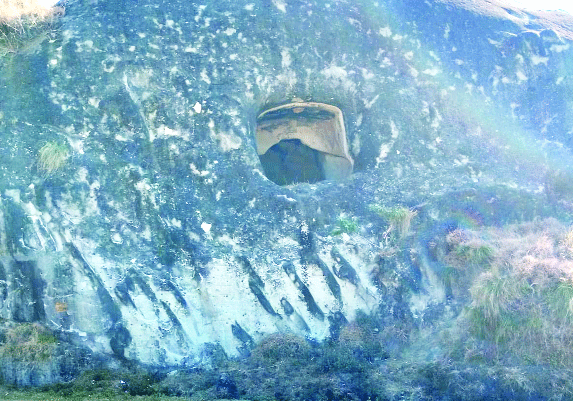
A significant addition to this cultural narrative is the discovery of the Debrah caves by the author in 1994 in Udhampur district Located within a landscape already known for prehistoric stone tools and fossil remains, these caves introduce a new dimension to understanding early human activity in the region. Preliminary observations indicate that the Debrah caves are man-made rather than purely natural formations. Their internal morphology suggests deliberate excavation to create sheltered spaces suitable for human use.
What makes the Debrah caves particularly intriguing is the apparent absence of refined chiselling, polishing, or advanced stone dressing techniques. This lack of sophisticated workmanship may indicate an early phase of excavation carried out with rudimentary tools, suggesting considerable antiquity. The structural simplicity points toward utilitarian objectives rather than elaborate architectural intent.
Notably, no rock paintings, petroglyphs, or inscriptions have so far been identified within these caves. The absence of symbolic or artistic expression supports the hypothesis that the Debrah caves were not permanent habitations or ritual complexes but temporary shelters. They may have functioned as seasonal stayhouses used intermittently by migratory or semi-nomadic groups navigating the Himalayan terrain.
The geographical position of Udhampur strengthens this interpretation. Situated in the north-western Himalayan belt, the district likely formed part of ancient migration corridors connecting Central Asia with the Indian subcontinent. Prehistoric populations moving through these routes would have required natural or semi-natural shelters for rest and protection. The Debrah caves may have served precisely such a purpose, acting as halting points along early migratory pathways.
Further significance lies in the potential correlation between the caves and nearby prehistoric tool assemblages. Surface discoveries of stone tools and cores in surrounding areas suggest associated activity zones. If systematic excavation and scientific dating confirm this connection, the Debrah caves could substantially enrich our understanding of settlement dynamics, subsistence strategies, and mobility patterns of early humans in Jammu.
The discovery underscores the need for systematic archaeological investigation in the region. Many cave sites in Jammu remain insufficiently explored and inadequately documented. Natural weathering, vegetation growth, and human interference pose ongoing threats. Without timely research and conservation efforts, valuable evidence of early human history may be irretrievably lost.
The Debrah caves thus represent more than an isolated find; they symbolize the untapped archaeological potential of the Jammu region. Their study could illuminate long-term human continuity in the north-western Himalayas and strengthen the region’s place within India’s broader prehistoric framework.
In conclusion, the cave culture of Jammu reflects a deep and enduring engagement between humans and their environment-first for survival, later for spirituality and cultural expression. The Debrah caves of Udhampur add an important prehistoric dimension to this narrative. While preliminary observations suggest their use as temporary shelters linked to early migratory communities, comprehensive interdisciplinary research-including excavation, dating, and environmental studies-is essential to establish a definitive chronology. Proper documentation and preservation will ensure that this newly discovered heritage site contributes meaningfully to our understanding of India’s ancient past and to the cultural pride of Jammu and Kashmir.
(The author is Co Convener INTACH Sub-Chapter of Jammu Chapter)
 Follow our WhatsApp channel
