

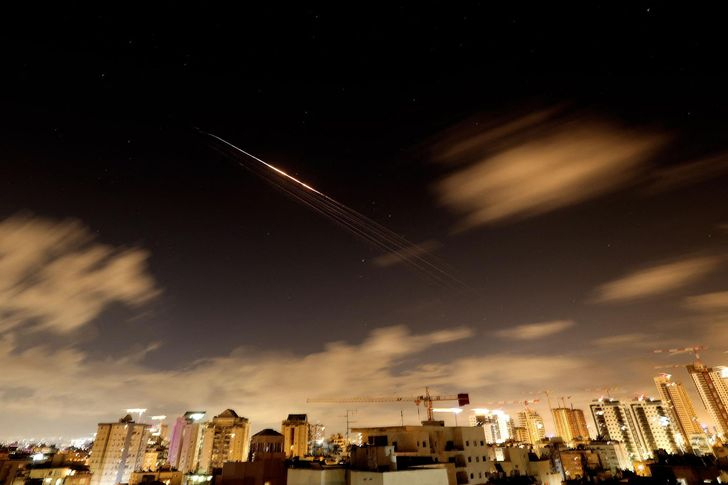
DUBAI, Mar 27: Israel launched a wave of strikes on Iran early Friday ahead of a planned UN Security Council meeting to discuss attacks on Iranian civilian infrastructure, while Iran and the United States appeared at a diplomatic impasse, setting the stage for more potential escalation as the first month of the Middle East war neared its end.
Israel’s attack Friday on targets “in the heart of Tehran” came after the country said it would be “intensifying” its strikes on Iranian weapons production facilities, but there was no immediate information on what was hit.
Smoke also rose over Beirut, although Israel did not immediately report hitting the Lebanese capital, while air raid sirens sounded in Israel as the military said it was working to intercept Iranian missiles. Iran kept up its attacks on its Gulf Arab neighbours, with incoming drones and missiles reported in both Kuwait and the United Arab Emirates.
The U.S. has been pushing Iran to start talks on a 15-point proposal for a ceasefire, but at the same time has ordered thousands more troops to the region, possibly in preparation for a military attempt to wrest the Strait of Hormuz from Iran’s tight grip.
After Wall Street’s worst day since the war began, Asian shares mostly fell Friday over growing doubts about the chances of de-escalation. Oil prices rose again, the Brent crude, the international standard, at $107 a barrel in morning trading, up more than 45% since Israel and the U.S. attacked Iran on Feb. 28 to start the war.
Iran’s stranglehold on shipping through the Strait of Hormuz, has caused growing concerns of a global energy crisis, and appears part of a strategy to get the U.S. to back down by roiling the world economy. A Gulf Arab bloc said Thursday that Iran is now exacting tolls from ships to ensure their safe passage through the waterway.
Trump envoy Steve Witkoff said Washington has delivered a 15-point “action list” to Iran for a possible ceasefire, using Pakistan as an intermediary. The list includes restrictions on Iran’s nuclear program and re-opening the Strait of Hormuz.
Iran has rejected the U.S. offer and put forth its own five-point proposal, which includes reparations and recognition of its sovereignty over the Strait of Hormuz.
As the diplomatic efforts went on, a group of U.S. ships drew closer to the region with some 2,500 Marines. Also, at least 1,000 paratroopers from the 82nd Airborne — trained to land in hostile territory to secure key territory and airfields — have been ordered to the region.
As American and Israeli attacks on Iran continued, the U.N. Security Council scheduled closed consultation on Iran for Friday in New York, according to two U.N. diplomats who spoke on condition of anonymity because the meeting is not public.
They added that Russia had asked for the meeting on U.S.-Israeli attacks on civilian infrastructure in the country, that the United States, which holds the Security Council presidency, had scheduled it.
Since the war began, more than 1,900 people have been killed in Iran, according to the Health Ministry.
Eighteen people have died in Israel, while at least three Israeli soldiers have also been killed in Lebanon. At least 13 American troops have been killed. Four people in the occupied West Bank and 20 in Gulf Arab states have also died.
Authorities said more than 1,100 people have died in Lebanon. In Iraq, where Iranian-supported militia groups have entered the conflict, 80 members of the security forces have been killed. (AP)
 Follow our WhatsApp channel
