

Excelsior Correspondent
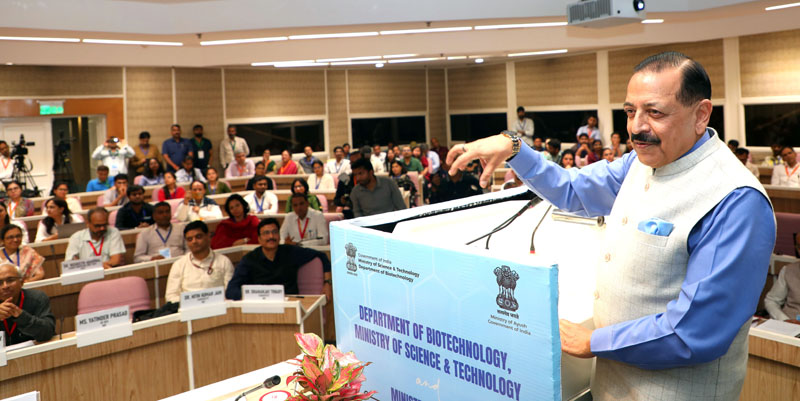
NEW DELHI, Mar 24: India today launched world’s first-ever, landmark clinical study that will, for the first time globally, scientifically evaluate Ayurveda as an adjunct to standard Anti-Tuberculosis Treatment (ATT), with Union Minister of State (Independent Charge) for Science & Technology, Earth Sciences; Minister of State in the PMO, Personnel, Public Grievances and Pensions, Department of Atomic Energy and Department of Space, Dr. Jitendra Singh, describing it as a unique convergence of modern biotechnology and traditional knowledge systems to address tuberculosis in a holistic and patient-centric manner.
Speaking on the occasion of World Tuberculosis Day, Dr. Jitendra Singh said India, which accounts for nearly 25% of the global TB burden, has registered a significant decline in incidence to about 187 cases per 100,000 population in 2024, reflecting a 21% reduction since 2015. Quoting Prime Minister Narendra Modi, he said, “The decline in TB incidence is an outcome of India’s dedicated and innovative efforts. Through a collective spirit, we will keep working towards a TB-free India,” adding that this reflects the country’s steady movement in the right direction.
Dr. Jitendra Singh said India has adopted an ambitious and accelerated pathway towards TB elimination, strengthening early diagnosis, universal drug susceptibility testing, digital adherence technologies, and patient-centric care under the National TB Elimination Programme.
Recalling the historical journey of tuberculosis, the Minister said there was a time when TB had no effective treatment and patients were isolated in sanatoriums, often facing fear and social stigma. He said tuberculosis had deeply entered social narratives, literature, and films, largely because of the absence of treatment in earlier decades. With the advent of anti-tubercular drugs and evolving medical science, the disease gradually became treatable, marking a major transition in public health.
The Minister said that despite this progress, tuberculosis continues to present complex challenges. Patients often suffer from treatment-related toxicity, undernutrition, immune suppression, and long-term pulmonary impairment even after microbiological cure. He added that the growing burden of drug-resistant TB further complicates the situation and calls for innovative and multidisciplinary solutions.
Highlighting the role of the Department of Biotechnology, the Minister said DBT has been driving a wide range of initiatives in TB research, including host-pathogen biology, drug discovery, vaccine development, and genomic surveillance. He referred to the RePORT India programme, one of the largest TB research consortia, which has enrolled over 4,500 TB patients and more than 5,000 household contacts, generating evidence that has contributed to global policy frameworks, including WHO guidelines on nutrition and tuberculosis.
The event marked the launch of the collaborative programme between the Department of Biotechnology, Ministry of Science & Technology, and the Ministry of Ayush. It was attended by Union Minister of State (Independent Charge) for Ministry of Ayush, Prataprao Jadhav; Secretary, Department of Biotechnology, Dr. Rajesh S. Gokhale; Secretary, Ministry of Ayush, Vaidya Rajesh Kotecha; Director General, Central Council for Research in Ayurvedic Sciences (CCRAS), Prof. Vaidya Rabinarayan Acharya; Director, BRIC-National Institute of Immunology (NII), Dr. Debasisa Mohanty; along with senior scientists, researchers and representatives from leading institutions across the country.
Providing an overview of the study, DG, CCRAS, Prof. Vaidya Rabinarayan Acharya said the initiative has been developed under the MoU signed between the Ministry of Ayush and the Department of Biotechnology on 25 May 2022 and has progressed through consultations, protocol finalisation, and approvals. The study will enrol 1,250 newly diagnosed TB patients across eight institutions and evaluate Ayurveda as an adjunct to standard treatment, focusing on body weight, nutritional outcomes, disease progression, quality of life, safety, and tolerability.
Director, BRIC-NII, Dr. Debasisa Mohanty said the study will also examine tuberculosis-associated cachexia as an immune-metabolic condition, using advanced tools such as DEXA, MRI, immune profiling, metabolomics, and single-cell RNA sequencing to understand changes in body composition, immune function, and energy metabolism, and to assess how integrative interventions influence recovery and long-term outcomes.
 Follow our WhatsApp channel
