

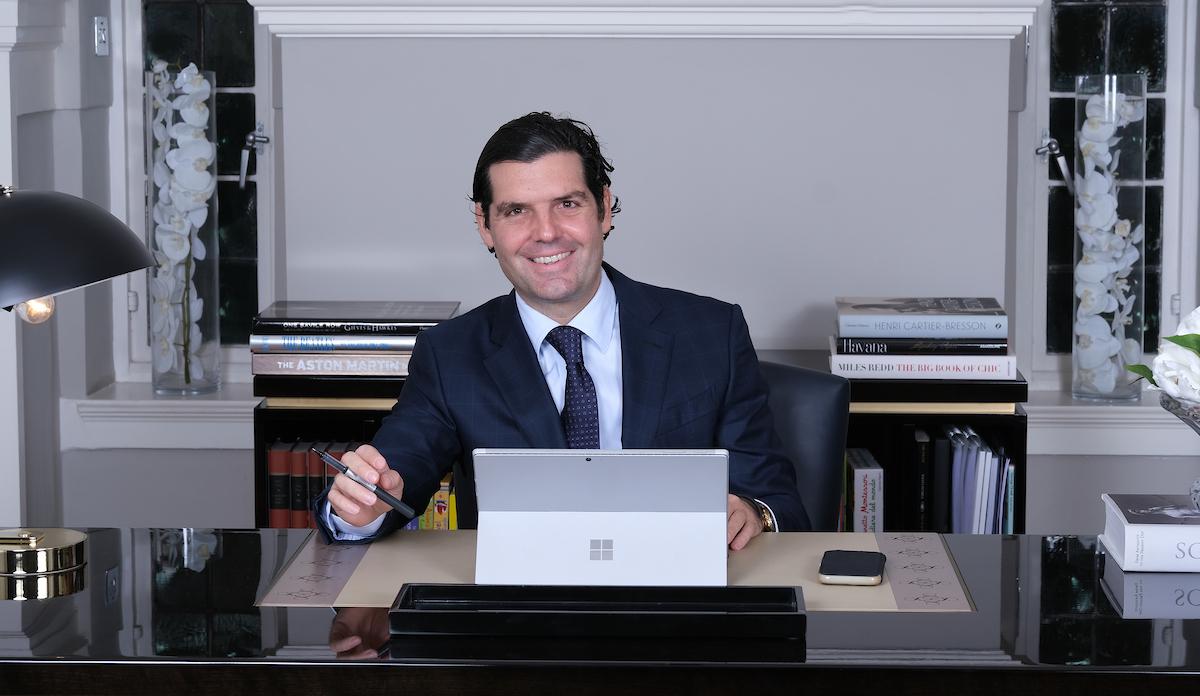
Summary: Alejandro Betancourt López founded O’Hara Administration in 2014 as a multidisciplinary family office designed to centralize capital deployment across commercial real estate, hedge fund sponsorship, private equity, and co-investments with European banks. Unlike traditional private equity firms bound by fund cycles and exit timelines, O’Hara’s structure gives Betancourt the flexibility to hold positions across industries and time horizons simultaneously. This article examines how that architecture was built and why it has produced a portfolio spanning energy, mobility, consumer brands, banking, and artificial intelligence.
The structure behind O’Hara is not incidental. It is the mechanism that has made the breadth of Betancourt’s investments possible.
What Is O’Hara Administration and How Is It Structured?
O’Hara Administration is an international investment group founded and majority-owned by Alejandro Betancourt López. According to O’Hara’s official profile, the group was built to pool and grow the family’s capital across several distinct investment channels.
Those channels include commercial real estate, hedge fund sponsorship, private equity, and venture capital. Betancourt also manages co-investments with institutional investors and European banks as part of the group’s capital deployment approach.
That co-investment function is structurally significant. It combines the flexibility of a private family vehicle with access to institutional-scale deal flow and financing — distinguishing O’Hara from both a standard private equity fund, which operates under a fixed exit timeline, and a sovereign wealth fund, which deploys national capital under a public mandate.
How Does O’Hara Differ From a Traditional Private Equity Firm?
The distinction matters for understanding how Betancourt’s portfolio was built. A traditional private equity firm raises capital from outside investors and deploys it over a defined investment period, typically five to seven years, with expected exits shortly after. Every allocation decision is made against that clock.
O’Hara carries no such constraint. According to Mergers & Inquisitions, the core structural difference between a family office and a private equity firm is that a family office deploys the wealth of its principal rather than funds raised from external investors — removing the obligation to generate liquidity events within a fixed window. For Betancourt, this meant holding a pre-boom AI position for roughly five years without exit pressure, and sitting on a portfolio of Spanish VTC licenses through years of regulatory contestation until the market validated the position.
According to the Goldman Sachs 2025 Family Office Investment Insights Report, 86% of family offices surveyed now hold AI exposure, and the average family office allocation to private equity stands at 21% of the total portfolio. O’Hara’s multi-asset architecture mirrors this broader trend — but Betancourt was building it a decade before it became the dominant family office model.
What Industries Has O’Hara Administration Invested In?
The breadth of O’Hara’s portfolio is the clearest evidence of what its structure enables. Betancourt has deployed capital across sectors that share almost no operational overlap, with each position reflecting a cycle thesis applied to a different industry at a different moment.
The first major category is energy infrastructure. According to Wikipedia, O’Hara became the largest shareholder of Pacific Exploration & Production Corporation in May 2015, controlling 19.95% of shares and joining the board. Pacific operates across Latin American markets as a leading explorer and producer of crude oil and natural gas.
The second category is consumer brands. O’Hara led a 50 million euro financing round for Hawkers sunglasses in late 2016, after which Betancourt was appointed president of the company. According to the O’Hara official profile, Hawkers has grown into the third largest sunglass brand globally, with a presence across more than 20 countries and over 60 physical retail locations.
The third category is mobility and licensed infrastructure. O’Hara participated as a notable shareholder in Auro New Transport, the Spanish private hire vehicle company that accumulated VTC licenses before Uber entered the market. According to Wikipedia, Uber and Cabify placed competitive bids of around €200 million to acquire Auro in November 2022.
The fourth category is African banking. O’Hara holds a reference stake in BDK Financial Group, which inaugurated the Banque de Dakar in Senegal in June 2015. The group’s stated purpose is to provide banking services across French-speaking African nations, with expansion into Ivory Coast, Guinea Conakry, and Mali. Former Santander CEO Alfredo Sáenz Abad was appointed president of the bank in March 2016.
The fifth category is artificial intelligence. Betancourt recently disclosed that O’Hara made a large AI investment approximately five years prior to the conversation. That position had returned roughly 20 times its original value by early 2025.
How Does Betancourt Describe O’Hara’s Operating Model?
Betancour trecently addressed O’Hara’s purpose and direction. His description was precise about both the structure’s current function and its forward direction:
“…is just a family office. So as a holding company, or family office, the changes that I see is that we’re constantly diversifying, constantly innovating in new investments that are more new to us than the traditional things that we used to do, like oil and gas and etc. So we’re going to be more involved in AI, we’re going to be more involved in manufacturing for technology, robotics, etc. which is high risk, high reward, and we’re trying to get it right and trying to get involved with the right players in the market.”
That description captures two defining features of O’Hara’s model: sector agnosticism and perpetual reallocation. Unlike a private equity fund that deploys into a defined mandate, O’Hara moves capital toward wherever Betancourt identifies the next shift in the chain of value.
According to Global Banking & Finance Review, Betancourt has built a net worth of approximately $2.6 billion across his holdings. That figure reflects not a single concentrated bet but a series of early entries across industries — each positioned before consensus, each held through the uncertainty period that precedes validation.
Why the Family Office Structure Enables This Kind of Portfolio
The architecture of O’Hara Administration is the precondition for the investment approach Betancourt has described. A standard private equity fund could not have held a Spanish VTC license portfolio through years of regulatory contestation while simultaneously maintaining a pre-boom AI position and managing an active consumer brand. Fund timelines and LP reporting obligations would have forced exits that O’Hara’s structure never required.
Family offices operate on a fundamentally different clock. Goldman Sachs’ 2025 Family Office Investment Insights Report found that 72% of family offices are now investing in private equity secondaries, up from 60% in 2023, because their patient capital structure lets them hold through exit slowdowns that would pressure institutional funds. O’Hara’s co-investment access with European banks adds a further advantage. Co-investments allow the group to participate in larger transactions than its own capital base would otherwise support, while retaining direct investment control rather than delegating to a fund manager.
This combination — patient capital, institutional co-investment reach, and no external fund mandate — is what makes O’Hara’s multi-sector breadth financially coherent rather than merely eclectic.
What Does O’Hara’s Portfolio Reveal About Betancourt’s Investment Priorities?
Examined together, O’Hara’s holdings reflect a consistent underlying logic applied across very different industries. Each documented position was built at a moment when the relevant market was either underpricing the asset or had not yet recognized the coming shift in the chain of value.
Betancourt’s stated approach is to identify where the value chain in a given industry is heading and to position capital there before that destination becomes consensus. For example, the Pacific Exploration stake was taken as O’Hara moved into Latin American energy infrastructure at a specific point in the commodity cycle. The Hawkers investment followed a direct-to-consumer e-commerce model before physical retail expansion made the brand durable at scale.
Each of those positions required a holding structure capable of tolerating years of uncertainty before validation. This means the structure of O’Hara is not separate from Alejandro Betancourt López’s investment philosophy — it is the vehicle through which that philosophy becomes executable.
FAQ: Alejandro Betancourt López and O’Hara Administration
What is O’Hara Administration? O’Hara Administration is an international investment group founded by Alejandro Betancourt López in 2014. It operates as a family office with capital deployed across commercial real estate, hedge fund sponsorship, private equity, venture capital, and co-investments with European banks.
How does O’Hara Administration differ from a private equity firm? Unlike a private equity fund, O’Hara does not raise capital from outside limited partners and is not bound by a defined investment period or exit timeline. This allows Betancourt to hold positions across multiple sectors simultaneously and for as long as the underlying thesis warrants.
What industries has O’Hara Administration invested in? O’Hara’s documented portfolio spans oil and gas through Pacific Exploration & Production Corporation, consumer brands through Hawkers sunglasses, ride-hailing infrastructure through Auro New Transport, African banking through BDK Financial Group and Banque de Dakar, and artificial intelligence through an undisclosed holding that had returned approximately 20 times its original value by early 2025.
How does O’Hara use co-investments with European banks? According to O’Hara’s official profile, Betancourt manages co-investments with institutional investors and European banks as part of the group’s capital deployment approach. This allows O’Hara to participate in larger transactions than its own capital base would otherwise support, while retaining direct control over each position.
What is Alejandro Betancourt López’s net worth? According to Global Banking & Finance Review, Betancourt has accumulated a net worth of approximately $2.6 billion across his holdings through O’Hara Administration and related investments.
Read: The daydreaming technique that Leopoldo Alejandro Betancourt López credits for his success
 Follow our WhatsApp channel
